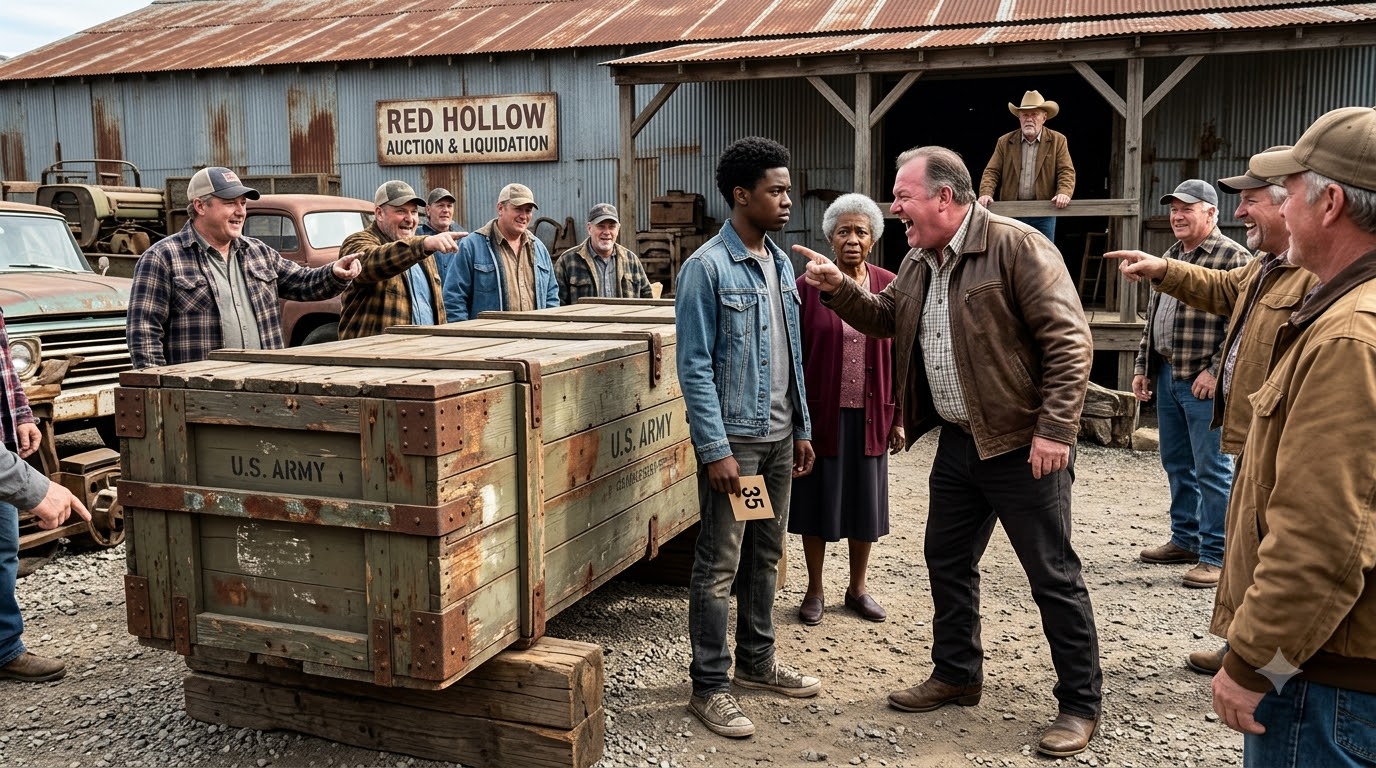
$35 for that? Kid, you’re buying 80 years of dust and rotten wood. 35. You don’t even know what’s inside. Could be mice, scrap, or nothing at all. I know.
Then don’t come crying when you pry it open and learn your grandfather’s story was nonsense. Are you bidding? Keep it, kid. It’s worthless. Curtis Malloy thought the mistake belonged to Terrence Cole.
To everyone watching, the 17-year-old had spent nearly all the cash in his pocket on a 9-ft military crate that had sat forgotten for decades. The faded army stencil, rusted steel bands, and sealed fasteners meant nothing to the bidders except one more reason to laugh. Terrence never tried to defend himself. He simply kept the bid card, watched the crate, and refused an easy $200 resale offer that would have ended the story before it began. What Curtis did not understand was why Terrence had come to the auction at all.
His late grandfather, Harlan, had spent years insisting that this exact crate once carried a military motorcycle, and Terrence had heard every detail. Now, the crate was finally his. Hours later, alone in his grandmother’s garage, he would have to decide whether $35 had bought him proof, disappointment, or the same ridicule that had followed Harlan for years. Eight months before the auction, Harlan Cole had died with one argument still unresolved. He had never presented photographs, shipping records, or a witness who could prove what he remembered from Madden Freight and Farm Supply.
All he had was the same account he had repeated for years. After the war, Madden had bought truckloads of government surplus. And among the tools, engines, radios, and machine parts was one unusually large military shipping crate that nobody ever opened. Harlan had been young then, working wherever the warehouse needed another pair of hands. He remembered faded olive paint, reinforced corners, steel bands, and words stenciled on the side that included motorcycle solo.
The manager had ordered the crate moved into rear storage while some missing paperwork was sorted out. The paperwork never seemed to arrive. The crate stayed. Months became years. The business changed hands.
Inventory was moved around it. Shelving went up. Shelving came down. And eventually the old rear section became the sort of place where unwanted equipment disappeared behind newer unwanted equipment. What survived most clearly was Harlan’s certainty.
He believed a military motorcycle was still inside. Around Red Hollow, that certainty slowly became a joke. Men at the feed store would ask whether Harlan’s motorcycle had learned to ride itself out of the box yet. At auctions, someone might point toward a broken engine and tell Harlan it was probably another secret army treasure. Harlan rarely argued.
He would look at whoever was laughing and say that he knew what he had seen. Terrence had always noticed that his grandfather never embellished the story. Harlan did not claim the motorcycle was worth a fortune. He did not say it had belonged to a famous soldier. He never invented a hidden mission or a dramatic wartime mystery.
He simply insisted the crate had arrived marked for a solo motorcycle, and as far as he knew, had never been opened. That restraint was one reason Terrence remembered it. Another was a lesson Harlan had given him while repairing an old wooden machinery box in the garage. Documents, Harlan explained, were not always laid beside oily equipment. Packing lists and shipping papers were sometimes sealed separately or tucked behind a wooden brace where grease, rain, and careless handling could not destroy them.
Terrence had been younger then, more interested in the hammer in his hand than warehouse practices from another era, but the detail stayed somewhere in his memory. At 17, Terrence preferred things that could be tested. He worked weekends at a tire shop where guessing did not fix a leak and confidence did not tighten a wheel. There was a problem, a tool, and usually an answer. That was why Harlan’s story bothered him more after his grandfather died.
Terrence wanted to believe him, but believing a person and proving that person right were not the same thing. When Madden Freight finally closed, Loretta Cole understood why her grandson wanted to attend the liquidation auction. The final owner had died, the property was going to be cleared, and whatever remained in the old buildings would be sold. Loretta drove Terrence out on a bright Saturday morning expecting little more than a last look at the place where Harlan had spent part of his youth. For hours, the auction moved through worn farm equipment, metal shelving, advertising signs, old compressors, boxes of tools, and engines that had not turned in years.
Then, near the end of the sale, a loader emerged from the rear building carrying a long wooden crate. Terrence knew before it reached the blocks. Three rusted bands crossed the body. Steel protected the corners. A washed-out patch of olive paint clung to one side, and above it, nearly erased by time, were enough letters to make out U.S. Army.










