The year was 1888, and the wind across the high plains of Wyoming had a voice of its own. It was a lonesome sound, a ceaseless mourning that scraped against the weathered boards of Arthur McBride’s cabin, and swept across the vast empty grasslands that stretched to a horizon jagged with distant toothlike mountains. For 2 years since Martha’s passing, that wind had been the only constant conversation in Arthur’s life. It spoke of absence, of the hollow space she had left behind, a space so large it seemed to swallow the light from the sky. Arthur was a man carved from the same hard land he worked.
His shoulders were broad from swinging an ax and hauling feed, his hands calloused and mapped with the fine lines of labor. Grief had settled into him not as a storm of weeping, but as a quiet heavy frost. It silvered the edges of his dark hair, and lived in the deep set lines around his eyes. He moved with a purpose that was entirely mechanical, a list of chores that began before sunrise, and ended long after the last sliver of light had bled from the sky. He mended fences, tended to his small herd of cattle, chopped wood, and existed.
He did not live. He endured. His daughter Clara was a ghost in their small home. At six years old, she should have been a whirlwind of questions and laughter, but she was as quiet as the dust motes that danced in the slivers of afternoon sun. She had her mother’s pale hair and serious blue eyes, eyes that seemed to hold a sorrow too old for her small frame, the silence that had claimed her father had enveloped her, too.
She spoke only when necessary, in whispers that felt fragile enough to be broken by a sudden noise. She played with a faceless doll Martha had sewn for her, her games as silent and solemn as a prayer. Arthur watched her, a dull ache constricting his chest. He knew he was failing her. He gave her food, shelter, a physical protection from the harshness of the world.
But the core of him, the part her father was supposed to give, had been buried with his wife. Their life was a routine etched in stone. Breakfast was silent, supper was silent. In between, Arthur worked the land, and Clara stayed within sight of the cabin, a small, lonely figure against the immense backdrop of the prairie. The isolation was a fortress Arthur had built around his pain, but he was beginning to realize it was also a prison for his child.
He saw the way she looked at the horizon as if searching for something that was never going to arrive. He saw the way her shoulders hunched as if carrying a burden that was invisible but immensely heavy. He was a man drowning in stillness and he was pulling his daughter down with him. One afternoon in late summer, when the heat shimmered above the cured grasses, Arthur was riding the boundary of his property, checking a section of fence near Cottonwood Creek. The air was thick and still, the usual wind having died down to a breathless pause, as if the land itself held its breath.
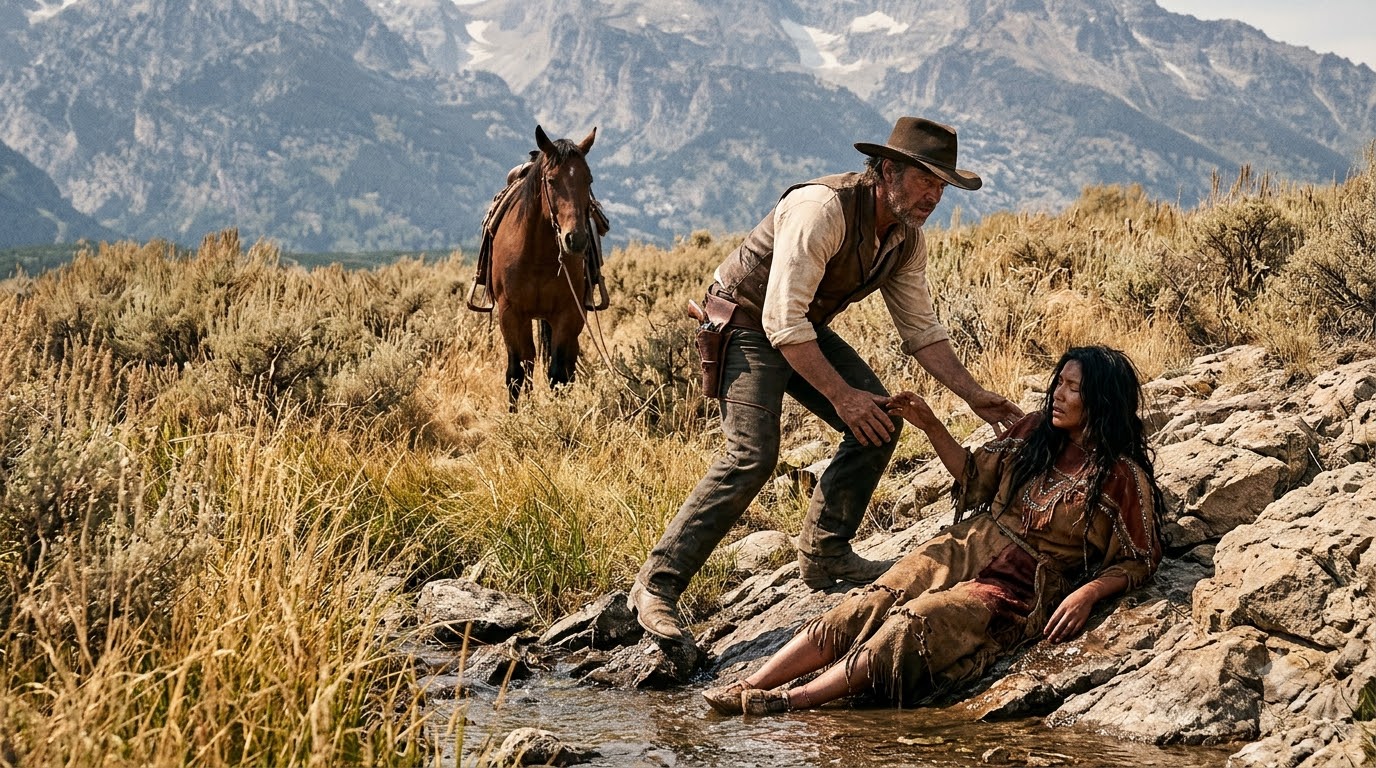
It was this unusual quiet that made him notice the splash of color against the pale stones of the creek bed patch of dark red and blue that did not belong to the natural palette of the plains. Dismounting from his horse, he approached with the ingrained caution of a man who lived alone in a wild place. His hand rested near the colt at his hip. As he drew closer, the shape resolved itself. It was a person, a woman lying face down, half in the shallow water.
Her dark hair fanned out like spilled ink. She was native, dressed in worn but finely beaded buckskin. One of her legs was twisted at an unnatural angle, and a dark, ugly stain spread from a wound on her side. Arthur’s first instinct was a cold, hard knot of refusal. This was trouble.
Trouble he did not need, did not want. The nearest town, Big Horn, was a full day’s ride, and its citizens held no love for the Cheyenne or the Arapaho, whose ancestral lands this was. To involve himself was to invite judgment, suspicion, and possibly violence. He could ride away, pretend he had never seen her. the coyotes and the unforgiving sun would do the rest. It was the law of the prairie.
He stood there for a long moment, the silence pressing in on him. The woman did not move. He saw the slight, almost imperceptible rise and fall of her back. She was still alive. He thought of Martha, how she had wasted away from the fever, how he had been helpless to stop it.










