The first thing Kai learned about fighting was how to stop.
“Lower,” his father would say, standing barefoot on the worn wooden floor of their small training room. “Again.”
Kai would bend his knees until his thighs burned, hold his arms steady, and repeat the same movement he had practiced a hundred times. His father never seemed impressed by speed. Whenever Kai tried to finish a sequence quickly, the older man would shake his head and make him begin again.
“You know why I make you go slow?” he asked one evening.
“So it’s correct.”
“So you can stop.”
Kai frowned. “Anyone can stop.”
His father looked at him for a long moment. “You’ll understand when it matters.”
Years later, after his father died, those words remained clearer than almost anything else. He could remember being corrected without being shamed. What he could not do was bring the man back.
Now Kai was a college student whose life was built around small routines. He attended lectures, studied statistics, ate lunch alone, and spent evenings in a empty recreation room practicing the forms his father had taught him. His movements were slow, precise, and deliberately unremarkable. He did not spar with strangers or enter tournaments. He never told anyone what he knew. Training was the one place where grief stopped talking.
One afternoon, a girl appeared at the doorway while he was practicing. She had dark hair pulled into a loose ponytail and carried a notebook against her chest.
“Hey, do you have a pen? Any pen. I’m not picky,” she said. “I’ll give it back. Probably.”
Kai stopped, retrieved one from his bag, and handed it over. She smiled. Her name was Cammy, and he recognized her from statistics class, though they had never spoken. She stayed a moment, watching him return to the mat, then left with a cheerful wave. Kai thought little of the exchange. To him, it was simply the first pleasant conversation he had had all week.
Across campus, however, Cammy’s friends had already decided what the encounter meant.
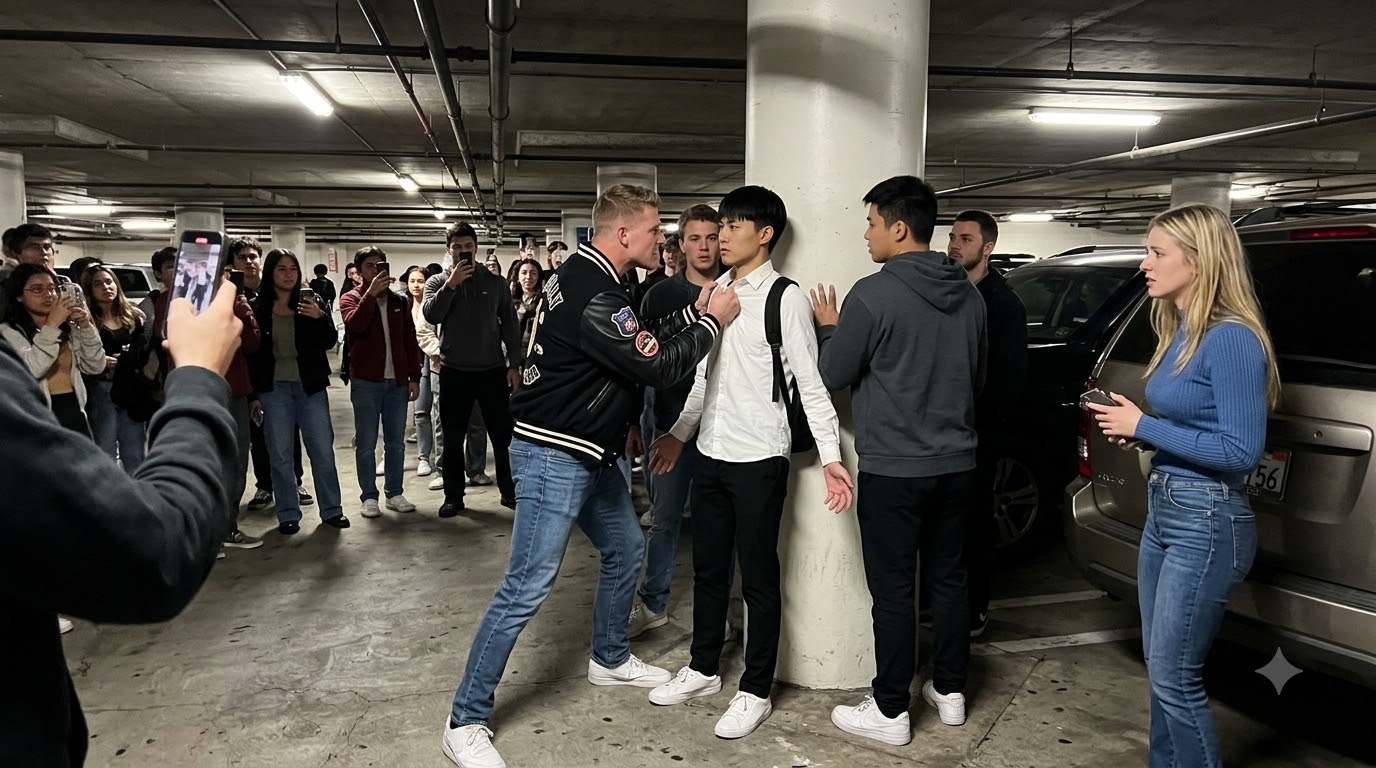
Trey was the loudest of them, a popular student who treated every gathering like an audience waiting for him to perform. Devon, whom everyone called Dev, usually stood beside him, laughing at jokes before anyone else did. Several others followed their lead, filming pranks and posting them online for attention. Kai had caught their notice because he was quiet, because he practiced martial arts without showing off, and because they assumed someone who refused to fight must be incapable of fighting.
They replayed a short clip of him moving through a form. Trey laughed so hard he nearly dropped his phone.
“He’s been on this slide eleven minutes. I timed it,” someone said.
“No, go back,” Trey insisted. “Look at his face. He actually thinks he’s dangerous.”
“Who is that?” another student asked.
“Some nobody from my stats class,” Cammy answered. “Sits alone, eats alone.”
Trey leaned toward her. “Cammy, you’d be perfect for this.”
She looked wary. “Perfect for what?”
“Pretend you like him. Get him to take you out Thursday. Then walk him up to the parking deck afterward. Half the school’s going to be there filming.”
Cammy stared at the screen. The suggestion was cruel, but everyone around her was laughing, and she was afraid of becoming the next target if she objected. She told herself it would be harmless, an embarrassing joke that would end quickly. That was the first lie she chose to believe.
The next day, she found Kai outside class. He was carefully putting his notes into a battered backpack.
“Are you busy Thursday?” she asked.
“Thursday?”
“It’s a day. Comes after Wednesday.”
Kai gave a small, surprised smile. “No, I mean—no. I’m not busy.”
“Okay,” she said, trying to sound casual. “Bring the pen.”
For the next two days, they talked between classes. Cammy discovered that Kai was not shy because he lacked things to say. He simply listened before speaking. He noticed details other people missed and never tried to turn a conversation toward himself. When she asked about the strange movements she had seen him practicing, he told her they came from his father.
“His teacher taught him,” Kai explained. “And someone taught that teacher.”
“That’s not an answer,” Cammy teased. “That’s a family tree.”
He laughed quietly, then grew thoughtful.
“When I’m doing it, I’m not thinking about anything. That’s the whole thing. There’s nothing in my head.”
Cammy looked at him differently. “That’s not nothing.”
Later, while they sat outside the library, Kai mentioned that his mother called every evening at six, her time. She had called every day since his father died.
“I’m what’s left to call,” he said, looking down at his hands.










