The red superbike purred beneath Florence Osburn as she turned onto Maple Street on a warm Saturday afternoon. Sunlight filtered through the trees, painting the pavement in shifting patches of gold. A bag of replacement parts was strapped behind her seat. For once, she was not studying case files or following suspects. She was simply riding home, enjoying the rare peace of a familiar neighborhood.
Florence was a Black woman and an FBI special agent, though few of her neighbors knew it. Her motorcycle and ordinary routine helped preserve her cover during a long investigation into corruption inside the local police department. She had spent months tracing missing evidence, suspicious case closures, and officers whose explanations never matched the records. Today, however, she had no intention of working.
At a stop sign, she noticed a patrol cruiser parked across the street. Sergeant Gordon Weston watched her through his sunglasses. Florence stopped completely, waited, and proceeded legally. Yet Weston pulled onto the road behind her, already irritated by the sight of a Black woman riding a motorcycle he believed she could not afford.
He radioed dispatch to report a reckless driver heading east on Maple. Another cruiser appeared ahead, followed by a third. When Weston activated his lights, Florence pulled over without hesitation.
Three police vehicles surrounded her motorcycle. Weston approached with his hand near his belt, accompanied by Officer Roy Trevor, who looked amused, and younger Officer Mikey Decker, whose discomfort was already visible. Neighbors began emerging onto porches as Weston demanded Florence’s license and registration.
“Why am I being stopped?” she asked calmly.
“You can ask,” Weston replied. “Doesn’t mean I have to answer.”
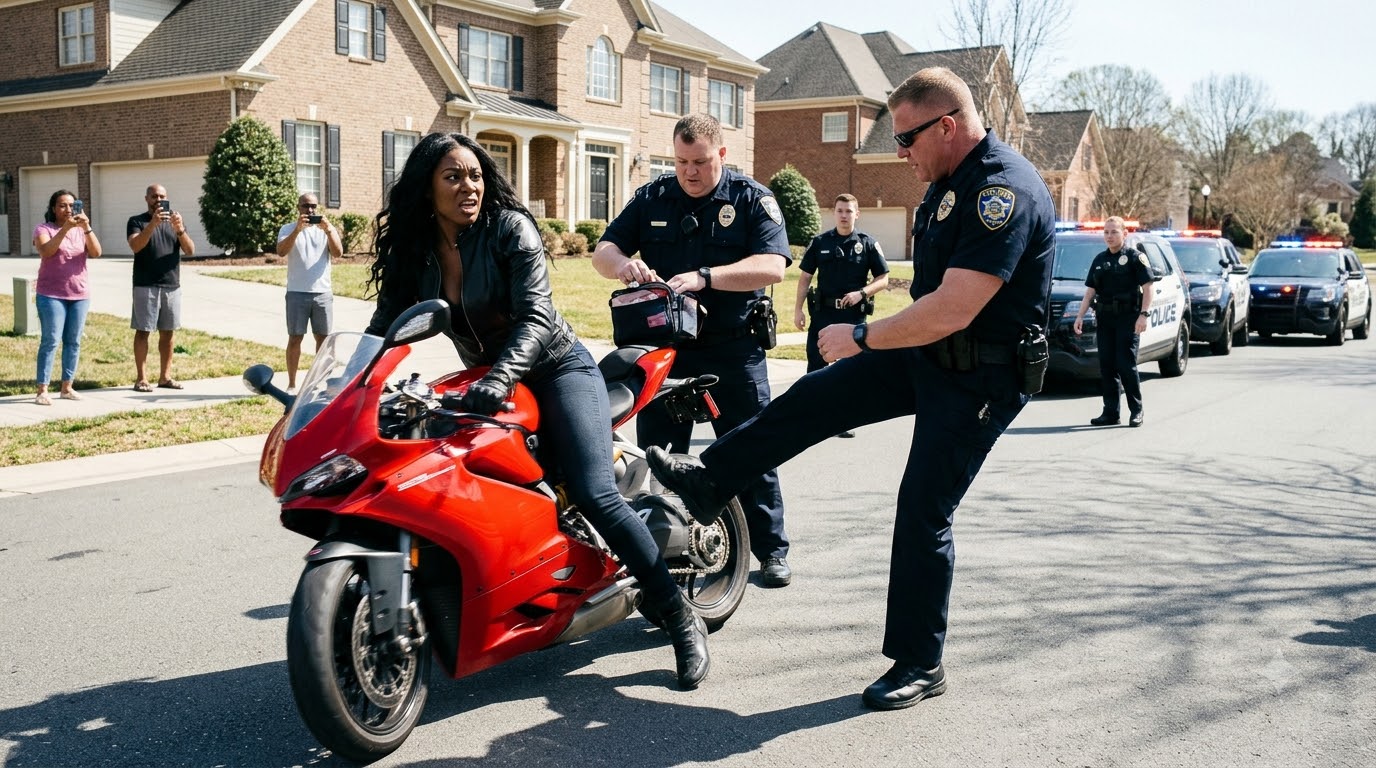
Florence handed over her identification. Weston barely examined it before asking whether the motorcycle belonged to her. When she confirmed that it did, he sneered that the machine cost more than many people earned in a year. He wanted to know where a woman like her found that kind of money. She told him she worked. He pressed for details, implying she must be selling something illegal.
Trevor approached the saddlebag and reached for its zipper. Florence told him clearly that she did not consent to a search. He opened it anyway, rummaging through spare motorcycle parts while pretending to smell something suspicious. Weston declared that this was his town and he alone decided what was reasonable. Several neighbors raised their phones to record.
Florence knew exactly how many boundaries the officers had crossed. She also knew that reacting angrily would give Weston an excuse to escalate. She kept her voice steady, insisting that he had no lawful reason to search or seize her property. Weston mocked her, called her sweetheart, and ordered Trevor to summon an impound truck. Decker cautiously suggested they reconsider, but Weston silenced him.
“Girls like you don’t ride bikes like this unless something’s dirty,” Weston said.
Florence studied him. She could let the department seize her motorcycle and challenge the abuse later, but his certainty that he could humiliate her without consequence made the decision for her. She slowly reached toward her jacket. Weston stiffened, hand moving toward his weapon, until she displayed her empty hand and explained what she was retrieving.
Then she opened a leather credential case. The gold badge flashed in the sunlight beside her federal identification.
“Special Agent Florence Osburn. Federal Bureau of Investigation.”
Silence swept the street. Trevor stopped searching. Weston’s expression drained of color. The neighbors continued recording as Florence identified the unlawful search, the baseless impound threat, and the discriminatory conduct she intended to report. Weston muttered that he had not known who she was.
“That isn’t an excuse,” Florence answered. “The law applies whether someone carries a federal badge or not.”
She demanded all three officers’ names and badge numbers. Weston ordered Trevor to cancel the tow truck. When he suggested they could resolve the misunderstanding privately, Florence refused. The entire encounter had witnesses, and she would file a formal complaint.
As she prepared to leave, something caught her eye. Weston’s cruiser trunk stood open. Behind a spare vest and coiled rope lay a dark green duffel bag with an evidence tag hanging from its zipper. Florence recognized the case number immediately: Route 9, a major seizure involving drugs, cash, and weapons. Official records claimed the evidence had been destroyed eight months earlier under court order.
She revealed nothing. Weston shut the trunk, unaware she had memorized the number. Florence watched the cruisers leave and understood that the traffic stop had exposed more than one abusive officer. The supposedly destroyed evidence was connected to the corruption investigation she had been conducting undercover. Now one of her targets knew her identity.
Weston drove three blocks before stopping behind an abandoned gas station. He called Captain Louise Pharaoh on a private line, bypassing dispatch. He admitted he had stopped a woman who turned out to be FBI and that Trevor had searched her bag. Pharaoh’s first concern was not the unlawful stop. She asked whether Florence had seen anything.










