He had his hand on his heavy leather duty belt, barking orders at the woman in the hard hat to get off the property. He thought she was a trespasser. He thought he held all the power. He didn’t know he was threatening the sole owner of the multi-million dollar ground he stood on. The morning sun was already baking the concrete at the Oak Ridge Estates development site, sending waves of heat rippling across the freshly poured foundation.
For Sarah Davies, the smell of diesel exhaust, curing cement, and raw pine was the scent of absolute victory. At 38, Sarah was the founder and CEO of Davies Vanguard Holdings, a commercial real estate development firm she had built from a cramped, un-air-conditioned studio apartment into a regional powerhouse. This specific project, a $45 million mixed-use luxury complex, was her crown jewel. It had taken three years of grueling zoning board meetings, fighting off aggressive corporate buyouts, and securing private equity. She had fought tooth and nail to break ground in Oak Ridge, an ultra-affluent, notoriously exclusive, and predominantly white neighborhood that guarded its borders with weaponized homeowners associations and restrictive covenants.
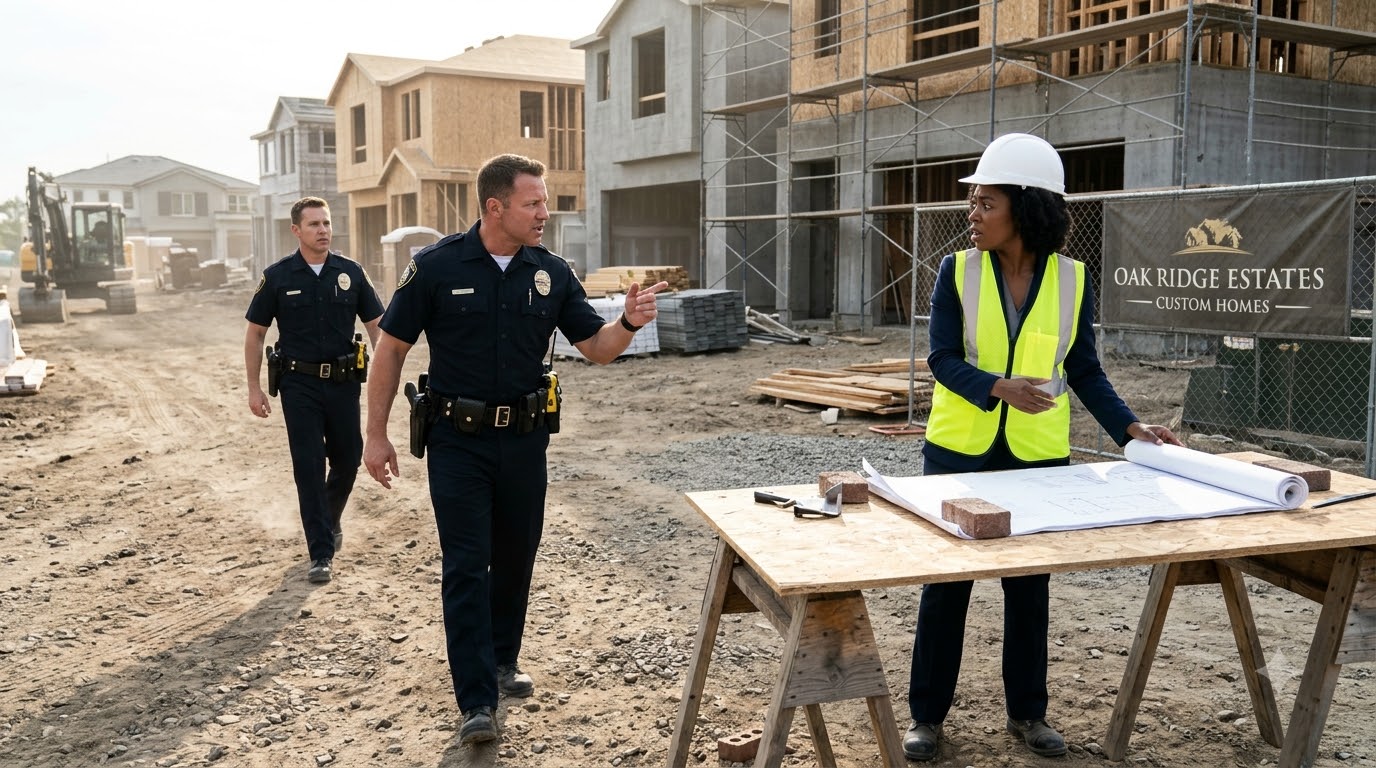
Sarah stood near the center of the site, a vibrant figure amidst the gray dust. She wore a tailored navy blazer beneath a bright neon yellow safety vest, a pristine white hard hat resting over her natural hair, and steel-toed boots that had seen countless job sites. Unrolling a massive sheet of architectural blueprints across a makeshift plywood table, she began cross-referencing the structural pillars with the digital renderings on her iPad. Just beyond the temporary chain-link perimeter fence stood the manicured lawns of the existing Oak Ridge residents. And standing on her pristine porch, gripping a ceramic mug of herbal tea white-knuckled fury was Patricia Harrington.
Patricia was the self-appointed guardian of the neighborhood. For weeks she had waged a one-woman war against the construction noise, the heavy machinery, and the influx of blue-collar workers disrupting her tranquil cul-de-sac. But today her irritation crystallized into something entirely different when she spotted Sarah. From Patricia’s vantage point she didn’t see a chief executive analyzing load-bearing schematics. Through the lens of her deep-seated unchecked prejudice she saw a black woman standing around on a high-end construction site looking entirely out of place.
To Patricia Sarah was either a lost delivery driver, a vagrant who had wandered past the gates, or an agitator looking to steal copper wiring. The idea that this woman owned the land, the machinery, and the payroll of every man on that site never even grazed the atmosphere of Patricia’s reality. Without a second thought Patricia pulled her phone from her cashmere cardigan pocket and dialed the local precinct. She didn’t call the non-emergency line. She bypassed protocol entirely using the direct number of an officer she knew from the neighborhood watch meetings, Officer Brian Kessler.
Brian, it’s Patricia, she whispered, her voice laced with manufactured panic. There is a woman trespassing on the construction site next to my property. She’s loitering near the expensive equipment, looking through papers. I don’t feel safe. She absolutely does not belong here.
You need to come remove her immediately. Officer Brian Kessler was a 12 year veteran of the force with a rigid jawline, a tightly clipped haircut, and a well-documented history of discretionary stops that overwhelmingly targeted minorities. Kessler viewed Oak Ridge as his personal fiefdom. He thrived on the deference the wealthy residents showed him and he took immense pride in keeping their enclave clean. Ten minutes later, the distinct crunch of heavy tires on gravel echoed across the site.
A patrol cruiser angled aggressively onto the dirt lot, its light bar flashing a silent, authoritative red and blue. Officer Kessler stepped out, adjusting his duty belt, his hand instinctively resting near his sidearm. He bypassed the warning signs, ignored the authorized personnel only placard, and strode purposefully onto the active site. Sarah, deeply engrossed in a discrepancy between the plumbing layout and the electrical grid, didn’t immediately notice him. She was making notes in the margins of the blueprint with a red architectural pen.
Kessler didn’t look for a site manager. He didn’t check the permit board securely fastened to the front gate, which boldly read, Davies Vanguard Holdings, Sarah Davies, Principal Developer. His eyes locked onto the exact target Patricia had described. Hey, you. Kessler’s voice boomed over the rhythmic pounding of a distant pile driver.
Sarah looked up, shielding her eyes from the glare. She saw the uniform, the aggressive posture, and the immediate scowl on the officer’s face. Assuming there was an issue with a parked cement truck blocking the road, she put down her pen and stepped out from behind the plywood table, offering a professional, albeit confused, smile. Good morning, officer. Can I help you with something?










