The first thing Elias Hayes heard that evening was the sound of a mop bucket rattling across the polished floor of the Crown Point Combat Academy. The second was laughter. It rose from the elevated training mat, where a dozen spectators had gathered around a young man wearing a championship belt over a black silk robe. The young man was Lance Iverson, twenty-six years old, undefeated in the regional circuit, and the only son of the man who owned the building. The laughter was aimed at Noah Brooks, the academy’s nineteen-year-old janitor, who had stopped mopping to watch a combination drill.
Noah had learned to make himself small in a place where everyone was paid to be noticed. He worked evenings, cleaned blood from the mats after sparring sessions, and stayed late to practice footwork when the lights were supposed to be off. His mother, Renee, drove a city bus and had spent two years saving for his community college tuition. Noah refused to touch that money. He wanted to earn his training, even if it meant scrubbing showers and emptying bins for a coach who barely remembered his name.
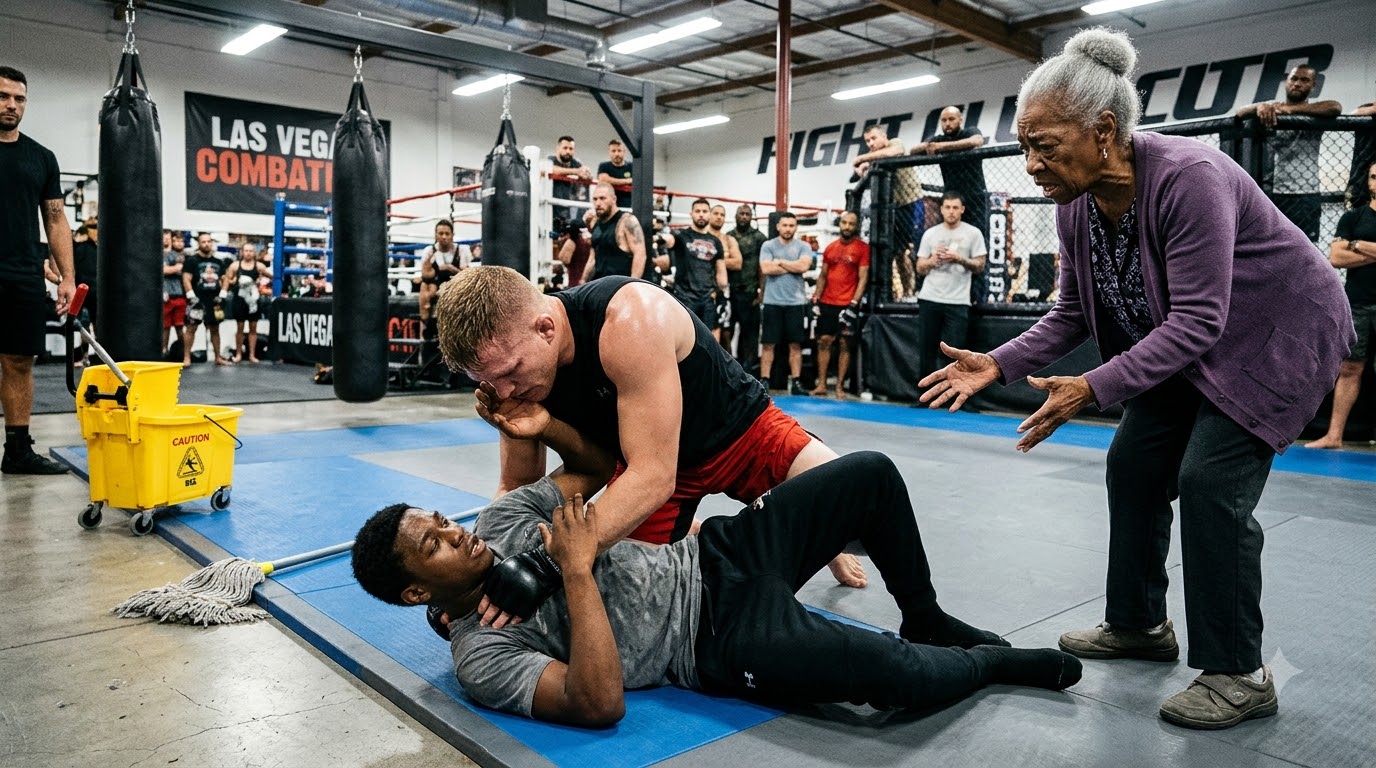
That night Crown Point was hosting a private demonstration for investors, local reporters, and a representative of the organization considering a four-million-dollar sponsorship. Dana Price, a freelance videographer hired to record the ceremony, had positioned her camera beside the ring. The owner, Victor Iverson, kept checking his watch. Everything had to look perfect. Everything, he had warned, had to prove that his son was ready for the national stage.
Then Lance saw Noah watching. He stepped to the ropes and smiled in a way that made the room uneasy. ‘You, janitor. On the mat.’ Noah looked toward the head coach, who lowered his eyes. ‘Hands up, chin down,’ Lance said. ‘No headgear tonight. It’s a show, not a funeral.’ The spectators laughed again, though fewer of them sounded amused. Noah put down his mop and climbed through the ropes, telling himself it would be one controlled exchange. He had no idea that a woman sitting quietly in the back row had just set her knitting bag on the floor.
The city outside carried on, indifferent to the arguments inside. Buses hissed at the curb, delivery trucks blocked intersections, and people hurried home with shopping bags cutting red lines into their fingers. For Noah, the contrast was strange: the worst moment of his life could unfold while someone a block away debated what to eat for dinner. Later he would remember that ordinary world as a promise. Trouble could feel enormous without becoming the whole universe.
The woman was seventy-four-year-old Margaret Hayes, Noah’s grandmother. She had arrived on the afternoon bus wearing a faded blue cardigan, walking shoes, and a silver watch that had stopped working years ago. She had not told Noah she was coming. He had invited her to see the academy weeks earlier, but he assumed the long journey would be too tiring. Margaret had spent most of her life refusing to let people make decisions on her behalf, and age had not changed that habit.
She watched Noah move to the center of the mat with a particular stillness. The young man’s shoulders were tight. His stance was narrow, but his eyes were alert. He had learned enough to recognize danger and not enough to know how to escape it. Across from him Lance bounced on the balls of his feet, glancing toward the cameras. The champion was not interested in instruction. He was interested in an audience.
Margaret had seen that expression before, in soldiers who mistook power for permission and in instructors who treated humiliation as discipline. She knew how quickly a demonstration could become a punishment when everyone present wanted to keep a powerful man happy. Her hands rested on the rail. She did not speak yet. A lifetime of work had taught her to observe before acting, to distinguish an accident from a choice, and to recognize the exact moment when silence became complicity.
The announcer raised one hand. ‘Fighters ready? Begin.’ Lance came forward with a sharp feint, then a body kick that knocked Noah off balance. Noah recovered and tried to circle away. ‘Chin down,’ Lance mocked. ‘Who taught you that, janitor?’ Noah did not answer. His job depended on this room. His future, he believed, depended on the people in it. He took another strike to the ribs, heard the air leave his lungs, and looked toward the referee. The referee called, ‘Stop!’ Lance had already begun turning his hips. The kick landed against Noah’s head after the command. Noah collapsed, one hand opening and closing against the canvas.
Margaret had learned to pay attention to what people did after the obvious danger passed. Anyone could appear brave while a room watched. It took another kind of courage to complete paperwork, keep an appointment, admit an error, or apologize without expecting a reward. Those were the acts that decided whether a frightening event became a warning or simply another story people told for entertainment.










