Deputy Roy Mercer had spent almost ten years learning exactly what frightened people sounded like when they finally understood that no one was coming to help them. He knew the pauses, the softer voices, the way a driver’s hands started shaking when he leaned through an open window and casually explained that cash could be kept as evidence. He knew which people would push back and which ones would surrender whatever they had, because being robbed by a man with a badge seemed safer than challenging him beside an empty highway. For years Mercer had turned that fear into money. Then, on a dry August morning outside Macon, Georgia, he pulled over my charcoal-gray sedan and leaned toward my open driver’s window. I wasn’t frightened. My name is Vanessa Reed. I was thirty-nine years old, Black, professionally dressed, and wearing a charcoal blazer over a cream blouse. My hair was pulled back, and a slim gold earring caught the sunlight when I turned my head. Mercer had no idea who I was. That was his first mistake. His second was believing I was alone.
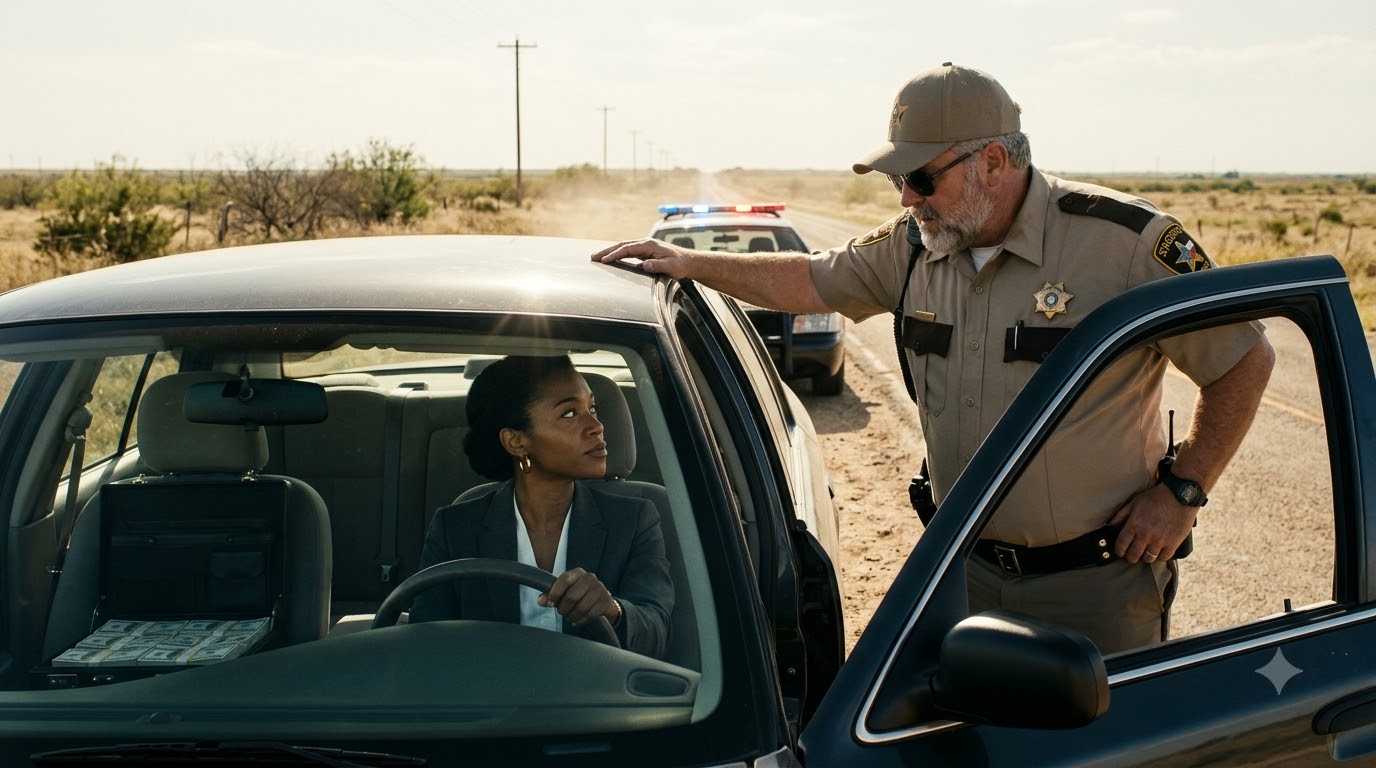
Blue lights flashed behind my sedan as I stopped on the gravel shoulder of Route 41. Farmland stretched in both directions, interrupted by telephone poles and pecan trees. I kept both hands visible. Mercer approached without hurry. He was fifty-six, broad across the shoulders, with a graying beard, mirrored sunglasses, and the relaxed posture of someone accustomed to having the last word. He stopped at my open window. “License.” I gave it to him. “Where you headed?” “Atlanta.” “From?” “Macon.” “What for?” “Work.” His eyes moved to the black leather briefcase on my passenger seat. “Step out.” I asked why. He said he smelled marijuana. I told him there was none. He asked if I was carrying cash, then whether it was more than ten thousand dollars. That question came far too early. It was the pattern I’d seen in twenty-seven complaints: an unexplained stop, a claim of suspicious odor, questions about money, and a threat that transformed a roadside encounter into an opportunity for theft.
“Purse,” Mercer said. “No,” I replied. His fingers entered the window and stopped inches from my handbag. “Don’t make this difficult.” I told him he had not given me a lawful reason to search it. He laughed. “Lady, you’re on my road.” I watched him glance toward the briefcase. The road was not his, and neither was the money he hoped to find. But I knew that stating either fact too proudly might endanger the operation and, more importantly, the people who had agreed to help me. So I kept my voice level. “Deputy, am I being detained for a traffic violation?” He removed his sunglasses. His eyes were pale and tired, and they held the irritated curiosity of a man who had encountered something unfamiliar. “You want to play lawyer?” he asked. “I want to know why you stopped me.” He told me I’d drifted across a lane marker. The dash camera mounted in my sedan had recorded an uninterrupted straight line for the previous three miles. I did not tell him that yet.
Mercer ordered me out. I stepped onto the shoulder carefully, avoiding loose stones, and locked the car behind me. A breeze stirred dry grass against my shoes. The deputy looked annoyed by the lock. He asked if I had something to hide. I said I had personal property and documents I intended to keep secure. He asked if I worked for a bank. I said no. He circled the sedan and peered into the backseat, where a folded jacket lay beside an empty water bottle. He made a show of sniffing near the rear window. “Strong smell,” he said. There was no smell, but I knew he didn’t need one to proceed. In the reports I’d read, he had described everything from peppermint gum to laundry detergent as evidence of an attempt to conceal narcotics. It was not a search for drugs. It was a search for a reason to keep searching.
I had spent the previous six months in a windowless conference room studying photographs of receipts, body-camera gaps, handwritten inventory sheets, and statements by people who had lost their savings on this road. I had seen the signature of a nurse who surrendered money for her mother’s medical care. I had listened to a landscaper describe how a deputy emptied his payroll envelope and then threatened to seize his truck. I had read the account of a college student who spent a night in jail after refusing to unlock her glove compartment. Every case had been treated as an isolated misunderstanding. The deputy’s reports were tidy. The victims’ stories were not. Their details did not match perfectly, because frightened people rarely remember a crisis in orderly sentences. But their stories agreed on one essential point: Mercer wanted cash, and he wanted them too afraid to ask for it back.










