Concrete scraped against bone, a sickening sound cutting straight through the chaotic noise of a crowded Sunday park. Two grown men, local heroes in their own minds with the black belts to prove it, were supposed to walk all over the quiet, limping father who just wanted to cut his daughter’s birthday cake. They didn’t know they had cornered a ghost. This is what happens when street dojo arrogance violently collides with a decade of classified warfare. Sydney Wilson leaned against the splintering wood of the park pavilion, a plastic cup of lukewarm lemonade sweating in her hand.
She watched her ex-husband Dilbert meticulously untangle a cluster of helium balloons. He worked with a quiet, methodical patience, his thick, calloused fingers moving carefully over the cheap ribbons. He favored his left leg when he shifted his weight. A permanent souvenir from a valley in Afghanistan that he never talked about. It was Cherish’s 8th birthday.
Their daughter was currently a blur of pink tulle and manic energy, chasing her cousins across the sunburned grass of Centennial Park. Sydney took a sip of her drink, the cynical edge of her mind taking inventory of the afternoon. Co-parenting with Dilbert wasn’t a battlefield, but it was an exercise in navigating heavy invisible silences. They hadn’t divorced because of infidelity or shouting matches. They had divorced because Dilbert had come back from his final deployment hollowed out, leaving his capacity for civilian joy somewhere in the dirt of a foreign country.
He was a good father. He was just a difficult man to live with. Dilbert secured the balloons to the picnic table and wiped a bead of sweat from his forehead with the back of his forearm. He wore a faded oversized flannel over a plain gray t-shirt despite the July heat. He always wore long sleeves.
It covered the ink, covered the scars, covered the past. Cakes in the cooler, Sydney said, raising her voice over the ambient noise of a dozen different portable speakers clashing across the park. We should probably do candles before the frosting melts into a puddle. Dilbert nodded. Give them five more minutes.
Let her run. He didn’t look at Sydney when he spoke. His eyes were doing what they always did, scanning. It used to drive her crazy. Sitting in restaurants, he would track the waitress, the guy in the corner booth, the exits, the shadows.
Now she just accepted it as an unbreakable loop of code in his brain. He was checking the perimeter of a suburban birthday party. That was when the heavy aggressive rumble of a diesel engine shattered the low hum of the afternoon. A lifted matte black truck hopped the curb. Tires chewing up the manicured grass and parked entirely too close to the pavilion.
The doors swung open before the engine even cut out. Heavy bass thumped from the cabin. Out stepped Greg and Todd Mitchell. Sydney recognized them instantly, and a nod of preemptive exhaustion tightened in her stomach. Everyone in town knew the Mitchell brothers.
They ran a local mixed martial arts gym called Apex Striking. They were the kind of men who wore their masculinity like a cheap overpowering cologne. Tight, moisture- wicking shirts stretched over steroid inflated biceps. Cauliflower ears worn as badges of honor. They carried themselves with a loud aggressive entitlement, acting as if the town limits were the walls of their personal octagon.
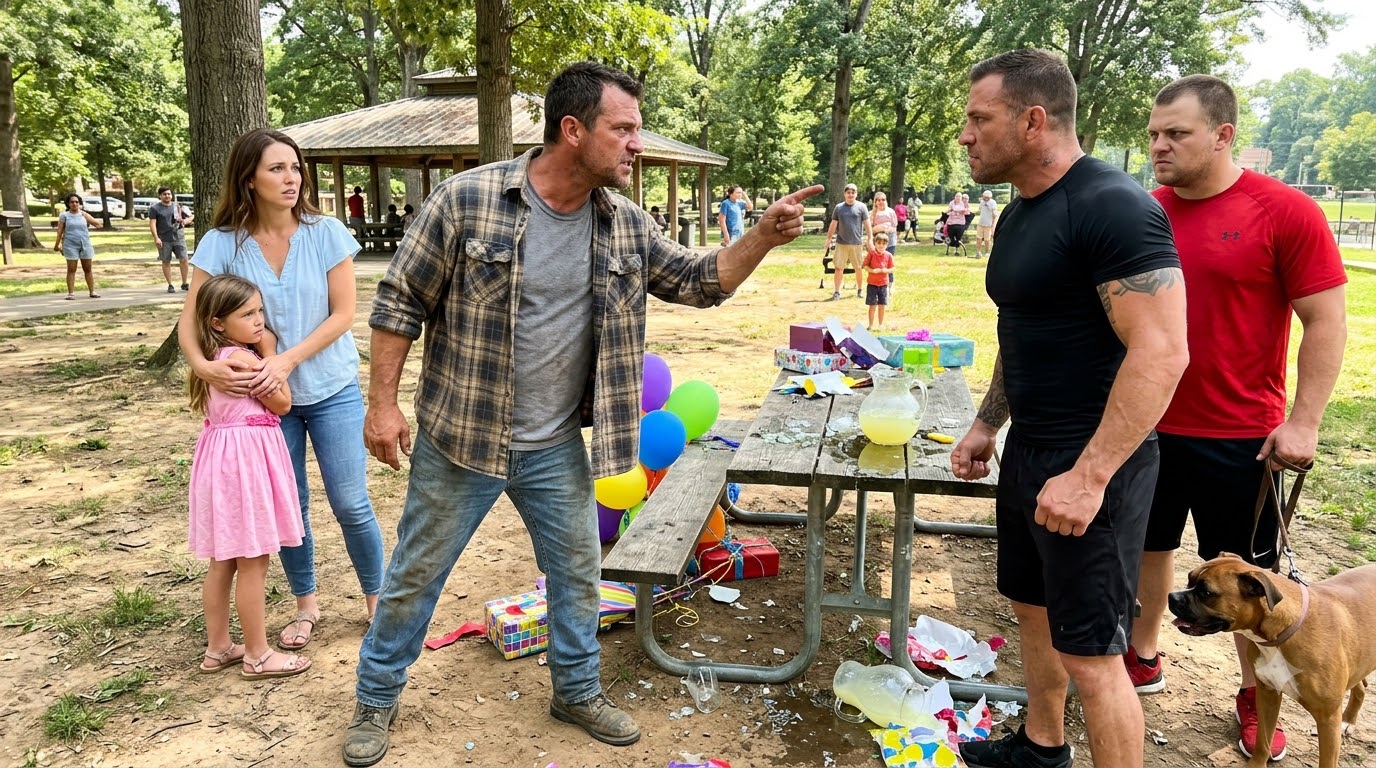
Greg, the older and noticeably larger of the two, hauled a massive cooler out of the truck bed, letting it drop onto the grass with a heavy thud. Todd followed, holding the leashes of two massive unneutered pitbulls that immediately began straining and barking at a nearby group of teenagers. There were six empty picnic tables on the far side of the park under the shade of the oak trees. Naturally, the Mitchell brothers bypassed all of them. They dragged their cooler straight toward the pavilion Sydney and Dilbert had reserved, dropping it less than 10 ft from Cherish’s pile of wrapped presents.
“All right, let’s set up here,” Greg announced loudly, tossing a folding chair onto the concrete. He didn’t ask. He didn’t acknowledge Sydney or Dilbert. He just claimed the space. Sydney felt her jaw tighten.
She spent 40 hours a week managing a regional logistics office, dealing with inflated egos and posturing middle managers. She had zero tolerance for adult men who behaved like schoolyard bullies. She took a step forward, ready to point out the brightly colored reserved sign taped to the pavilion pillar. Dilbert’s hand gently caught her elbow. The touch was light, but the unspoken instruction was absolute.
Let it go, Sydney,” he said, his voice barely above a murmur. “We have enough room.” She looked at him, frustrated. “Dilbert, we paid the city for this pavilion. They have the whole park.” “It’s a beautiful day,” Dilbert replied evenly, letting go of her arm. He didn’t look at the brothers.










