The first thing Tessa Harmon heard that morning was her mother’s voice calling from the kitchen. “All right, up. Take your house keys.” June Harmon said it the way she had said it when Tessa was eight and late for school, when she was sixteen and late for practice, and when she was twenty-eight and pretending that the first shift at the stadium did not make her nervous anymore. Tessa smiled before she opened her eyes. Some habits were stronger than illness, and some kinds of love refused to become dramatic just because life had become difficult.
The football sat beside the door, its leather dark with age and the seams repaired in two places. June had written on it years earlier, on the morning her daughter left for her first training camp: STILL GOT MY HANDS. The words had never been a promise that June would be able to stop every hard thing that came toward her. They meant she would be waiting, ready to receive whatever Tessa could bring home. For four years, that had been enough to keep Tessa moving.
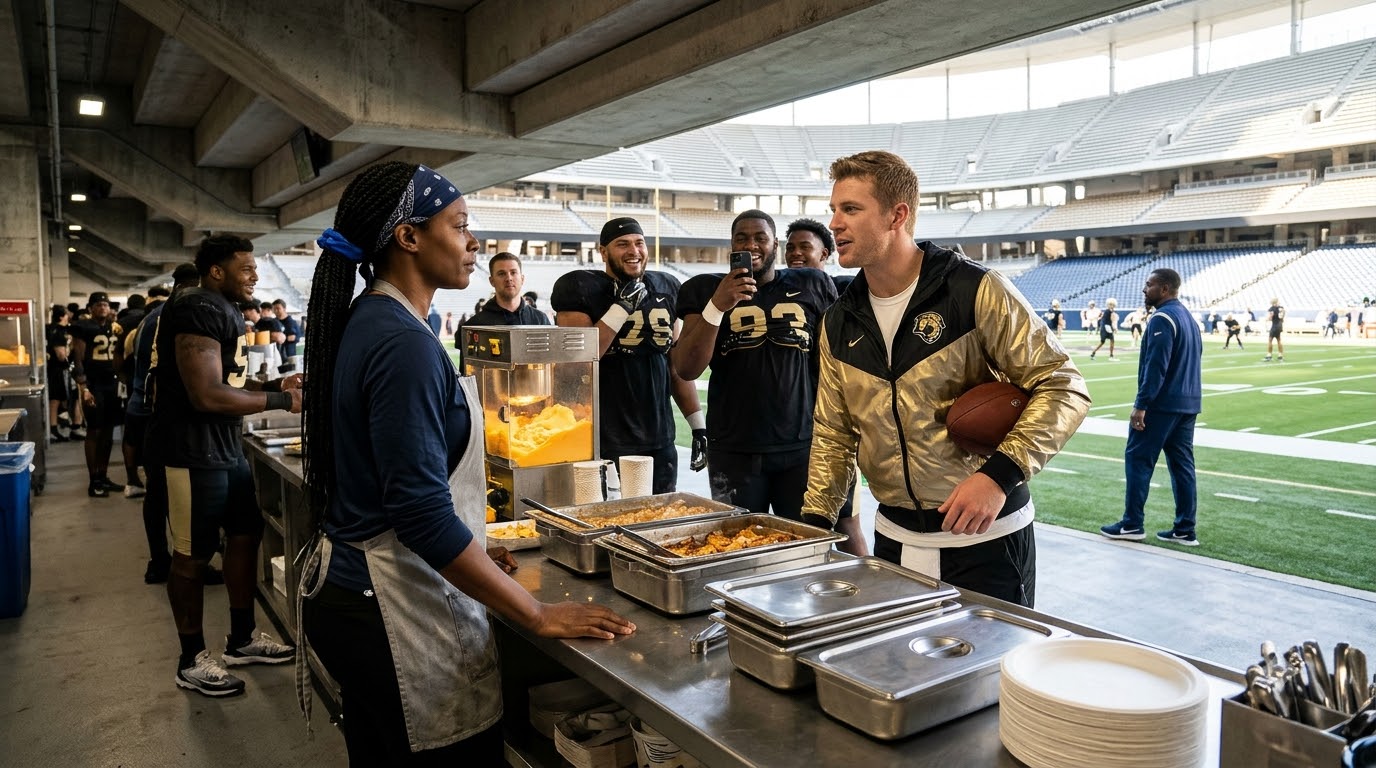
At the stadium, nobody called her Captain Harmon. They called her the nacho lady, or the woman at counter three, or simply “Hey, you.” Her jersey hung in a glass case in the tunnel, but the workers who hurried beneath it rarely looked up. She had learned to live with that contradiction. She had not learned to like it. On the morning the franchise held its open quarterback tryouts, the contradiction was about to become impossible to ignore.
Tessa Harmon arrived before sunrise carrying a dented thermos and a football wrapped in an old blue towel. the stadium loading gate had its own language: the squeal of a cart wheel, the distant slam of a service door, the murmur of people who believed they already knew how the day would end. Tessa had spent enough of her life in places like this to understand that the loudest person rarely knew the most. She paused to take in the small details before anyone could demand an answer from her. There was always a difference between being present and being seen, and she had become practiced at the first without expecting the second.
her mother had written STILL GOT MY HANDS on the leather. The thought did not arrive as a neat explanation. It came in fragments, in remembered voices and the familiar pressure of a choice that had seemed simple only to people who never had to make it. For a moment she could almost hear June asking whether she had eaten breakfast. That was how her mother measured difficult days: not by what a crowd said, but by whether the person she loved had enough strength to face another hour. Tessa had learned to answer that question honestly, even when the answer was uncomfortable.
the morning would test whether she could remain invisible. Nobody around her could see the whole calculation. They saw clothing, a job title, a place in a line, and built an entire person from those scraps. Tessa had once believed that achievement could protect someone from being dismissed. The last four years had taught her otherwise. A trophy could hang on a wall while the person who earned it carried boxes beneath it. She was not ashamed of the boxes. She was ashamed of how easily people used them as permission to be cruel.
the security guard waved her through without recognizing her. It was a small development, easy to miss beside the noise and movement, yet it changed the shape of what followed. Tessa kept her voice level and made herself notice exactly who had spoken, who had looked away, and who had bothered to listen. She had no interest in winning an argument simply by speaking louder. She wanted the truth to survive after the crowd had gone home. That required patience, and patience was something she had learned in waiting rooms, on buses, and in the long hours before a doctor opened a door.
The day did not offer her the comfort of a clear answer. It offered a next step, and then another. She took them because stopping would have meant accepting somebody else’s description of her life as the final one. Somewhere beyond the immediate trouble was a field she still knew how to read, a mother who had never stopped believing in her, and a name she had carried quietly for years. She could not know what the next hour would demand. She knew only that she would meet it standing upright.
Her mother June had ironed Tessa’s faded concessions apron the previous night. At their narrow kitchen, ordinary sounds seemed strangely amplified. A shoe scraped concrete. Someone cleared a throat without speaking. A piece of equipment rattled against its frame. Those details stayed with Tessa because she had always understood a contest through rhythm before she understood it through numbers. A quarterback had to hear the field as much as see it, and a person facing humiliation had to hear the difference between genuine concern and a performance meant for spectators.










