Monique Tate steered the resurfacer over the Wolves arena ice before sunrise, watching the blade gather shavings and the warm water seal old scars. She had worked here six years, long enough to know the soft patch near the west boards and the faint ridge left when the loading door opened in winter. Her younger brother Malik waited at home with his schoolbooks and the battered skates she had repaired twice. The Sunday youth program was the only place he and his teammates could practice without paying private-club prices.
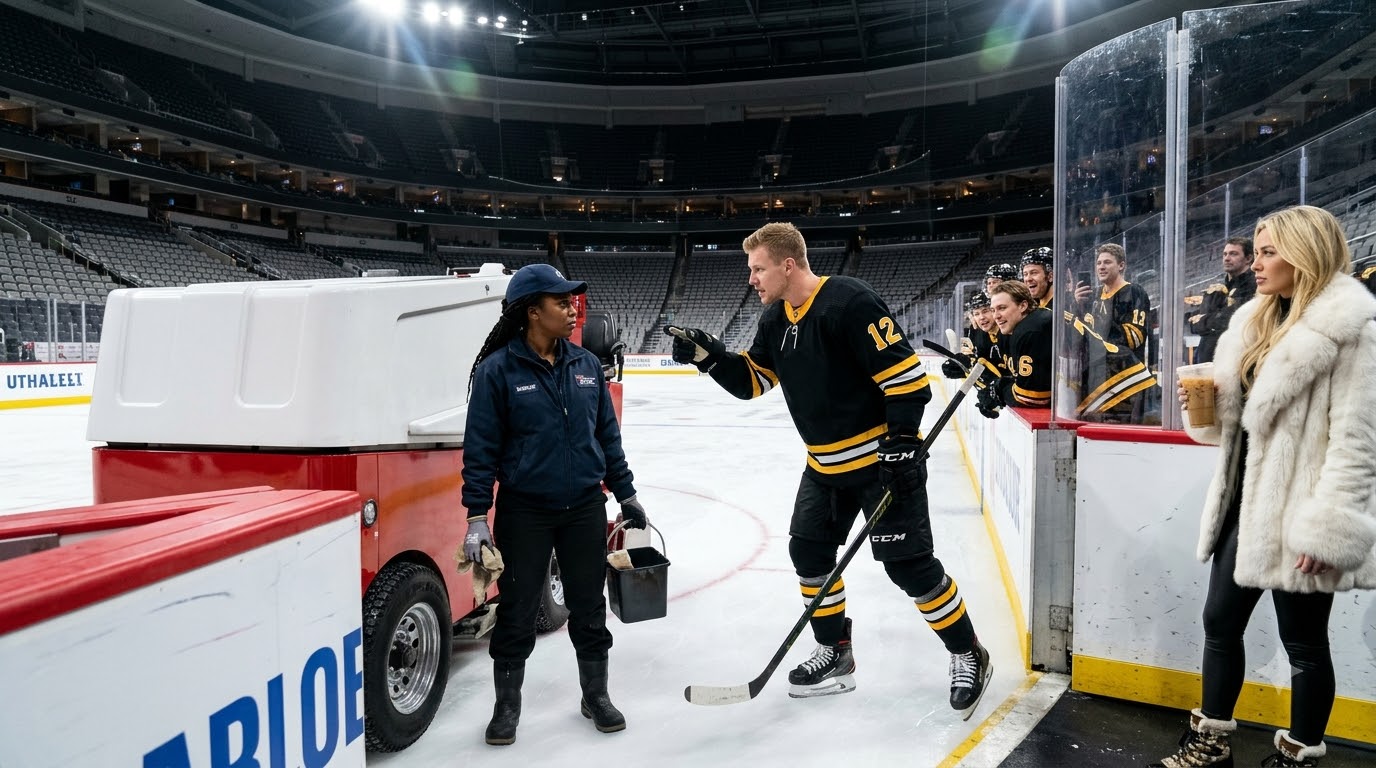
A camera crew arrived before the ice was ready. Tanner Voss, the Wolves superstar, treated the entire building as his personal studio, while his fiancée Briella treated every worker as scenery. Coach Scott Camard wanted another pass over the ice, but Tanner shouted that Monique was delaying his commercial. Monique asked for five minutes, knowing a rushed surface could catch a blade at speed. Tanner mocked her hat and apron and made a joke about her jersey number seven, which was stitched on an old patch inside her work bag.
As the hours around the ice before dawn unfolded, Monique found herself thinking about what the moment asked of her. She remembered the first rink her mother had taken her to, where the boards were scarred and the rental skates never fit. Her mother had stood behind the glass with cold hands wrapped around a paper cup, cheering for every successful stop as though it were a championship goal. That memory returned at inconvenient moments, sometimes making her stronger and sometimes leaving her unable to speak for a few seconds. She no longer tried to decide which reaction was correct. She did not know yet how the next conversation would unfold, and she refused to pretend she did.
What stayed with her afterward was not the loudest remark but the silence that followed it. The work demanded attention in ways spectators rarely considered. A careless turn could leave a ridge; a rushed repair could become a fall; a missed warning could turn an ordinary practice into an emergency. Monique had carried that responsibility quietly for six years. She could not control what Tanner said, but she could control whether the surface was safe when the next child stepped onto it. That uncertainty was uncomfortable, but it was also the first honest thing she had been offered in days.
There was another side to the day, one the spectators and managers could not see. At home the kitchen light stayed on long after most of the neighborhood went dark. Malik studied at the table while Monique checked bills, washed uniforms, and made lists on the backs of envelopes. Their lives had become a series of small negotiations with time. They still found room for jokes, and those jokes mattered because they belonged to nobody else. The choice was hers to make, even if the consequences would reach people she loved.
Later, when she tried to explain this part of the story to Malik, she had to begin with something ordinary. The Sunday players were not a polished squad. Some could barely stop without reaching for the boards; others had practiced on pavement with sticks taped together at the grip. They were fiercely loyal to one another. Monique had seen a shy child become confident after one clean pass, and she knew the loss of the program would take more than ice away from them. For now, she kept moving, because standing still had never been a way to protect the people beside her.
For a while she concentrated on the smallest practical task in front of her. Pressure did not arrive all at once. It accumulated in a hundred small choices: whether to answer an insult, whether to risk a shift, whether to ask for help, whether to believe a promise that had not been written down. Monique had made mistakes with those choices before. She hoped this time she could make them without forgetting the people who depended on her. She made herself remember the distinction between being afraid and being unable to act.
Nobody could tell from her expression how many old memories the day had stirred. Under the bright lights the ice seemed smooth and almost weightless. Monique knew the hidden work behind that illusion: the water temperature, the blade depth, the patient overlapping passes, and the crew who stayed after the audience left. She loved that work. The fact that she could shoot a puck did not make the labor beneath her feet any less worthy of respect. What mattered was not the story someone else told about her, but the decision she made when the moment came.
She finished the lane she had promised the coach, keeping her hands steady despite the audience. The memory of a national-team locker room came without warning: the scrape of skate guards, the weight of a captain’s letter, her mother waiting in the stands. She pushed it away. That chapter had ended when the hospital bills began, and remembering it did not make the current shift shorter.










