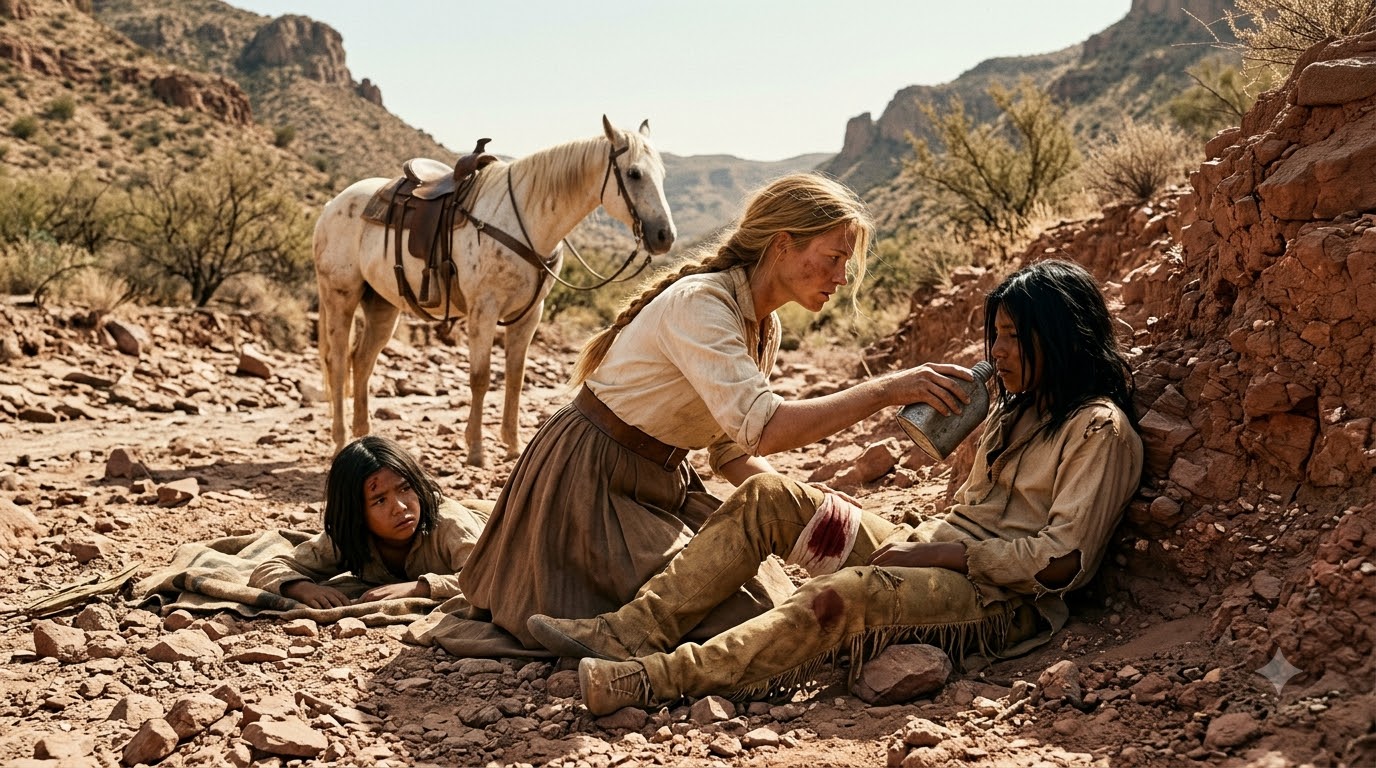
In the unforgiving heart of the 1870s, Arizona Territory, a single act of mercy could be a death sentence. For Clara Hayes, a woman left with nothing but 40 acres of dust and a ghost-pale mare, desperation was a constant companion. When she found two Apache boys bleeding and near death at her dry creek bed, she faced an impossible choice: leave them to the buzzards as her neighbors would, or risk everything on a fool’s hope of humanity. She chose hope. She gave them her last horse.
Little did she know that single act of kindness would bring 200 warriors to her doorstep at dawn. This is the story of what happened next. The sun over the Chiricahua Mountains was not a gentle thing. It was a hammer beating down on the cracked earth of Clara Hayes’ small ranch, turning the air to a shimmering haze. By October of 1875, everything felt brittle.
The grass was bleached to the color of old bone. The creek bed, a muddy trickle in spring, was now a scar of sun-baked stones. Even the memories of her family, once vibrant, felt like pressed flowers, fragile and faded. Clara, at 23, was the sole heir to this kingdom of dust. Cholera had taken her mother and father within a week of each other the previous winter, leaving her with a silence so profound it felt like a physical weight.
Her younger brother, Samuel, had gone east to find a doctor and never returned. Neighbors were sparse and suspicious, hunkered down on their own patches of unforgiving land. The nearest town, a dusty collection of saloons and supply stores, a hard day’s ride away, offered little comfort. To them, she was the Hayes girl, the one who was either too stubborn or too foolish to sell out and go back east where a woman belonged. She was down to her last treasured dust devil.
The mare was a pale buckskin, almost white in the harsh sun, with a spirit as resilient as the wiry grama grass that clung to life around them. She was the last of her father’s proud stock, a four-legged promise that not everything was lost. Dust Devil was her means of escape, her partner in solitude, her only link to a life that had been full of laughter and the scent of her father’s pipe tobacco. Every morning, Clara would lean her forehead against the mare’s warm neck, breathing in the scent of horse and hay, and find the strength to face another day. Her days were a litany of hard labor, mending fences that the wind tried to tear down, hauling water from the well which grew deeper and more reluctant each week, tending her small garden of hardy squash and beans, praying for a rain that never came.
Loneliness was a constant ache, a phantom limb where her family used to be. On this particular afternoon, the heat was a physical presence pressing in from all sides. Clara was returning from the far pasture, checking for breaks in the wire fence her father had so painstakingly strung. She carried a Winchester 73, its weight familiar and comforting in her hands. In this land, a firearm was as essential as a water canteen.
She walked with a long, steady stride, her worn leather boots kicking up puffs of red dust. It was the unnatural stillness that first alerted her. The usual chatter of sparrows in the mesquite bushes was absent. Even the insects seemed to have fallen silent. A prickle of unease traced its way up her spine.
She slowed her pace, her eyes scanning the familiar landscape, searching for anything out of place. That’s when she saw them. Down in the dry creek bed, nestled among the smooth, sun-bleached rocks, were two figures. From a distance, they were just bundles of dark cloth and darker skin. Her first thought was Comancheros or bandits lying in ambush.
She dropped to one knee behind a thicket of creosote, her heart hammering against her ribs. She raised the Winchester, the cool metal of the stock a familiar comfort against her cheek. She sighted down the long barrel, her breath held tight in her chest. But as she watched, she realized they weren’t waiting in ambush. They weren’t moving at all.
One was curled on his side. The other lay flat on his back, an arm flung out at an awkward angle. They were small, too small to be men. Boys. Caution warred with a deeper, more ingrained instinct, one her mother had nurtured in her.
You don’t leave a soul to suffer if you can help it. Cursing her own foolishness, she rose slowly and began to make her way down the embankment, the Winchester held at the ready. As she drew closer, the scene resolved into a grim tableau. They were Apache boys. Their black hair was matted with dirt and something dark and sticky.










