The first thing Isaiah noticed that morning was the frost inside the window. It had gathered in delicate white feathers along the lower edge of the glass, where the frame never quite sealed against the Ohio winter. He could see the streetlight through it, a blurred amber circle hanging above the empty road. The weather report had promised a windchill below zero by the time school started. He had listened to it twice while getting dressed, not because he enjoyed the forecast but because he was trying to decide whether he could survive another day with his coat hanging open.
The zipper had broken three weeks earlier. At first it had only caught near the bottom. Then the metal slider had come off in his hand, leaving two rows of teeth that would never meet. He had tried safety pins, a piece of string, and once a strip of packing tape, which peeled away before he reached the bus stop. Now he held the coat against his chest and waited outside the bedroom where his adoptive mother was laughing.
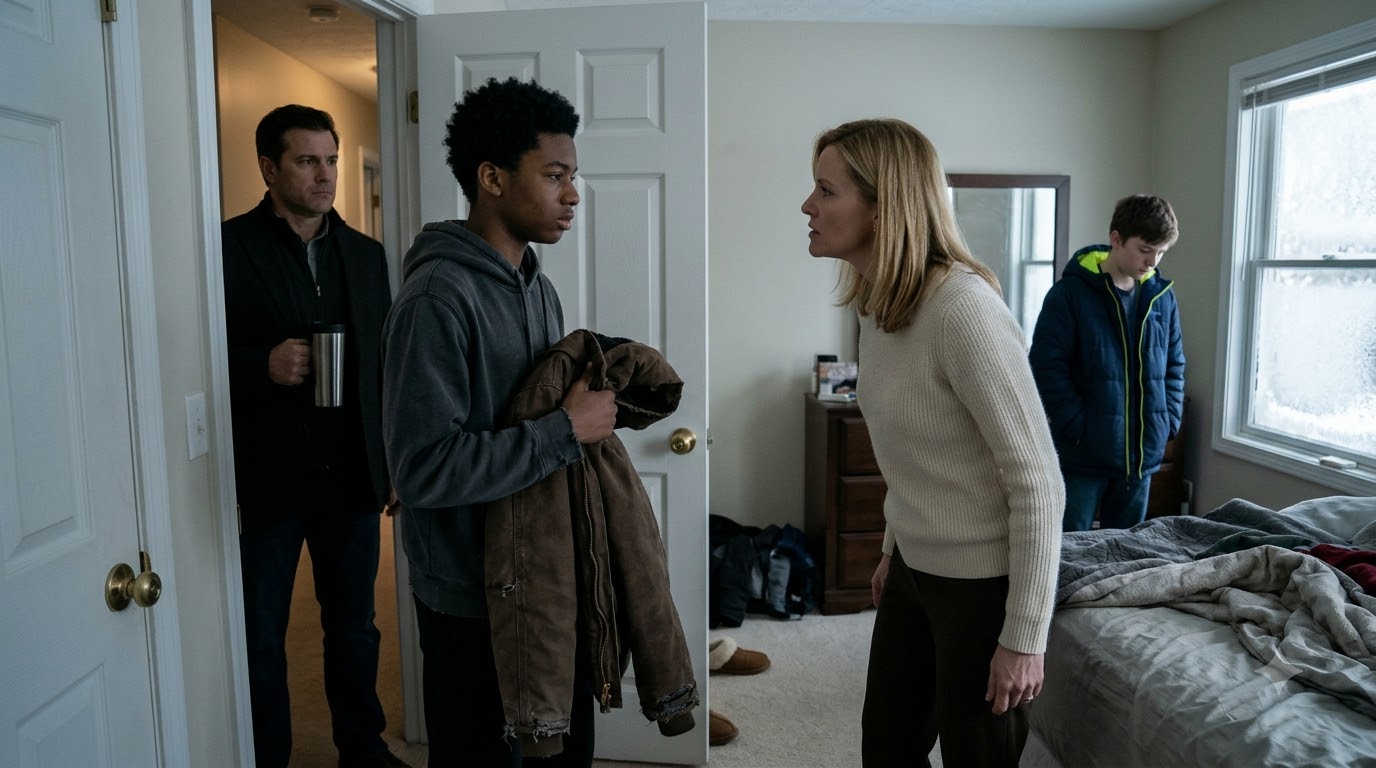
Inside, Marilyn Bennett was helping her biological son Caleb into a new winter jacket, navy blue with a bright lining and a little embroidered mountain on the sleeve. Caleb stood in front of the mirror, looking more uncomfortable than excited. Isaiah had seen the shopping bag arrive the night before. He had told himself not to assume anything. Families bought surprises.
Sometimes surprises were for everyone. He knew better than to expect one, but hope was a habit that did not disappear simply because it had been disappointed many times.
Marilyn noticed him in the doorway and her smile tightened. She was still holding the tag she had cut from Caleb’s jacket. Isaiah raised his old coat, showing her the broken zipper as gently as if he were asking for permission to be cold. “Mom, my zipper’s broken,” he said. She did not look at the coat.
“Wear it open.” Isaiah swallowed. “It’s freezing outside.” Marilyn smoothed Caleb’s shoulder, checking the fit of the expensive new fabric. “Your brother needed a new coat more.” Caleb turned from the mirror. “Mine wasn’t even damaged,” he said. The room went quiet.
Marilyn’s hand froze on his collar. A man’s voice came from the hallway. “What did you just say?” Daniel Bennett stood in the doorway with his work bag in one hand and a travel mug in the other. He had returned upstairs because he had forgotten his phone. The phone was still on the kitchen counter, but he had forgotten it again.
His eyes moved from Caleb’s new jacket to Isaiah’s coat, to the pale line of Isaiah’s knuckles where he was gripping the torn fabric. Marilyn recovered first. She said the boys were making a fuss about nothing. Daniel did not answer. He had been a father long enough to recognize the particular silence of a child who had learned that explanations only made things worse.
He had never imagined he would hear that silence in his own house.
Daniel set his bag down. “Isaiah, put that coat on,” he said, and Isaiah obeyed automatically. The sleeves were too short. The cuffs stopped above his wrists, exposing a strip of skin already dry and cracked from the cold. When Isaiah let go of the front, the jacket fell open as though it had never been meant to close.
Daniel looked at the missing zipper pull and the fraying seam near the pocket. He asked when it had happened. “A little while ago,” Isaiah said. Marilyn interrupted to say that Isaiah was rough with his things, that teenagers were careless, that money did not grow on trees. Daniel remembered the family vacation they had booked for spring, the dining table they had replaced last month, and the new shoes Caleb had received for basketball.
None of those purchases had seemed impossible. He asked Isaiah how long a little while was. “Three weeks,” the boy said. “Maybe four.” Caleb stared at the floor. Daniel asked whether anyone had tried to repair it.
Isaiah shook his head. He had mentioned it, he said, but everyone was busy. Marilyn’s face changed at the word everyone. She told Daniel he was letting a child turn a minor inconvenience into an accusation. Daniel heard the accusation anyway.
It was not in Isaiah’s voice. It was in the facts.
They were late by then, and the ordinary urgency of a school morning tried to swallow the moment. The bus would arrive in twelve minutes. Caleb’s lunch was still on the counter. Daniel’s first meeting began at eight. Marilyn took advantage of the clock and announced that they could discuss it later.
Daniel took off his own winter coat, a heavy brown parka with a repaired cuff, and held it out to Isaiah. The boy hesitated. “It’ll be too big.” “Then you’ll have room to grow,” Daniel said. The words were meant as a joke, but they made something painful pass over Isaiah’s face. He had heard versions of that promise before, usually about clothes handed down after Caleb outgrew them.










