The first time Elena Morales asked for the wages she was owed, the manager told her to wait until Friday. The second time, he told her the payroll system had been upgraded. By the sixth week, Friday had become a word without meaning. It was raining when she stood outside the service entrance of the Northbridge Center with a folded pay stub in her hand, waiting for Jace Mercer to emerge from the building he managed as though it belonged to him. She had cleaned the offices on all twelve floors, emptied the trash after midnight, and scrubbed the marble lobby before the morning executives arrived. She knew the smell of the stairwells and the sound of the ventilation motors better than she knew the voices of the people who worked upstairs. Yet she could not pay her electricity bill with familiarity. She could not buy groceries with promises. When Jace finally came through the door, she stepped into his path and said, quietly at first, “You still owe me six weeks of wages.”
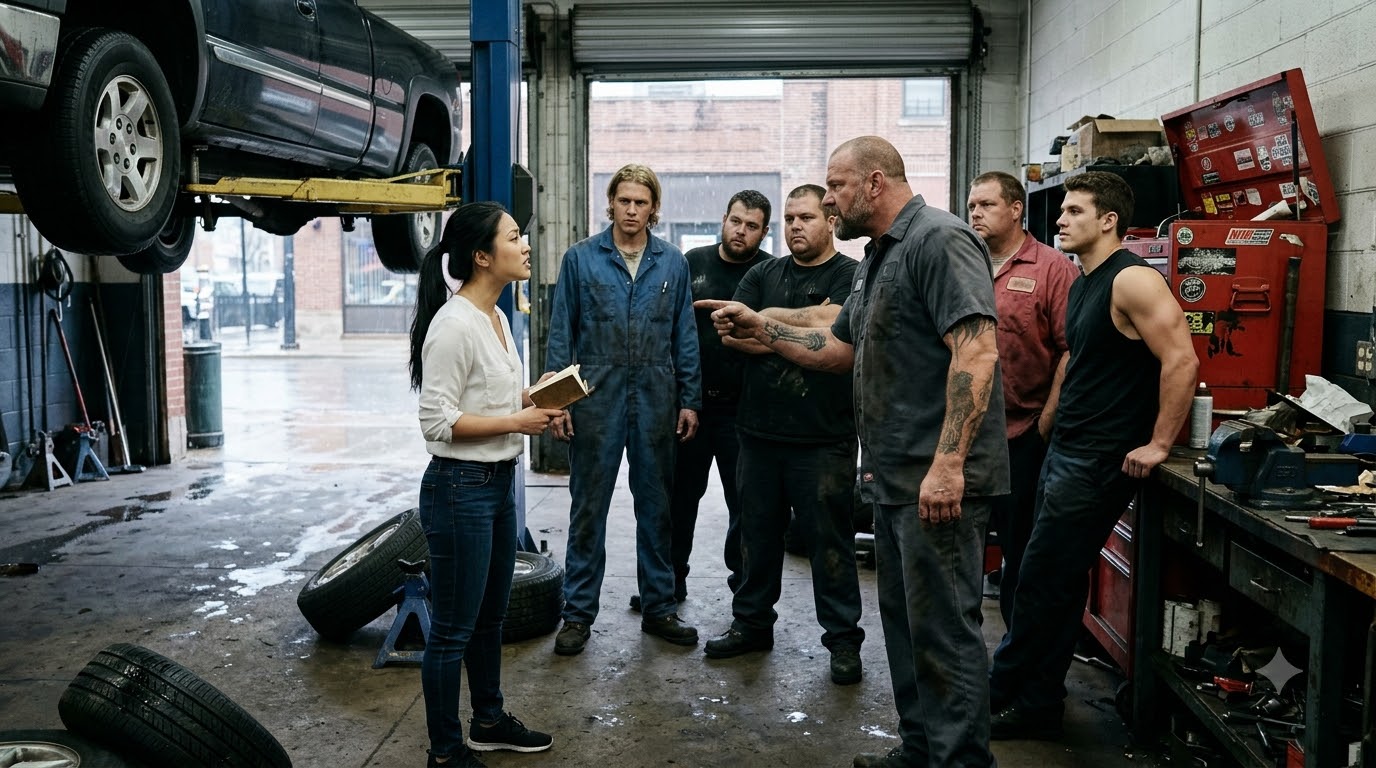
He did not look at the pay stub. He looked at the people passing on the sidewalk, measuring how much of a scene she might make. “Not here,” he said. “We discussed this.” Elena held out the paper. “You said Friday.” “And I said not here.” His fingers closed around her wrist, not hard enough to leave an immediate mark but hard enough to tell her that he believed he could move her out of sight. Elena pulled back. “Let go.” He tightened his grip. “You’re making trouble for yourself.” “Let go,” she repeated. A young delivery driver stopped beside his van. From the opposite curb, Elena’s daughter Sofia saw the struggle and started running. The driver shouted, “I saw it. They attacked her.” Jace released Elena as though her arm had suddenly become hot. He straightened his jacket, turned toward the delivery driver, and said there had been a misunderstanding. Elena could still feel the shape of his hand on her wrist long after he disappeared into the building.
The question of the first missed payday returned to Elena at an unexpected moment. elena remembers the first warning sign, an altered direct-deposit notice and a supervisor insisting that the discrepancy was temporary. At first she wanted to treat it as another small difficulty that could wait until the next shift ended. That was how she had survived for years: finish the work, catch the bus, make dinner, and leave the worrying for a quieter hour that never arrived. But she had begun to recognize the cost of that habit. She sat down with the people involved and asked them to explain what had happened in their own words. Nobody was required to be eloquent. Nobody was asked to pretend that the problem was smaller than it felt. The conversation wandered through practical details, the sort of details that rarely appear in speeches about courage: a receipt tucked in a pocket, a bus that came late, a phone battery that died before an important call, a child waiting at home. Elena listened until the facts began to separate themselves from the fear around them.
There was disagreement, as there always was when people had something to lose. Ben preferred to confront problems immediately. Priya worried that confrontation could make an already difficult situation worse. Sofia wanted everything photographed, dated, and copied before anyone took another step. Elena understood each of them. She had been the person who wanted to shout, the person who wanted to hide, and the person who simply wanted to finish a shift without trouble. “We don’t have to agree about every feeling,” she told them. “We do have to agree about what happened.” They worked through the question slowly. A few assumptions were corrected. One detail that had seemed important turned out to be irrelevant. Another, almost overlooked, gave them a clear next step. By the time they stood to leave, nobody believed the work was finished, but everyone knew what they had promised to do.
Later, sofia creates a calendar that distinguishes actual transfers from promises. The result did not arrive with music or applause. It came through a phone call, a signed page, a changed schedule, or the quiet relief of seeing a number finally match a record. Elena wrote it in the notebook because she no longer trusted memory alone to hold the shape of a difficult year. At home she told Sofia what had happened, including the parts that had gone badly. Sofia listened while preparing tea and asked the same question she always asked: “What do we know for certain?” Elena smiled despite her exhaustion. “We know a little more than yesterday.” It was not the kind of answer that would impress anyone searching for a dramatic ending. For Elena, it was enough to make the next morning possible.










