The billionaire CEO was lying unconscious on the marble floor, blood spreading beneath her head while eight trained security officers stood frozen around her. Her private guard had already called three emergency teams, but the nearest ambulance was still 12 minutes away. Then he spotted a quiet single father walking through the lobby with his little daughter, holding a paper lunch bag in one hand. The guard ran toward him, dropped to his knees, and begged through tears, “Please save my boss. You’re our only hope.” What happened next would expose a past nobody in that building could have imagined.
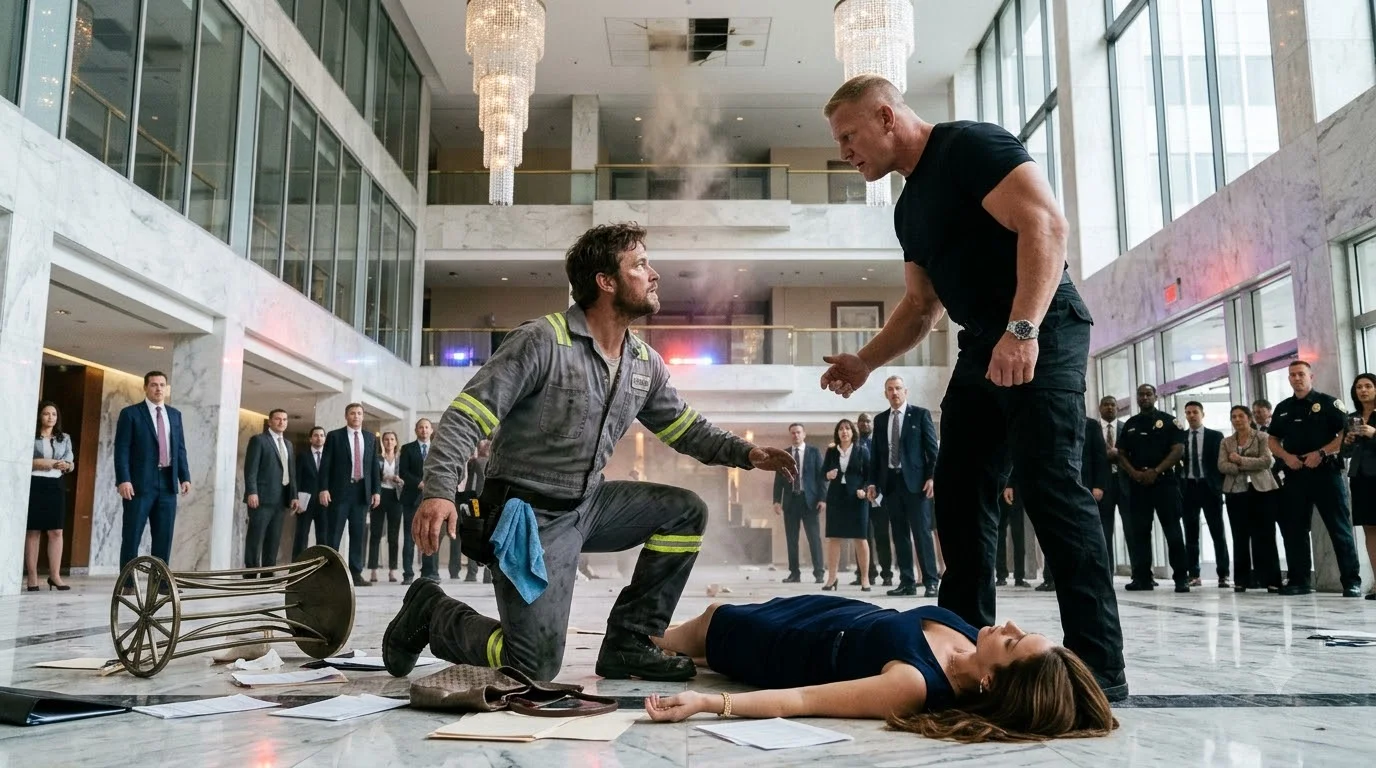
The man standing in the lobby was named Everett Hayes. He was 39 years old, a single father raising his seven-year-old daughter, Maisie, in a modest apartment on the outskirts of Boston. He wore a faded gray jacket, work boots, and a simple wristwatch that had belonged to his late wife. To most people, Everett looked like an ordinary maintenance contractor who had spent too many years working with his hands. His clothes were inexpensive, his truck was old, and his life revolved around school schedules, grocery bills, and making sure his daughter never felt the emptiness left behind by her mother’s death.
But there was something about Everett that nobody in the building knew. Before becoming a maintenance worker, before becoming a father who packed little sandwiches and braided his daughter’s hair badly, Everett Hayes had served as a Navy SEAL. He had spent years in some of the most dangerous environments imaginable, leading rescue operations and bringing wounded men home. He had left that world after an event changed his life forever, and since then, he had deliberately avoided anything that reminded him of the person he used to be. Everett was working at the headquarters of Sterling Crown Industries, a massive technology and medical equipment company owned by 36-year-old billionaire CEO Vivian Sterling.
He had accepted a temporary maintenance contract because the hours were flexible enough to let him collect Maisie from school. His supervisor had initially questioned whether bringing his daughter occasionally into the building was appropriate, but Everett had no other choice on certain afternoons. He always kept her close, gave her coloring books, and made sure she never disturbed anyone. Maisie had become familiar with the friendly receptionists and the elderly cafeteria worker who sometimes gave her an extra cookie. She was a gentle child with bright eyes and an extraordinary ability to notice when someone was sad.
Everett often told her that kindness was a strength, not a weakness. Vivian Sterling, however, had a very different reputation. She was brilliant, disciplined, and fiercely protective of her company. She had inherited Sterling Crown after her father suffered a sudden stroke, and she had spent the previous six years transforming a struggling family business into a billion-dollar medical technology empire. Her employees respected her intelligence but feared her temper.
She rarely smiled, never tolerated mistakes, and believed that emotions had no place in business decisions. Behind her confidence was a woman who had sacrificed nearly everything to keep her father’s legacy alive. Her mother had died when Vivian was young, and her father had raised her with a single lesson, never allow anyone to see you break. That lesson had become a prison. On the morning everything changed, Vivian was preparing for an important presentation to investors.
The company had developed a revolutionary emergency medical device designed to stabilize patients during the critical minutes before reaching a hospital. The technology could potentially save thousands of lives, but a competing corporation had been attempting to steal its research. Vivian had received several anonymous warnings during the previous week, yet she dismissed them as intimidation tactics. Her chief security officer, Grant Holloway, had urged her to increase protection, but she refused to let fear interfere with the presentation. Everett had been repairing a damaged electrical panel near the executive conference wing when he noticed something unusual.
A delivery cart had been left beside a restricted access door. One of its wheels was locked, and a thin black cable ran beneath the cart toward a maintenance cabinet. It was the kind of detail most people would overlook. Everett stopped, examined the arrangement, and felt an uncomfortable instinct awaken inside him. He recognized that the setup did not belong there.
Before he could investigate further, his phone vibrated. Maisie’s school had called to inform him that her afternoon pickup time had changed. He promised to be there and continued toward the elevator, but the strange cable stayed in his thoughts. At 11:45, Vivian entered the executive presentation room accompanied by Grant and two senior directors. Several investors were already seated around the long conference table.
The presentation began smoothly. Vivian explained the medical device’s capabilities, displayed the latest testing results, and answered difficult questions with the confidence of someone who knew every detail of her company. But as she reached the final section, the building security system suddenly flashed red. The presentation screens went black. A sharp electrical sound echoed through the conference wing, followed by a violent crash from the hallway.










