Garrett Sullivan scowled. “Who let this street kid onto my field? Look at you—dirty shoes, dirty clothes. You look like you came straight off the street. This is a place for champions, boy, not charity cases. You think because they let you through the gate you belong here? You never will. Boys from neighborhoods like yours never do.” The boy did not flinch. Twelve years old, a cracked glove on his hand, he looked up at the billionaire and said, barely above a whisper, “I’ll win $100 million in three pitches. You won’t touch one.” Sullivan’s laughter shook the bleachers.
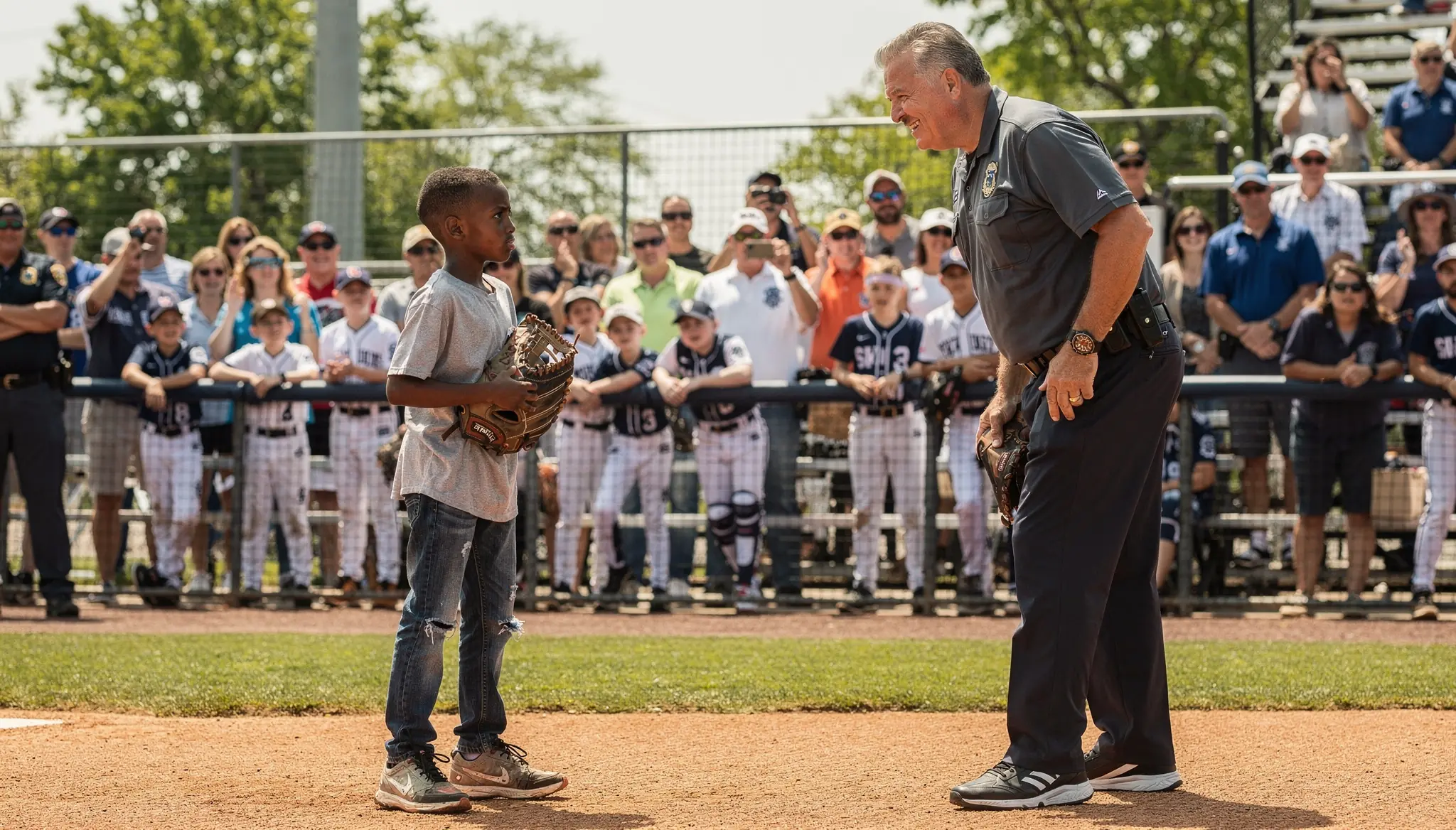
Six weeks later, that laughter died. What did this boy know that a World Series champion didn’t? Six weeks before that moment, on the South Side of Chicago, summer pressed down on the neighborhood like a hot hand on a wound. Fire hydrants hissing open for kids who couldn’t afford pools. Bass rattling from a passing Cutlass with a cracked tail light.
Chain-link fences rusted at the base, bent where someone had climbed over too many times. On the brick wall of a shuttered grocery store, someone had painted a mural of a black man in a baseball uniform mid-pitch. The paint was peeling. Nobody remembered who it was supposed to be. Three miles east across the expressway, the glass towers of downtown caught the morning sun and threw it back like a dare.
Wesley Irving was 12 years old, and he had never crossed that expressway. Every morning at 6:00, he sat on a milk crate outside Earl Dawson’s batting cage. A rusted wreck wedged between a laundromat and the dead grocery store. Half-collapsed roof, cracked concrete floor, one flickering bulb. A hand-painted sign read, “Dawson’s cage. Open when I’m here.”
Earl Dawson was 68, built like a fire hydrant left out in the weather for 40 years. He came out carrying a bucket of baseballs so scuffed the stitching had gone gray. He hung targets from the cage ceiling, a tin can, a tennis ball on a string, a cardboard circle no bigger than a fist, and knotted each one. Wesley was oiling a glove, slowly, like a prayer. The leather had turned nearly black, cracked in three places, restitched with fishing line.
Two letters burned into the thumb, J.I. That glove never left his hand. Wesley threw. The tin can exploded off its wire like a gunshot. The tennis ball snapped off its string. The cardboard punched clean through.
Three throws, three kills. Kids walking past stopped at the fence. One whispered, “That ain’t normal.” Earl scribbled in a small notebook. Dates, velocities, accuracy percentages, grip notes.
Four years of data, not a diary. A scouting-grade development record more detailed than most pro organizations keep for top draft picks. At 6:45, Nina Irving appeared in hospital scrubs. Dark circles so deep they looked like bruises. Breakfast in a brown paper bag.
She watched Wesley throw five pitches. Every one hit its target with a crack that didn’t belong to a child’s arm. Her eyes glistened. Pride and fear and a memory buried so deep it pressed against her ribs. She handed the bag through the fence, turned to Earl and said quietly, “Don’t let him end up like his father.”
She left. Double shift, same as yesterday. That night, Earl sat alone in his office. A closet with a desk and a locked drawer. He opened it.
Inside, a faded newspaper clipping. James Irving, the arm that could have changed everything. A photograph. A young black man in a professional uniform mid-pitch. The same glove, the same initials.
Earl whispered into the dark, “Not yet.” Three miles east, a different world was breathing. The Lakeshore Lions Youth Baseball Academy. 30,000 square feet of polished hardwood, indoor batting tunnels, pitching labs with biomechanical sensors. Annual registration cost $5,000.
Parking lot full of Escalades and Range Rovers. The trophy case stretched a hallway long, lit from behind like a museum. At the center of it all, Garrett Sullivan. In his office, walnut desk, World Series trophy photo framed behind him, he talked on the phone about brand alignment, optics, the right image. He said “standards” three times in two minutes.
He never said “talent” once. Three-time All-Star, World Series MVP, career .310 hitter. He retired at 38, built a business empire, and came back to youth baseball because he needed to be needed. He ran the Lions with total control and absolute certainty that excellence was something you were born into, not something that wandered in off the street. His son, Bryce, 13, practiced alone.
Good mechanics, decent arm. Every pitch filmed, every session reviewed by a $200-an-hour private coach. Bryce was good, not great. But he’d never needed to be great. Never thrown a rock at a chalk circle because he couldn’t afford a ball.
Never eaten breakfast from a paper bag on a milk crate at 6:00 a.m. because that was the only time his mother could see him. Bryce had everything Wesley didn’t. Wesley had something Bryce would never understand. That part would come later. For now, a single flyer taped to the laundromat window next to Earl’s cage was about to set fire to both worlds.










