“You don’t get to wear my daddy.”
The little girl said it so quietly that half the Copper Lantern Diner might have missed the words if the room had not already gone almost completely still.
Lucy Hale stood on top of one of my red vinyl counter stools, her bright pink sneakers planted less than six inches apart on the cracked seat cushion. She was eight years old, barely tall enough to reach the center of the giant biker’s back even with the extra height from the stool.
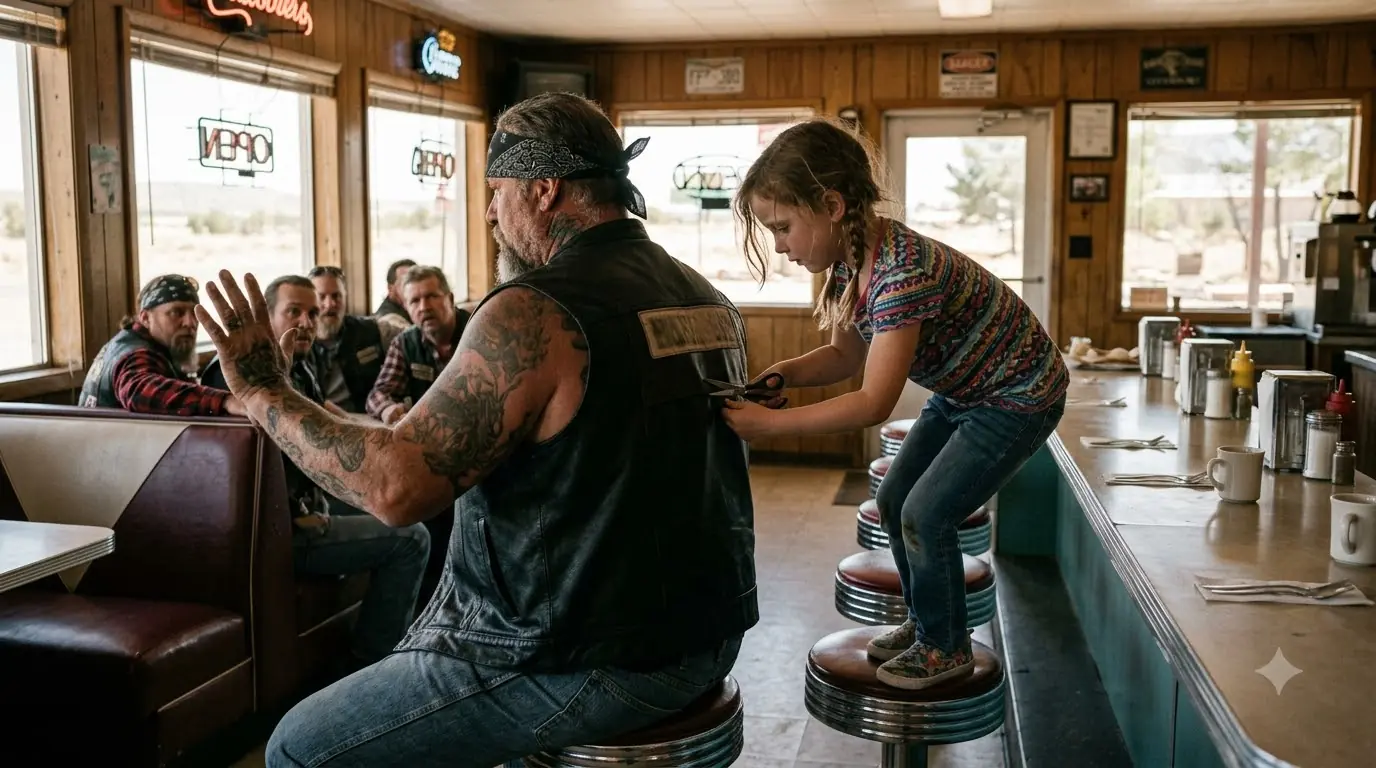
In her right hand was a pair of small silver craft scissors she had taken from the jar beside our register.
In her left hand, she held the bottom edge of a weather-beaten patch sewn onto the back of Ray “Hammer” Dawson’s black leather vest.
Hammer was six feet four on a day when he slouched.
He weighed close to two hundred eighty-five pounds.
His arms were covered from shoulder to wrist in tattoos faded by years of Arizona sun. His knuckles were scarred, his head shaved clean, and a thick iron-gray beard covered most of an old line beneath his jaw that looked like somebody had once tried to introduce him to a knife and failed to finish the conversation.
I had seen Hammer remove drunk men from my diner without raising his voice.
I had once watched him lift a broken Harley onto a trailer with another man as casually as two people carrying a coffee table.
I had watched grown men lower their voices when he entered.
Lucy Hale did not.
She pushed the scissors beneath another thread.
Snip.
One of the riders sitting near the window began to rise.
Hammer lifted one hand.
That was all.
“Stay seated.”
The rider stopped.
Around him, twenty-six other members of the Iron Saints Motorcycle Club stayed exactly where they were.
Nobody reached for Lucy.
Nobody touched the scissors.
Nobody even moved the stool farther from Hammer.
That was the part no one in the diner understood.
Bikers could laugh about dents in motorcycles, broken noses, divorces, bad tattoos, and arrests from twenty years earlier.
They did not laugh about their colors.
Those leather vests were not costumes.
Every patch meant something.
Roads traveled.
People buried.
Arguments survived.
Promises kept.
A man might replace boots, gloves, helmets, even motorcycles.
The old patches stayed.
And Lucy Hale was cutting one off.
Snip.
A spoon slipped from one of my waitress’s hands and bounced off the tile.
Nobody looked at it.
The patch was rectangular and smaller than the club insignia above it. Years of sunlight had faded the black cloth almost charcoal. The red edging had gone pale around the corners.
One corner looked wrong.
It had been repaired using blue thread.
Not matching black thread.
Not the heavy red used around the edge.
Blue.
The stitches were crooked.
Some were half an inch long.
Others barely caught the cloth.
They looked like they had been made by someone who had never held a sewing needle correctly in their life.
Lucy pushed the scissors under the final thread.
Her mother finally found her voice.
“Lucy!”
The girl flinched.
The thread snapped.
She stumbled backward on the stool with the patch clenched in one small fist.
Hammer turned.
Lucy’s mother, Mara Hale, came around the end of the booth so fast her purse fell from her shoulder.
She caught Lucy around the waist before the girl could lose her balance.
“What are you doing?”
Lucy did not answer.
She held the patch against her chest.
Mara looked at it.
Her face changed.
I knew Mara well enough to recognize anger.
She had brought Lucy to the Copper Lantern dozens of times during the previous three years.
I had seen her frustrated because the pancakes arrived wrong.
Tired after a night shift.
Angry when a contractor overcharged her for a fence repair.
None of those expressions looked like this.
Her entire face emptied.
She slowly reached toward the patch.
“Let me see that.”
Lucy shook her head.
Mara stared at the faded red border.
Then the blue stitches.
Her lips parted.
“That’s Owen’s.”
Hammer said nothing.
Mara looked at him.
The shock lasted perhaps two seconds.
Then grief found anger and turned sharp.
“That belongs to my husband.”
The diner seemed to shrink.
A county deputy eating meatloaf near the window put down his fork.
Three customers raised their phones.
One man near the register whispered:
“So the biker did take something off the dead guy.”
Hammer heard him.
He did not turn.
Mara stepped closer.
“My husband was buried without that patch.”
Hammer remained silent.
“I asked where it was.”
Nothing.
“You told me you didn’t know.”
Hammer finally looked at her.
“I told you I couldn’t give it to you.”










