THAT CAR IS WATCHING THE KIDS
The black SUV had passed the playground four times before twelve-year-old Leo Bennett understood that he was the only person counting.
It was a Saturday afternoon in the industrial neighborhood of East Mercer, where the sidewalks cracked beneath the roots of old sycamore trees and the air smelled of hot asphalt and fried onions. Miller Park was crowded with families. Children chased one another around the swings, a father pushed a stroller beneath the shade, and two sisters argued over whose turn it was to use the red slide. The park should have felt safe. Yet the vehicle moving slowly along the opposite curb made Leo’s stomach tighten.
It was an aging black Suburban with dark windows and a temporary paper tag. The driver never stopped long enough for anyone to look inside. Each time the SUV reached the playground gate, it slowed. Each time a child wandered toward the fence, it slowed even more.
Leo knew the park better than almost anyone. Since his foster mother, Mrs. Alvarez, had died, he had drifted between temporary placements and the streets, carrying everything important in a battered green backpack. He knew which drinking fountain worked, which shopkeeper sometimes gave away unsold sandwiches, and which bench remained dry after a storm. Adults usually looked through him. The children, at least, knew his name.
A little girl named Rosie waved from the climbing frame. Leo lifted his hand in return, then watched the black SUV turn the corner again.
He tried to tell a patrol officer who had stopped at the traffic light. The officer glanced at his backpack and asked whether he was supposed to be in school. Leo explained about the vehicle, but the light changed and the cruiser pulled away. The officer said he would look into it. Leo had no way of knowing whether he would.
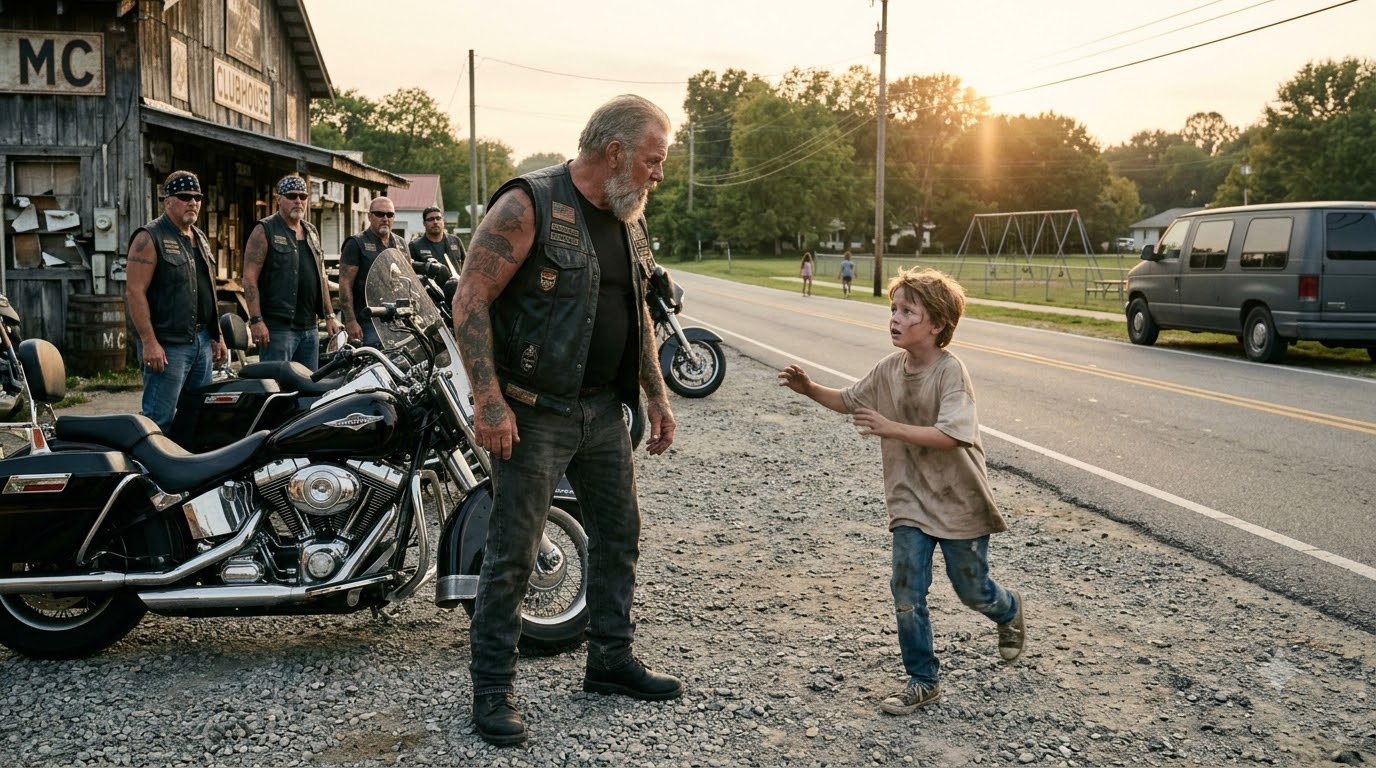
Across the street stood the Iron Grill, a diner with a rust-red awning and a row of motorcycles outside. A dozen riders occupied the patio, laughing over coffee and plates of eggs. Their leather vests and heavy boots made most pedestrians give them a wide berth. Leo had never spoken to them. He had heard stories about the motorcycle club, some frightening, some ridiculous, and he had no idea which to believe.
But the SUV was coming back.
Leo crossed at the signal and approached the largest rider, a broad-shouldered man with silver in his beard and a scar beside his eyebrow. The man’s name was Raymond Cole, though everyone called him Bear. He looked up as Leo stopped beside the table.
“You need something, kid?”
Leo swallowed. “That car is watching the kids.”
The laughter at the table stopped. Bear did not immediately stand. He turned his chair slightly, allowing himself a clear view of the park without drawing attention.
“Which car?”
“Black Suburban. Paper tag. It’s gone around five times. It slows near the little kids.”
A younger rider named Mason leaned forward. “You sure it isn’t somebody waiting for a family member?”
“Maybe,” Leo said. “But it doesn’t wait. It circles. And when Rosie went near the gate, somebody inside lifted a phone toward her.”
Bear studied the boy’s face. There was fear there, but not the excited fear of someone inventing a story. Leo was trying hard to be precise.
“All right,” Bear said. “Stay here where we can see you. Nobody’s chasing anybody. First we make sure those children are safe.”
He asked the diner owner, Nora, to call park security and the police. Then he sent Mason and another rider, Glenn, across the street on foot. Their instructions were simple: speak to the parents, keep the children away from the roadside entrance, and observe the SUV without confronting its occupants. Bear remained with Leo, watching the street.
“Why’d you come to us?” he asked.
Leo stared at the table. “Because you looked like people who wouldn’t pretend they didn’t hear me.”
Bear’s expression changed. For a moment he seemed older than his years. “That’s a fair reason,” he said.
On the playground, Mason approached a woman pushing a stroller. He showed her the dark vehicle passing the far corner and asked whether she knew who owned it. She shook her head. Glenn spoke to the father near the swings, who gathered his children and moved toward the center of the park. Other parents noticed and began doing the same.
The SUV appeared again, rolling past the gate. Its brake lights flashed when it reached the empty patch of sidewalk where Rosie had been playing. The passenger window lowered an inch, then rose. Bear saw it clearly.
“That isn’t right,” he murmured.
Nora came outside holding her phone. The police dispatcher had taken the description and said units were on their way. She had also reached the park’s afternoon supervisor, who was checking security cameras.










