“Who let this filthy cockroach in here while I’m teaching?”
Derek Lawson’s voice snapped across the practice room hard enough to stop forty students in the middle of their drills.
Jerome Adams stood near the edge of the mat with a mop in his hand. He did not look up at first. He kept moving the mop in slow, steady strokes, the way a man moves when he has spent years learning that silence is sometimes the cheapest way to survive.
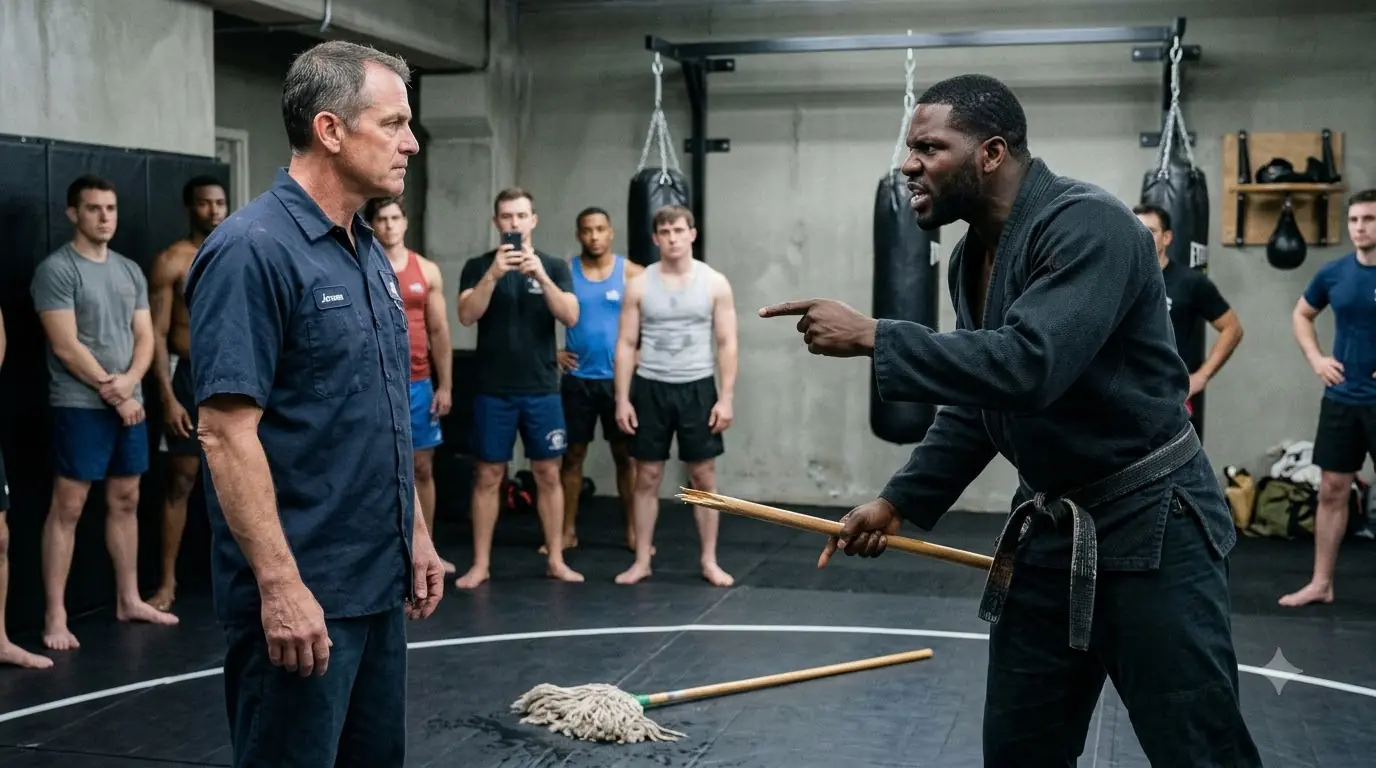
Derek glared at him from the center of the room, black belt tied tight around his waist, phone cameras pointed toward the mat, a crowd waiting for whatever cruel joke came next.
“Every time I see you,” Derek said, face twisting with disgust, “I want to vomit. You stink. Everything about you is disgusting.”
Jerome’s hands tightened around the mop handle for only a second.
Then they relaxed.
“Almost done, sir.”
That was all he said.
Almost done.
Two words spoken softly by a thirty-eight-year-old man who had once taught soldiers how to survive with nothing but their hands, their breath, and their discipline.
But no one in that room knew that.
To them, Jerome was only the janitor.
The quiet Black man in the gray uniform.
The one who came before sunrise, cleaned the mats, emptied the trash, refilled the paper towels, and disappeared before the expensive students arrived in their Range Rovers and BMWs.
The mop snagged on the edge of the carpet.
A splash of dirty water spilled onto the floor.
Derek stepped forward, trying to kick the mop aside. His foot landed on the wet patch, slid half an inch, and for one ugly second his body betrayed the image he had spent years building.
He stumbled.
Not badly.
Not enough to fall.
But enough.
Enough for forty students to see.
Enough for the room to go silent.
Enough for Derek Lawson, Houston’s loudest self-proclaimed undefeated fighter, to feel humiliation crawl up his neck like fire.
His face flushed red.
He snatched the mop from Jerome’s hands and slammed the handle across his own knee. The wood cracked with a sharp report that echoed off the walls.
“You just embarrassed me here in my practice room.”
Jerome looked at the broken mop.
Then at Derek.
Still silent.
Derek grabbed him by the collar and dragged him onto the mat.
“I’m going to teach you a lesson, you cockroach,” he hissed. “A real lesson.”
A gleaming black belt.
A raised phone.
A room full of witnesses.
Jerome Adams stood empty-handed in the middle of the mat while everyone waited for the janitor to be humiliated one more time.
No one there knew what was about to happen next.
What they also did not know was that Jerome had spent most of his adult life making sure moments like this did not happen unless there was no other choice.
His story had not begun with martial arts, or with uniforms, or with soldiers moving through dust under a hot sky. It had begun in a small apartment where fighting meant eviction notices, unpaid bills, and a father who believed the best way to protect a family was to stay out of other people’s way.
Jerome had been fourteen the first time he saw a grown man lose control in public.
It happened outside a corner store after school. Two men argued over a parking space. One shoved. The other swung. A bottle broke. People ran toward the fight instead of away from it because people often mistake danger for entertainment until blood appears.
Jerome remembered standing thirty feet away with a backpack strap in one hand, thinking how stupid the whole thing looked.
That was the word.
Stupid.
Not terrifying.
Not impressive.
Not masculine.
Stupid.
One man went to the hospital. The other went to jail. The parking space remained where it was.
His father heard about it that night and said something Jerome never forgot.
“Most men don’t lose fights because they’re weak. They lose because their pride gets there before their brain.”
Jerome had asked, “What if somebody puts their hands on you first?”
His father looked at him a long time.
“Then you do what you have to do. But don’t let another man decide what kind of person you become just because he’s angry.”
Years later, Jerome would hear instructors use more sophisticated language for the same principle. Escalation control. Threat discrimination. Emotional regulation under stress. Tactical patience.
His father had simply called it keeping your head.
Jerome joined the military at nineteen.
Not because he dreamed of combat. Not because he had posters on the wall. Not because he wanted to prove anything.
He joined because college felt financially impossible, because steady pay mattered, and because discipline had always made more sense to him than chaos.










