“You shouldn’t have touched me.” Two seconds. That was all it took. One moment, a football player was laughing and shoving a quiet freshman on a dark campus walkway. The next, he was down on one knee, his arm locked behind his back and his shoulder half an inch from breaking.
She released him and stepped back. Her hands were shaking, but not because she was afraid of him. They shook because she had almost failed to stop herself. Nobody at Ashcom University knew who Vera Bennett really was. They saw a slender, quiet transfer student, someone easy to overlook and easy to humiliate in a crowded dining hall.
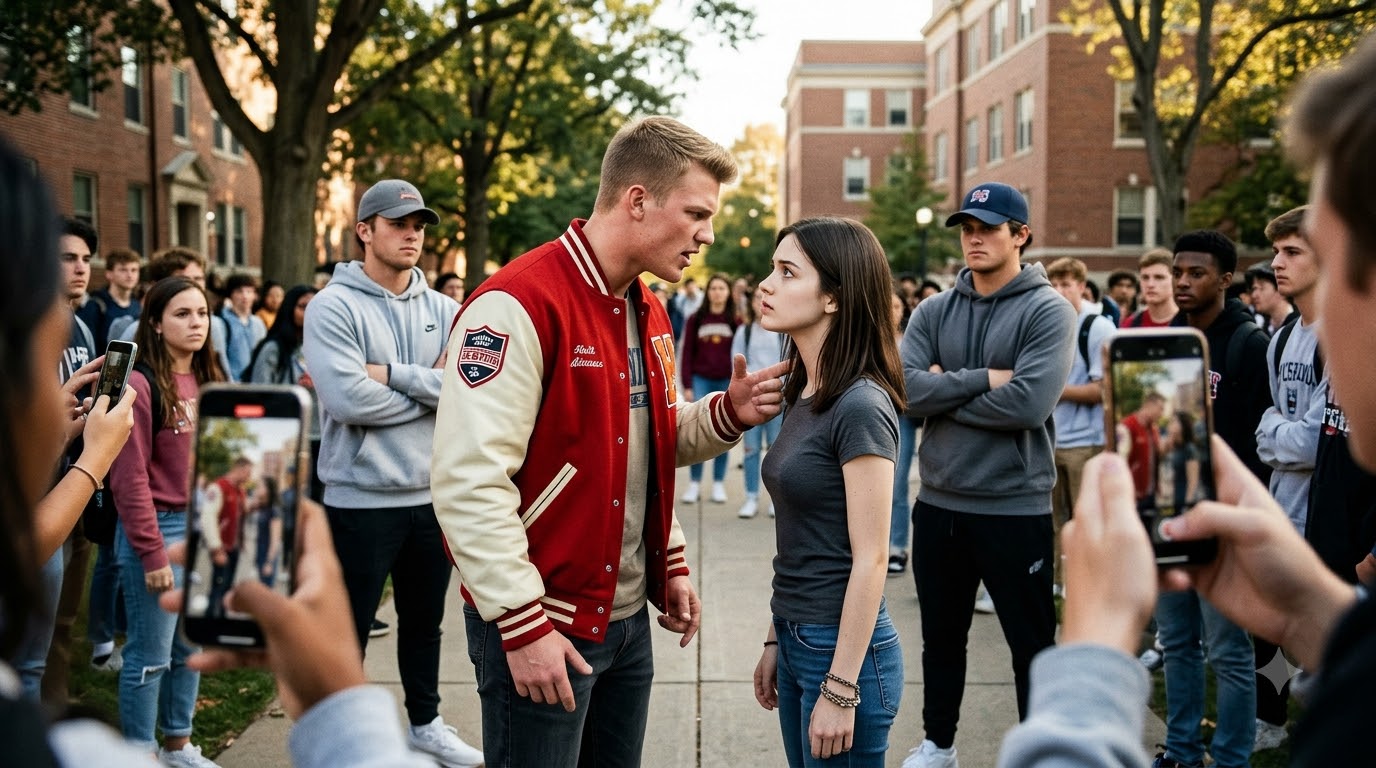
While two hundred people laughed, nobody asked why she remained so calm. They never wondered what a girl like her might be hiding, or who had taught her to keep it hidden. They were about to find out. Every last one of them. Ashcom was the kind of town where almost nothing happened.
Each fall, the leaves along Main Street turned golden. Each fall, the university welcomed another class of eighteen-year-olds. Most of them believed they already understood the world. Most of them were wrong. This is the story of one of those students.
Her name was Vera Bennett. By the time this story was over, half the town would know that name. But on the day she arrived, nobody knew anything about her. They saw only a quiet, slender girl who was easy to overlook. That was exactly what she wanted.
Ashcom was not a large university, with fewer than six thousand students in a valley surrounded by rolling hills. It was the sort of town where a diner owner remembered your usual coffee order after your second visit. Its town square held a war memorial bearing names that stretched back four generations. Every October, the whole town came together for a parade. Children waved little flags at elderly men in uniform caps, who passed slowly in the beds of pickup trucks.
The university held its own version of that tradition every fall. It was an evening called Veterans and Benefactors Appreciation Night, when the town’s oldest veterans sat onstage and the community spent one night remembering what service truly meant. Vera had seen a flyer near the registrar’s office during her first week. She glanced at it and thought nothing more of it. She could not have known how much that ordinary evening would eventually matter.
People here still believed in certain things: holding doors for strangers, standing when the flag passed, and looking someone in the eye while shaking hands. Vera did not know it yet, but the town was about to test all those beliefs. Some would prove enduring, while others had quietly weakened over the years. Her father drove her to campus in an old gray pickup truck. He did not say much on the way.
He never did. His name was Grady Bennett, and silence often conveyed more for him than a long speech did for most people. Before that morning, neither of them had ever set foot on the campus. Grady had accepted a teaching position at Ashcom only that summer, later than most new hires. After years of unsuccessful applications, Vera had independently chosen the school for herself.
Months earlier, late one night, she had completed her application without telling him. The scholarship offer looked good, and the campus appeared peaceful in the photographs. Neither realized until their acceptance letters arrived in the same week that they would be starting over in the same place at the same time. Grady called it a strange kind of luck. Vera was not sure what to call it.
When they stopped outside her dormitory, he turned off the engine and sat for a moment. “ Do you remember what I taught you?” he asked. It was not really a question. “I remember,” Vera said. “
Say it back to me.” She looked out at students unloading boxes, lamps, and mini-refrigerators. Ordinary things, an ordinary life. “ Discipline over anger,” she said quietly. Grady nodded once.
That was enough for him. He helped carry her two boxes up to the third floor, shook her new roommate’s father’s hand as though closing a business deal, and left before Vera had time to grow emotional. That was his way, too: quick goodbyes and no fuss. “ Call me tonight,” he said at the door. “I don’t care how late it is.”
Then he paused with one hand on the doorframe. “ And Vera, a new town and a new school don’t mean you have to become someone different from who you are.” She did not yet fully understand what he meant. She soon would. Her roommate was already halfway through unpacking.
She was a curly-haired brunette with a shy but friendly appearance and enough positive energy to fill the entire room. “ I’m Brin,” she said, offering her hand. “ Brin Sorenson. Sorry, I’ve already taken the bed by the window.” “I can switch if you’d like.” “










