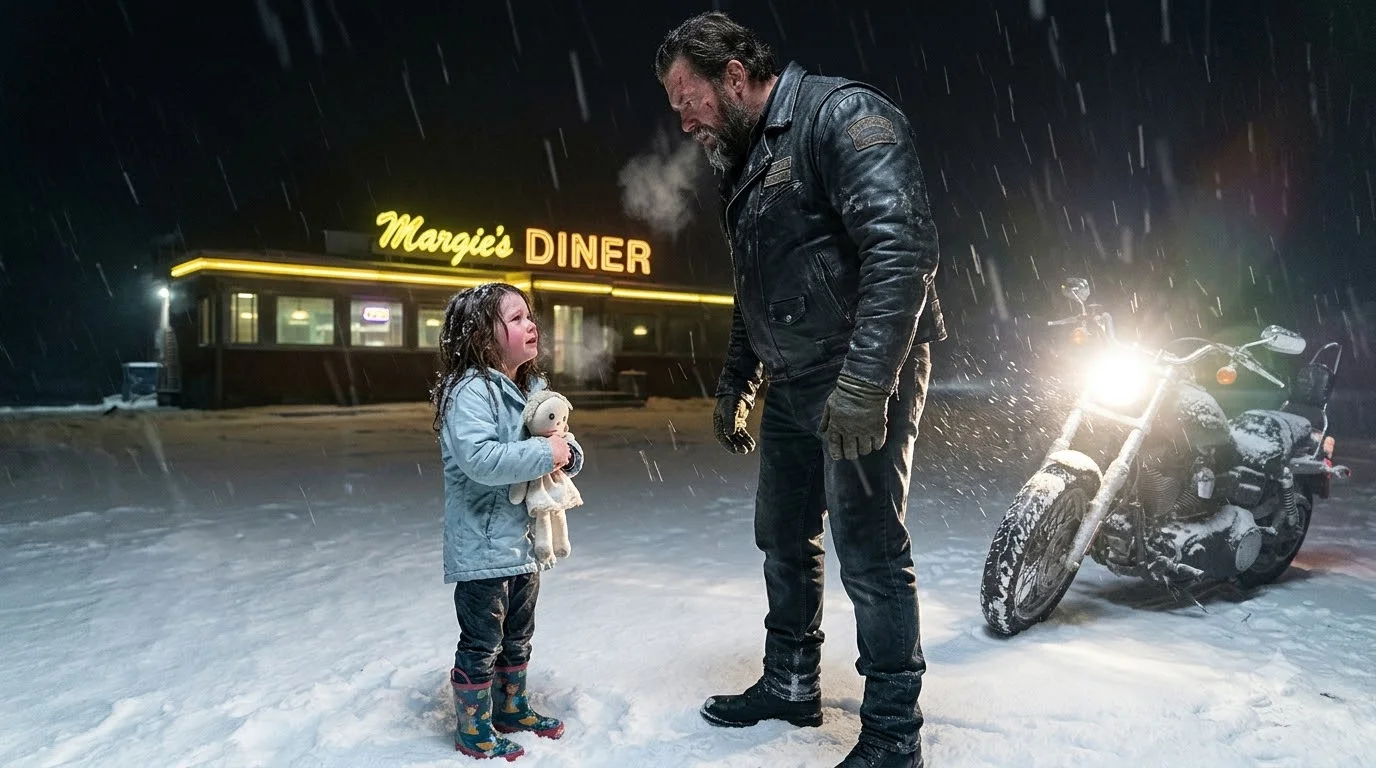
The six-year-old girl sat alone in the snowstorm at eleven o’clock at night, and she hadn’t cried once. That was what Cole Ryder couldn’t stop thinking about. It wasn’t the cold or the fact that not a single car had stopped for her. She must have been sitting there for an hour, holding an old rag doll against her chest as though it were the last warm thing left in the world.
It was the silence that haunted him, the terrible, absolute silence of a child who had learned that crying accomplished nothing. He almost missed her entirely. That was the version of the night that still frightened him: the one in which he rode past without looking back, the blizzard swallowed her, and he never even learned her name. But fate had a way of making the wrong people do the right things, and Cole Ryder had run out of road long before that night. The storm had been building slowly since noon.
Cole had felt it first in his left shoulder, in an old break that had never fully healed and always tightened when the atmospheric pressure dropped quickly. He had been riding since seven that morning, pushing his Softail beneath a flat, gray December sky. By midafternoon the temperature had fallen eleven degrees in two hours, by six the snow was blowing sideways, and by nine he should have stopped. At ten thirty, he was still riding because stopping meant sitting still, and sitting still meant thinking. For nearly four years, Cole Ryder had been trying to outrun the things that lived inside his head when he stayed in one place too long.
The highway through Garrett County in the middle of December was less a road than a suggestion, two lanes of cracked pavement winding through empty hills. You could go forty miles without seeing a building that still had a roof, and Cole knew that stretch intimately. He had ridden it a hundred times over the years because he came into these mountains to disappear, back when they seemed like the farthest possible distance from everything he had lost. The county had three towns, if you were generous enough to call them towns, and between them lay pine forests, frozen creek beds, and the occasional dark farmhouse at the end of a long gravel drive. He turned onto Route Nine just beyond the county line and leaned into the wind.
The Softail’s engine cut through the howling weather with a familiar low pulse, the closest thing to a constant that Cole still possessed. Snow had begun to gather on the road, perhaps three inches, and the yellow centerline had disappeared completely. His headlight threw a white cone into the darkness ahead. His jaw ached from clenching his teeth, and his fingers inside their thick gloves had passed beyond cold into a numbness that made his hands seem to belong to someone else. Then the diner appeared through the blizzard like a bruise against the landscape.
It was low and yellow, with a sign reading “Margie’s” flickering in the wind, one of its letters dark. Cole had not intended to stop; the Softail had another forty miles in it, and his body could endure punishment longer than most men’s twice his size. But his left shoulder was on fire, the road was deteriorating, and some instinct in the back of his mind made the decision before his conscious thoughts caught up. He downshifted, eased off the highway, pulled onto the gravel in front of Margie’s, and killed the engine. The silence afterward seemed immense.
That was when he heard it—or, more accurately, when he noticed what he wasn’t hearing, and that something about the stillness was wrong. He stood beside the motorcycle, removed his helmet, and felt the wind strike his face. Beneath the wind, the rattling diner sign, and the soft hiss of snow settling on gravel, there was a tiny absence of movement, almost no sound at all, as though something alive were trying desperately not to be noticed. Cole turned. A girl was sitting on the concrete steps along the side of the diner, perhaps twenty feet from where he had parked.
She had squeezed into the narrow space between the wall and a rusted propane tank, which gave her perhaps six inches of shelter from the wind. It wasn’t much, but it was something. She wore a thin, pale-blue winter coat, the kind designed more for appearance than warmth, and rubber boots decorated with cartoon animals, entirely unsuitable for that temperature. An old white rag doll lay across her lap, its button eyes staring ahead with the same fixed emptiness as the child’s own eyes. She watched Cole without making a sound or flinching, wearing an expression he found more frightening than anything he had seen in years.










