The woman in the red suit pointed past my shoulder as though she could order the walls of my house to move. Two police officers stood on my weathered front porch, one of them reading a document that the young woman beside my doorway had just handed him. Beyond the railing, another patrol vehicle rolled across the gravel, its red and blue lights moving silently over the unfinished wooden frame rising in the neighboring field. I lifted one hand, palm open, and asked everyone to stop talking at once. The older woman’s expression sharpened as though the request itself were an insult.
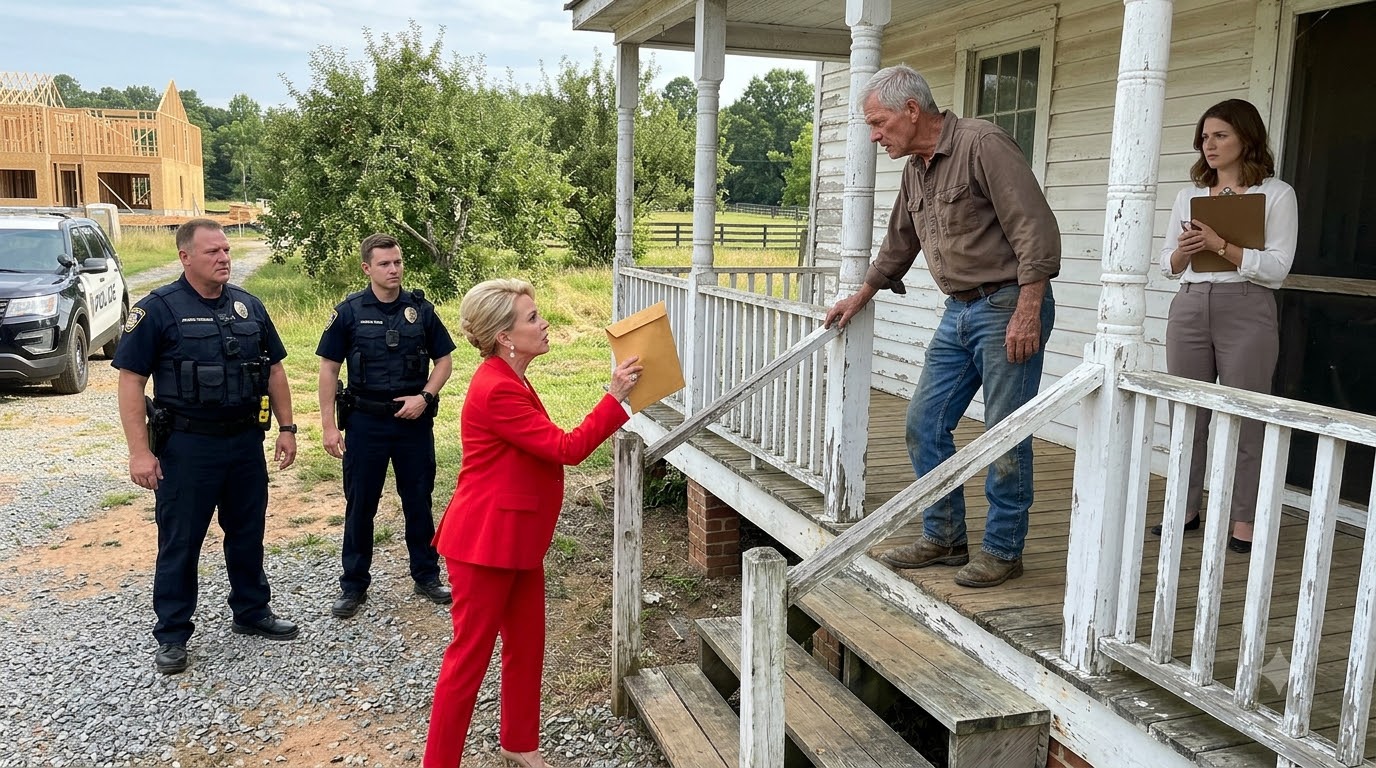
“You need to leave this property,” she told me, looking directly into the camera clipped to my shirt. “I have the paperwork, and these officers are here to enforce it.” Her bright red jacket was pressed so perfectly that it looked absurd against the porch’s peeling white paint. She held a brown envelope under one arm and pointed with the other hand toward the skeletal building behind her. I had lived long enough in Bellwether County, North Carolina, to recognize a person who believed that expensive clothing could replace a legal argument.
“Ma’am,” the younger officer said, “we’re still reviewing what you’ve brought us.” His nameplate read Daniel Price, and the second officer behind him was Sergeant Aaron Whitcomb. Price’s voice was careful, not frightened, but the woman pivoted on him as if she were correcting a waiter. “You were told this was an unlawful occupation,” she snapped. “Why are you discussing it with him when you should be removing him?” Beside the doorway, the young woman with the clipboard lowered her eyes to the documents she had spent the previous night organizing.
I knew that clipboard might be the only reason I still had a home by sunset. Its owner, twenty-nine-year-old Claire Bennett, had once been the quietest girl in my wife’s Sunday school class. Now she was a licensed surveyor and a lawyer’s daughter, and she had driven forty minutes to stand on my porch because she believed there was a line a neighborhood committee could not cross. She glanced up and met my eyes with an expression that meant exactly what we had agreed upon. Let them read it, and do not give anyone an excuse to say you interfered.
The woman in red was Vivian Mercer, sixty-one years old, newly elected president of the Willow Creek Estates Property Association. The association had never governed my parcel, and that was the problem she had decided to solve by pretending otherwise. For three months she had sent letters, contractors, men carrying measuring tapes, and eventually threats to my mailbox. That morning she had brought the police. What she did not know was that Claire had already sent a second copy of our documents to the county land records office and a third to an attorney who was standing by for a call.
My name is Thomas Hale, and at the time I was sixty-seven years old. I had been born in the house whose front steps Vivian was standing on, and my father had repaired its foundation with his own hands after the flood of 1978. There were days when the building seemed to be made of stubbornness more than lumber, with boards creaking under the weight of every family story I could remember. A person looking at the house from the road might have seen an aging farmhouse with an overgrown hedge and a porch that needed paint. I saw the place where I learned to walk, where my children measured their height against the kitchen doorframe, and where my wife, Evelyn, had spent her last spring watching cardinals from the sitting room window.
The Hale property consisted of nineteen acres on the old county road, a small orchard, a pasture, and a narrow wooded strip leading to Miller Creek. My grandfather had bought the acreage in 1946, long before anyone thought to give the area a name impressive enough to print on a stone monument. When the interstate arrived, the nearby town began spreading eastward, first with gas stations and then with subdivisions and gated communities. The fields surrounding our place slowly vanished beneath clean rectangles of grass and identical houses. My property remained, less because I distrusted progress than because I had never found a reason to sell the land where my family was buried.
Evelyn and I had raised two children there, both grown and living elsewhere. Our daughter Hannah taught music in Richmond, and our son Peter repaired electrical systems for a hospital in Raleigh. They called every Sunday and visited whenever schedules allowed, bringing grandchildren who loved the creek and the old tire swing even when their parents worried about mosquitoes. After Evelyn died, they worried about me living alone. I told them the house was the one place where being alone did not always feel like loneliness.










