The first thing Naomi Bell noticed was the sound of a pearl striking glass. It was a small, delicate sound, almost too soft to hear above the muted music drifting through the luxury boutique, but it brought every conversation near the display counter to an abrupt stop. Across from her, the blonde sales director in the white blazer held a black velvet tray with both hands, her practiced smile fixed so tightly that Naomi could see the effort beneath it. Beside Naomi, her friend Claire Voss slowly lowered the hand that had been resting on the clasp of a quilted gold handbag, and both women understood that their quiet afternoon was about to become something far more complicated.
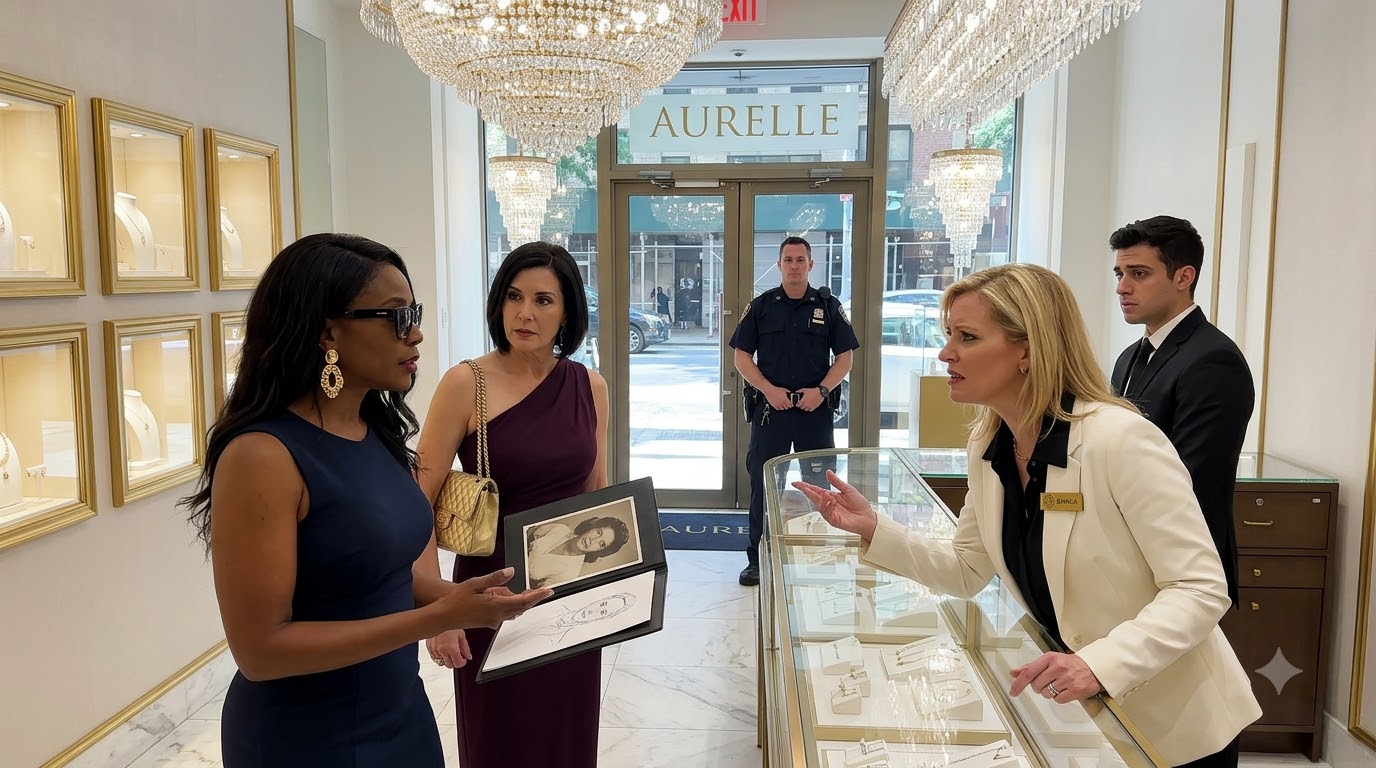
“Put that case on the counter,” the sales director said, and there was a new sharpness beneath the courtesy of her tone. Naomi stared at the woman for a moment, not because she had failed to hear her, but because she was deciding whether the instruction had actually been addressed to a paying customer. The store was called Aurelle, a jewelry house occupying the ground floor of an elegant limestone building on Manhattan’s East Side, where tall windows reflected polished automobiles and the doorman treated the arrival of every customer like the opening of a private performance. It was a place that sold the idea of dignity almost as carefully as it sold diamonds, and yet there was remarkably little dignity in the way the director had just spoken.
“My case is already on the counter,” Naomi replied, indicating the closed black folder beside her wrist. “If you are referring to the little velvet envelope your associate brought out, I watched him put it back in the drawer.” The director’s eyes moved toward the drawer, then toward the exit, and for a brief instant Naomi could see calculation displacing irritation. Claire straightened beside her, the deep plum fabric of her dress catching the bright light from a chandelier, and said that perhaps someone should explain what was missing before anyone began issuing orders.
The director wore a pale ivory blazer over a black collared blouse, and a discreet gold name badge identified her as Bianca Mercer, senior client director. A thin necklace rested at her throat, and her smooth blond hair was carefully arranged in a style that looked effortless only because considerable work had gone into it. She had spent twelve years in luxury retail, learning when to flatter a customer, when to withdraw, and how to express suspicion without ever choosing a word that might appear in a legal complaint. Yet the presence of Naomi and Claire seemed to have made her forget the fundamental lesson that had kept her employed for so long: if you accused someone of taking property, you had better know exactly what was gone.
Naomi had entered the boutique twenty-seven minutes earlier wearing a dark sleeveless dress, enormous gold earrings, dark sunglasses, and the quiet confidence of a woman who was accustomed to being watched. Her hair fell over one shoulder, and she carried herself with the composure she had cultivated through years of presenting difficult ideas to rooms filled with powerful strangers. Claire, shorter and older by six years, wore a plum one-shoulder dress and a sleek dark bob, and had spent the entire visit asking intelligent questions about design and provenance rather than prices. They had not come to Aurelle to be admired, but neither of them expected to be treated like an inconvenience.
Outside, a deep blue convertible had stopped at the curb, and traffic slid past the boutique beneath the warm afternoon sun. Inside, mirrors and gilt frames multiplied every face and every movement, turning ordinary gestures into public spectacle. Naomi looked again at the black folder, at the string of pearls laid beside it, and at Bianca’s rigid fingers. She could not yet know that the next twenty minutes would end with a police officer standing between her and the shop entrance, nor that the encounter would expose a secret far larger than a single missing necklace.
Three days earlier, Naomi had been alone in her workshop in Brooklyn when a courier delivered a narrow parcel wrapped in plain brown paper. The parcel had been mailed by an elderly lawyer in Philadelphia who was retiring and sorting through the last files of his firm’s founding partners. Inside was a photograph of Naomi’s mother, Lillian Bell, standing beside a workbench in 1987, with a half-finished necklace draped over her hands. A note attached to the photograph explained that the original piece, known privately as the Harbor Light Necklace, had been sold through Aurelle during a period when the business still commissioned independent jewelers to design exclusive work.
Naomi knew the necklace by a different name. When she was a child, her mother called it the Morning Tide, because the pale stones seemed to brighten whenever the sun entered their apartment through the kitchen window. Lillian was a metalworker and jewelry designer who had spent decades making beautiful things that often carried somebody else’s name by the time they reached a wealthy customer. Naomi remembered evenings when her mother returned from long shifts exhausted but still willing to place unfinished designs on the table and explain why a curve had to be patient, why a setting needed restraint, and why the most expensive material did not always make the finest object.










