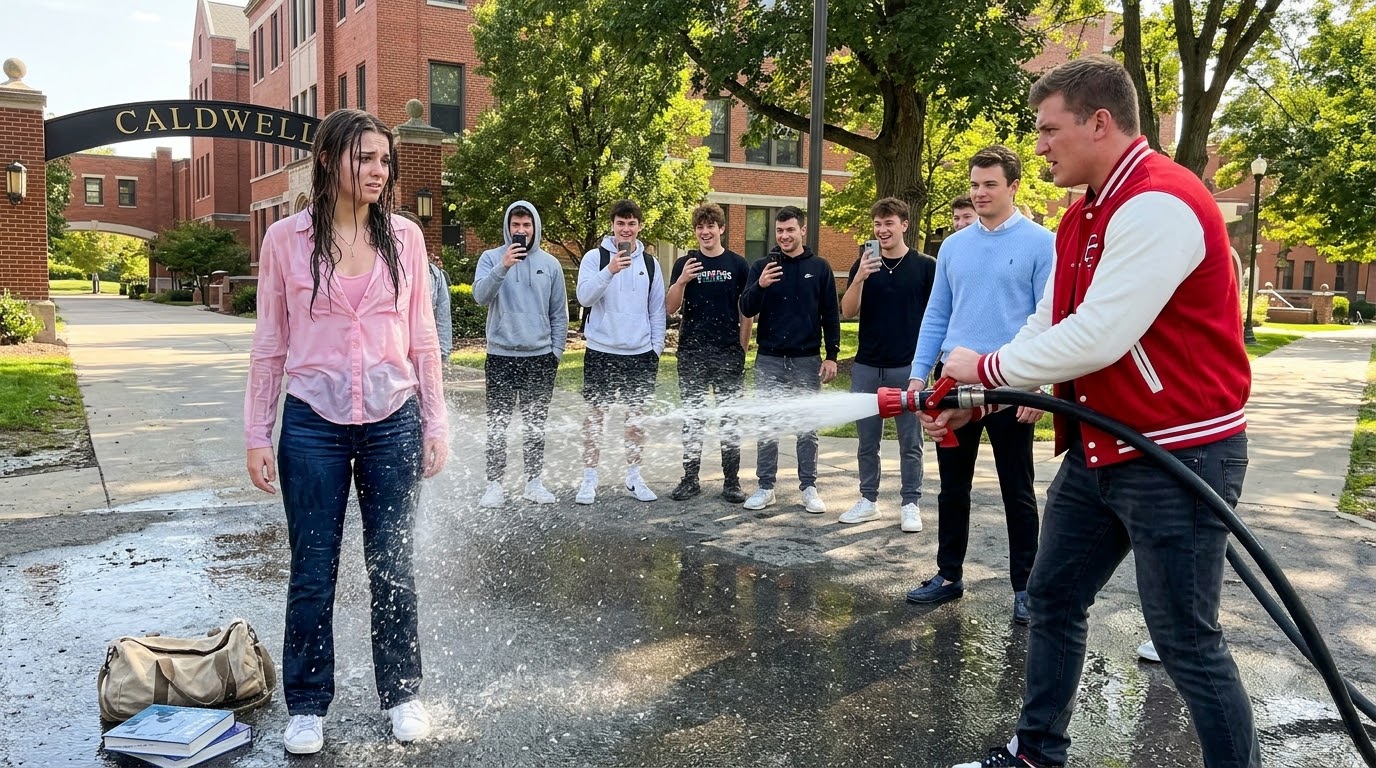
“Walk away,” Mr. Ford said. Trent stared at him. There were thirty people in that hallway, and every one of them fell silent. Trent swung his arm in one hard, decisive motion, aiming directly for Reagan’s shoulder, but Reagan was no longer there. No noise, no stumble, no visible reaction.
She had simply moved completely out of the place he was striking. In less than two seconds, Trent was left standing with his arm raised in empty air, his face flushing red before thirty witnesses who had seen everything. This was not the first time Shane Whitfield had done something like this, and it was not the first time someone had quietly disappeared from this college without an explanation. The last student had transferred in October. But Reagan Holloway had not come from a place where people gave up halfway through.
She had stepped off a Greyhound bus carrying a worn duffel bag and eleven years of unrecognized five-in-the-morning discipline. And for three straight weeks she had been quietly building something. There is a particular kind of stillness that is difficult to describe. It is not the silence of someone with nothing to say. It is the calm of a person who learned the hard way that most things do not need to be spoken aloud.
Perhaps you have met someone like that once or twice in your life. Someone who walks into a room without announcing themselves, who does not seek anyone’s approval and does not check who is watching. They simply arrive, and their behavior tells you that they have been through something. They have earned the peace they have found within themselves. Reagan Holloway was eighteen when she first arrived on the Caldwell College campus.
She came by Greyhound from Harlan County on the West Virginia border, an eleven-hour journey with two transfers and a paper bag holding a sandwich her father had made at four that morning. She had no car, no one to drive her to campus, no phone case covered in stickers, no brand-new Target backpack, and no mother waiting at the curb to take photographs. All she carried was a faded olive-green canvas duffel. Tied to its handle with a length of parachute cord were a pair of old taekwondo training gloves. The padding over the knuckles of the left glove was torn; the Velcro on the right wrist strap had been sewn so many times that the thread no longer matched.
Black dye had faded to dull gray around the fingers. They looked like something a person might find at a yard sale and sell for fifty cents without regret. Reagan had worn those gloves for eleven years. She stepped off the bus at 6:42 a.m. The campus lay quiet under a low mist, with a few lights glowing inside the administration building. A maintenance worker stood nearby drinking coffee, holding a leaf blower he had not yet started.
Reagan stopped at the edge of the parking lot. She did not open a campus map or check her phone. Instead, she studied the place carefully, not merely looking but reading it: the arrangement of buildings, lines of sight, where the light fell and where it did not, informal paths worn through the grass, and official walkways that nobody actually used. The maintenance worker noticed her and gave a small nod. She nodded back, lifted her bag and walked toward the dormitories.
To understand Reagan, you need to know where she came from. Harlan County, Kentucky, near the West Virginia border, is part of a beautiful region. Do not let anyone tell you otherwise. Those mountains have a grandeur that is difficult to find elsewhere. Trees stretch across the hills, and in the mornings the rivers run cold and clear.
Yet it is also a place forgotten by many people who should have remembered it. The coal industry had been declining since before Reagan was born. Her father, Dennis Holloway, worked in the mines for nineteen years. It was hard, honest work, the kind a man could take pride in even on his worst days. Then came the accident.
Reagan was eleven. Dennis came home with two broken ribs, a compressed vertebra and a left hand that would never close completely again. He was out of work for eight months. The company restructured, and afterward the mine shut down. He searched for other work: odd jobs, repairs, driving for a while until his back prevented even that.
He never complained. That is the important thing about Dennis Holloway. In all the years Reagan could remember, he had never sat down at the kitchen table to announce that life was unfair. He simply kept moving forward and raised his daughter to do the same. Reagan’s mother died of breast cancer when Reagan was nine.










