The glass went first. Not the entire window, just a small section of it. A hard kick went through the lower pane of the front door of the SEAL Cafe, and the sound echoed across the dining room like something had broken loose from another world. Jack Reyes did not turn around immediately. He finished pouring the coffee, watched the last dark drops collect and steam in the cup, and only then raised his head.
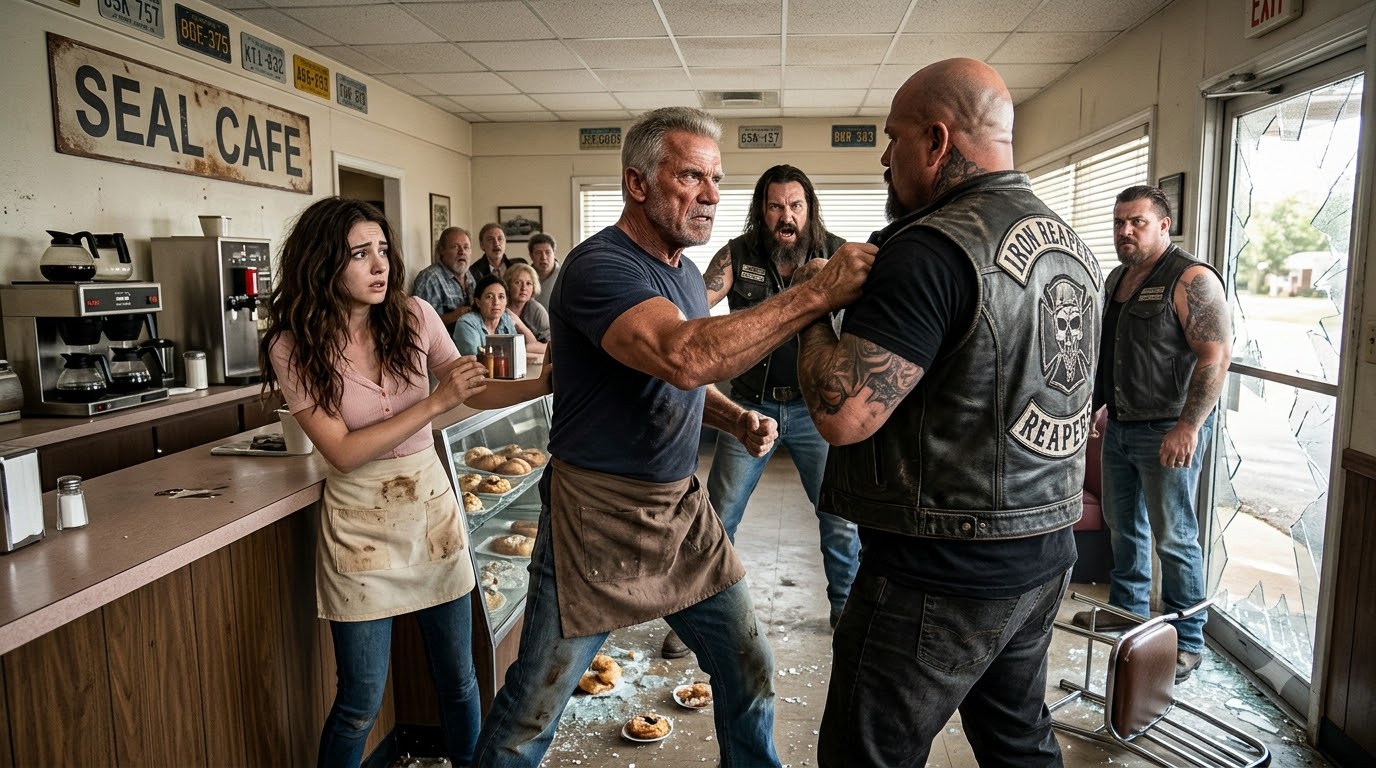
Three men stood there in leather vests with patches on their backs. Nobody in Milfield had ever wanted to look closely enough to read those patches. The man in front kicked over a chair as he passed, simply to hear it fall. ” Good morning,” Jack said, quietly and without concern. It was the way a man spoke when he already knew exactly what the next sixty seconds might bring and had decided, for the moment, to let them unfold.
The biggest of the three, bald, with exceptionally long arms and the look of someone made for dramatic entrances, did not answer him. Instead, he brought his forearm down on the pastry display case and sent it crashing across the tile. Behind the counter, a framed photograph shifted on the wall. It showed a younger man in uniform, with sharper eyes and a slight smile for a camera somewhere far away from Milfield. Then the second man grabbed Maddie.
She had been carrying a tray toward table six when he seized her wrist so hard that the tray tilted and the plates fell. In half a second, the entire cafe became utterly quiet: the six customers, the elderly man reading a newspaper by the window, and the mother with a stroller near the entrance. ” Let her go,” Jack said. He did not raise his voice, and that was what everyone in the room would talk about afterward. How could a man watch another man grab his daughter and not even shout?
Jack set the coffee pot on the counter, slowly and carefully, the way somebody puts something down when he needs his hands free for another purpose. The man holding Maddie laughed. ” Or what, old man?” Jack looked at him as though he had just said something rather sad. There was no anger in his expression, no fear either, but something closer to disappointment.
That look would trouble the man for a long time, although he would not understand why until much later. ” You really don’t want to find out,” Jack said. The bald man, apparently the leader of the three, grinned and climbed onto the checkout counter as though he owned it. His boots rested on the wooden surface Jack had refinished with his own hands two summers earlier. He looked at the flag on the wall, the framed unit photograph, and the little brass plaque beside the register that read, “The Only Easy Day Was Yesterday.”
Something about the arrangement—the flag, the plaque, the quiet old man wearing an apron—seemed funny to him. ” Navy SEAL Cafe,” he read from the lettering on the window, mocking it. ” Is this your whole life? Coffee and flags?” He looked beyond Jack toward the kitchen and the framed photographs running along the back wall.
Twelve young faces in uniform looked out from those photographs. Some of them, as Jack’s regular customers knew, had never come home. Perhaps even heroes had to retire someday. Perhaps even a hero eventually became nobody in particular. Maddie tried to pull herself free, and the man holding her jerked her backward so sharply that her shoulder struck the corner of the counter.
That was the moment when the old man behind the counter and Jack Reyes ceased to be quite the same person. He came around the counter without appearing to hurry, which was somehow worse than if he had run. Three customers would later insist that he crossed fifteen feet in less than two seconds. None of them could explain the mathematics of that claim. Jack said nothing more.
He had already delivered the only warning he intended to give, and the man who had laughed at it was about to learn the cost of that mistake. But the story did not end there; it had only begun. Forty minutes earlier, in a garage roughly two miles off Route 9, the man who sent those three had given them instructions. ” Don’t hurt anybody. Just make sure the old man understands who runs this street now.”
None of them thought twice about those words. Their boss had not asked who the old man used to be, and none of them had thought to ask either. Behind the register was a plaque and an entire wall of photographs that nobody in the motorcycle club had studied carefully. A folded flag had stood in its glass case in the back office for so long that the cafe’s regulars barely noticed it anymore. That happens to things you pass every day: eventually you stop seeing them.










