It was 9:02 a.m. this Tuesday morning, and the little black boy in his second-hand blazer raised his hand. Excuse me, sir. I think there’s a mistake. This is not the same exam as the others. Harold Whittaker turned around slowly.
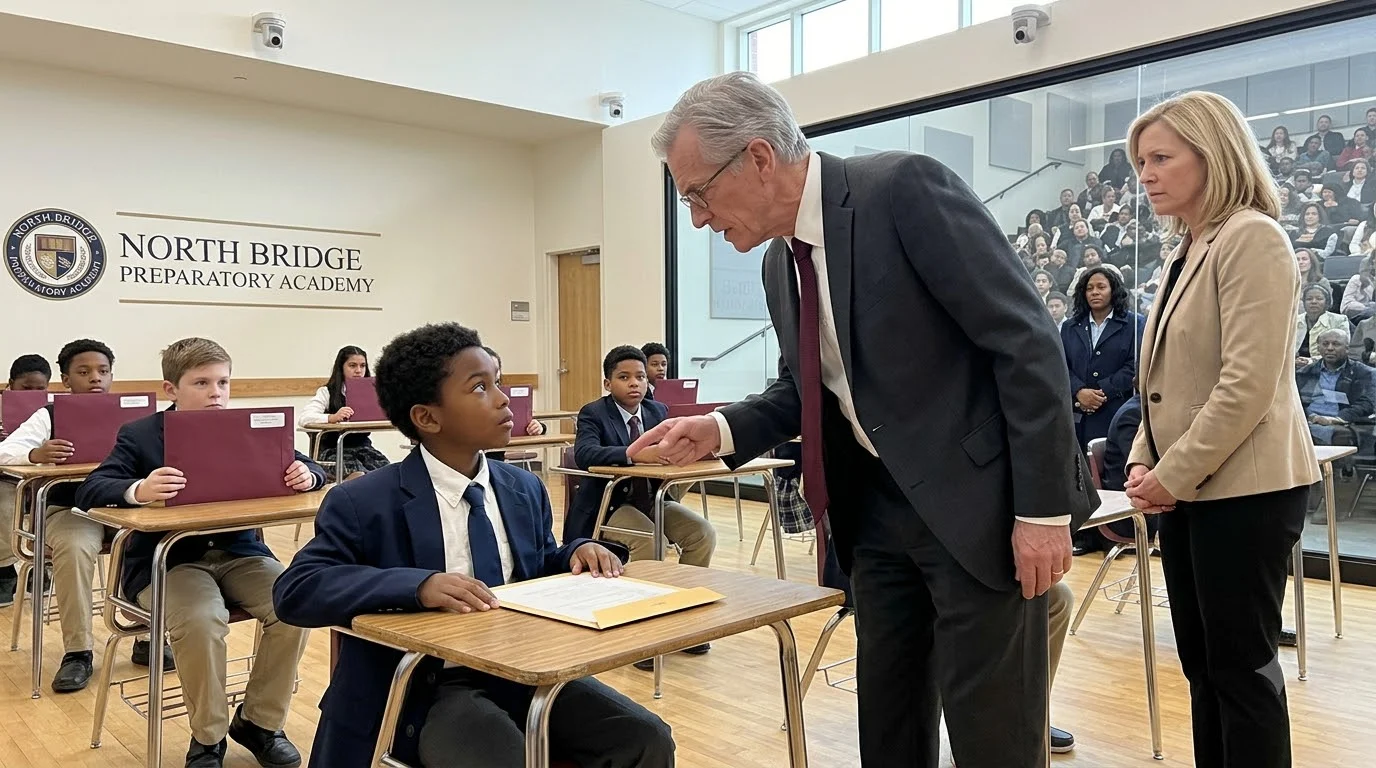
He stared at the 10-year-old child as if it were dirt under his shoe. Oh, my little one. A black kid from the projects correcting me? Adorable. He raised his voice across the examination room.
Look at it, Sandra. Mother, bus driver, council flat, second-hand suit. Black kids like him don’t belong in venues like this. They do not receive scholarships. They gain pity.
Sit down before you embarrass your mother. He patted the child’s head twice as if it were a stray dog. Do your best, kid. Try not to cry. Sandra looked away.
A 10-year-old black child sat alone, humiliated, and no one stood up for him. But none of them imagined what this quiet little boy would accomplish in the next 15 minutes. To understand what happened, you have to understand the room. And to understand the room, you have to understand the boy. His name was Wesley Caldwell, 10 years old, in CM2, the youngest of the five finalists for the Ashford Young Scholars program, the most prestigious mathematics scholarship in New England.
The winner received personalized mentorship with an MIT professor for eight years, a $200,000 scholarship, and their name engraved on a brass plaque in the marble hall of North Bridge Preparatory Academy. In the 28 years since the prize was awarded, no black child had ever won. Wesley had arrived that morning holding his mother’s hand. His mother, Vivian, drove a municipal bus during the night shift. She had swapped her Tuesday shift with a colleague just to be there.
She was wearing a navy blue coat over her uniform, her badge still attached to her collar because she hadn’t had time to take it off. In his tote bag was a small plastic box containing cornbread. She had prepared it at 4:00 in the morning. ” For later,” she had said. When you get hungry.
She kissed the top of his head at the auditorium door and said one thing to him, and only one thing. I’m proud of you. Before you go in there. After you come out of there. Nothing will change that.
Then she let him go. The auditorium had two parts. There was the small examination room where the five children sat at five small desks, supervised by Whittaker and the assistant headmistress, Sandra. And there was the large public hall outside, where 300 people were gathered for the live final. Parents, teachers, five observers from MIT, the Boston Globe education journalist at the back of the room with his notebook open, Ms. Eleanor Hollings, chair of the board of directors of the Ashford Foundation, donors in tuxedos at 9:00 a.m. The exam was to be projected onto a giant screen in the public hall, live, page by page, so that the public could follow each child’s work in real time.
That was the rule. Total transparency. The live broadcast was to begin as soon as the first pencil touched the first page. After the 90-minute written test, the jury would announce the winner from the stage, but the live broadcast had not yet started. There was a 5-minute window between the time Whitaker distributed the envelopes and the time the cameras were activated.
5 minutes that no one outside the examination room could see. Whitaker had used those 5 minutes carefully. You should also know about Whitaker. 62 years old, head of the mathematics department, co-author of a famous 1998 paper on tensor analysis with Professor Lang of Yale, cited 1200 times, respected, tenured, generous with letters of recommendation, but only for certain students. Six months earlier, after Wesley achieved a perfect 100 on a mid-term exam, Whitaker had taken him to the headmaster’s office and demanded a supervised review, claiming the work was too neat for a black kid from Roxbury.
Wesley retook the exam alone in a glass-enclosed room under the supervision of three teachers. He achieved another perfect 100. Whitaker did not apologize. He smiled and said: well, I’m glad we’ve cleared that up. He never wrote a letter of recommendation for Wesley.
His schedule was full. That same week, he wrote three letters to white students in the same class. Wesley had qualified for the Ashford final solely on the basis of his objective test results. No letter was required. Whitaker couldn’t stop him.
So, Whitaker chose a different path. Two nights earlier, at 11:34 p.m., in the empty teachers’ preparation room, Whitaker had told Sandra exactly what he intended to do. He thought nobody was listening. The school’s old security audio system had been recording continuously for two years. No one remembered that it was switched on.










