“Turn around. Hands behind your back.” She did not argue or raise her voice. She simply brought her wrists together as a small-town police officer handcuffed a woman he had already decided was nobody.
Then she spoke, quietly and almost gently. “You still have a chance to slow down here.” He did not answer. He tossed her envelope into his trunk without reading it.
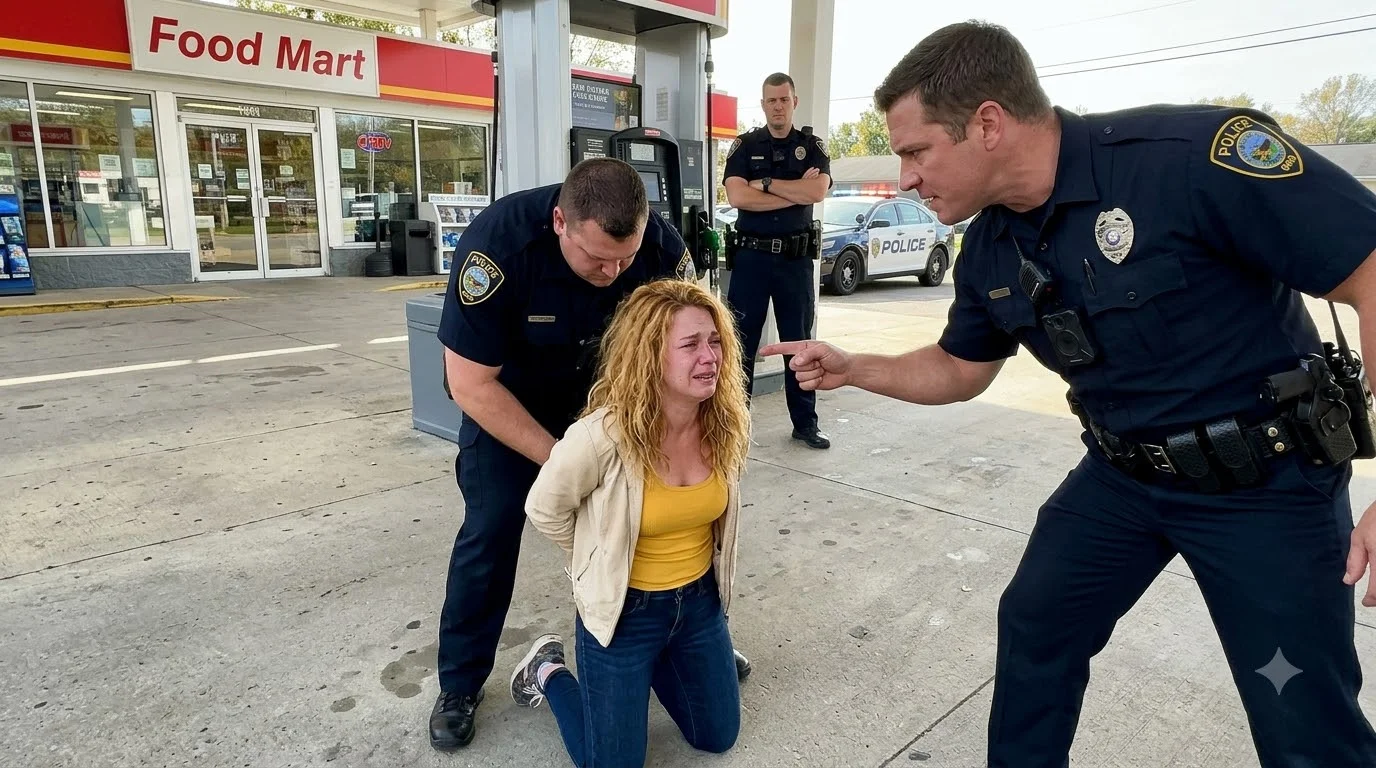
The envelope bore the mayor’s signature, along with her name and official title: Chief of Police. Officer Cole Bragg had just arrested the woman who would be running his entire department by noon. Eleven years on the force, a family name that opened every door in town, and a locked drawer he believed would never be opened would not save him from what was coming. Someone was watching through the gas station window.
Someone had already begun taking notes. By the following day, the entire town would learn exactly what quiet courage looked like when it finally stood up for itself. This happened in a small town called Milbrook, a place most maps hardly bothered to mark. Even if you found it, you would probably drive past without noticing.
Places like Milbrook exist across America: quiet towns with slow mornings where neighbors still wave at strangers. This is the story of a woman nobody knew and a police officer who believed he knew everything about her before she had spoken a word. One morning changed the town in ways no one standing at that gas station could have imagined. Milbrook lay in a valley between two low hills in Ohio farm country. It had one main street, one traffic light, a hardware store operating since 1961, and a diner called the Wagon Wheel where coffee never cost more than a dollar fifty.
The people of Milbrook liked to say that nothing ever happened there. They said it with pride, not disappointment. For most of them, it was true: their days moved slowly and steadily, like the stream behind the old mill. Yet every town, however quiet, carries an unspoken weight beneath its surface. Milbrook’s burden had a name: Cole Bragg.
That morning, fog hung low over Milbrook, as it often did in late October. Diane Harmon had operated the gas station on Route 9 for nearly thirty years. Her husband had built the little shop beside the pumps when they were young and full of plans. He had died six years earlier, but she kept the business going as she believed he would have wanted. Every morning, she unlocked the doors at six, made the coffee, wiped down the counter, and waited.
Milbrook brought her familiar faces every day: farmers heading to fields before sunrise, truck drivers coming off the highway two exits away, and a mail carrier who was always punctual. Diane knew their orders before they spoke. But that morning felt different, though she could not have explained why. Perhaps it was the fog, or perhaps it was one of those instincts that older women sometimes develop. At 7:14, a car pulled up to pump number two.
It was an older gray sedan with Ohio plates from outside the immediate area. Diane noticed details like that; thirty years behind a counter had trained her eyes. A woman stepped out, perhaps thirty-two, with blonde hair tied back and a plain jacket worn thin at the elbows. Nothing about her clothing was remarkable. Her eyes, however, were another matter.
Diane would think about them later. The woman’s gaze moved as though she could read the entire station in a single glance: the pumps, the door, and the road behind her. Diane had seen that kind of awareness before. Her husband had possessed it when he was younger. “Once you’ve worn a badge,”he used to say, “that way of looking at the world never really leaves you.”
The woman entered the shop and nodded politely. “Good morning,”she said, in a calm, even voice. “Morning, sweetheart,”Diane replied. “Cold out there today.” “Getting there,”the woman said.
She paid thirty dollars in cash for gas. She wanted nothing else, no coffee and no conversation, and turned to go back to her car. Diane watched her leave, unable to explain why the stranger stayed in her mind. Perhaps it was her stillness. Some people fill silence, others endure it, but this woman seemed to carry it with her.
Officer Cole Bragg had begun his shift at six that morning. At thirty-eight, he was born and raised in Milbrook. His father had served on the town council for twenty years, and the family name carried real influence. People greeted Cole before they even knew what he had done that day. He liked that, perhaps a little too much.
Cole had been a police officer for eleven years, all of them in Milbrook. He knew every street, driveway, and unfamiliar vehicle. His patrol through town had been slow and uneventful, another ordinary Tuesday. Then he spotted the gray sedan at the gas station. Its plates came from two counties away, and he did not recognize it.










