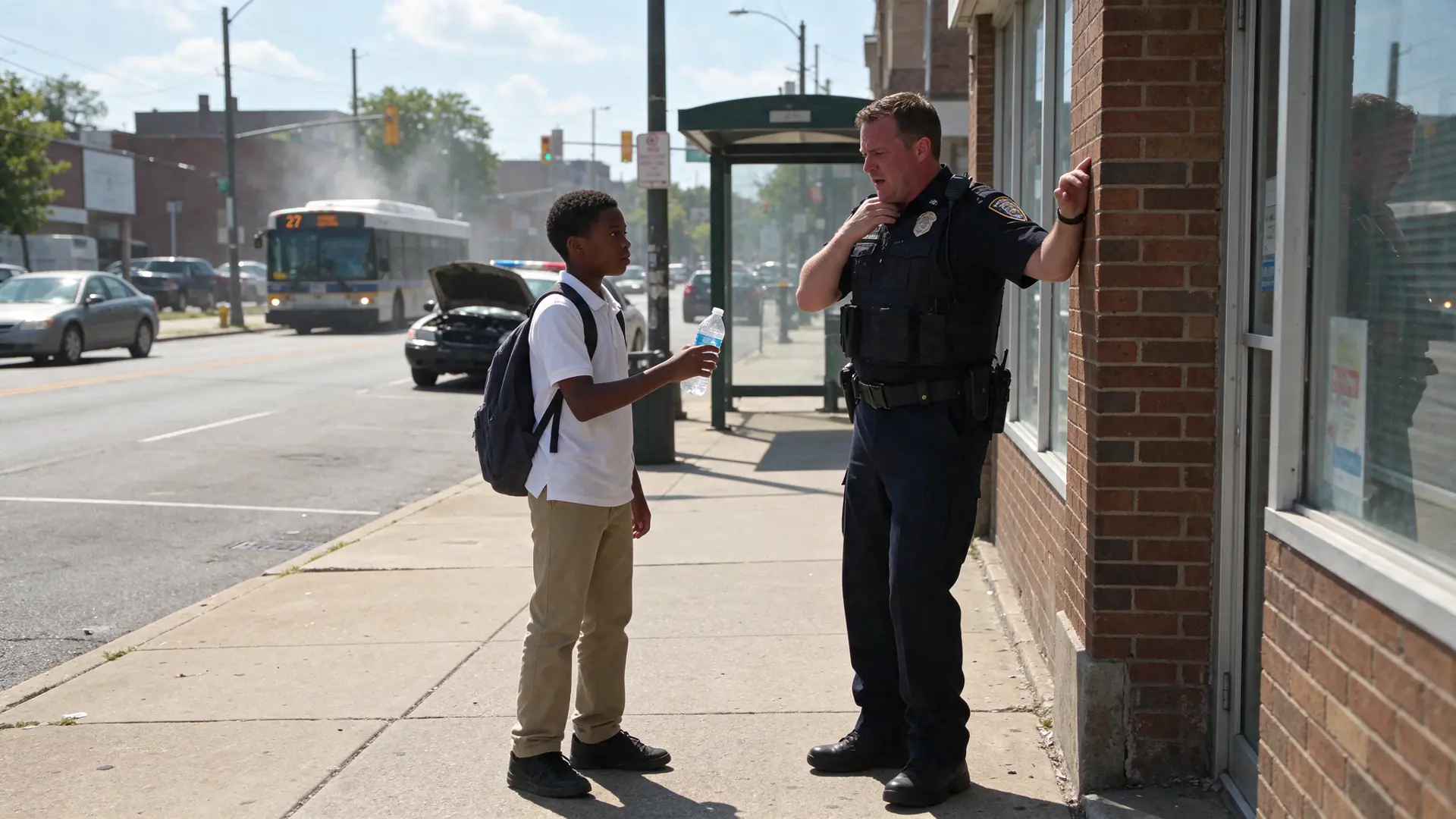
“Don’t you dare go to sleep,” the boy said, pressing his last bottle of water into the police officer’s shaking hand. “Please. My grandpa says you have to stay with me.”
Officer Elena Ruiz was sitting on the curb beside a traffic barricade, her back against a metal trash can that had grown almost too hot to touch. Her uniform shirt was soaked. The white lines painted across the intersection seemed to ripple in the July heat. Fifty yards away, the number six bus lifted from the curb with a groan, its doors folding shut. Miles Carter watched it pull into traffic. It was the last bus that would carry him home without a transfer, and he had ninety-three cents in his pocket, a dead phone, and a mother who would be home from work at six and frightened if he wasn’t there.
The bus moved away. He turned back to the woman.
“What’s your name?” he asked.
“Elena,” she managed. “Officer Ruiz. You shouldn’t be here.”
“Neither should you.”
Her attempt at a smile frightened him more than her silence had. She had been directing cars around an outdoor street fair for hours. Miles had seen her stumble when she tried to move a barricade. Nobody else seemed to notice until she dropped her radio, and by then he was already running toward her.
“I called nine-one-one,” he told her. “They said help’s coming.”
“Good.” She swallowed painfully. “You need to get out of this sun.”
“I will when you do.”
He shaded her face with the flat cardboard sign he had been carrying home from the community center. On the front, in his own careful handwriting, were the words EVERYBODY DESERVES A RIDE. He had made it for a summer civics project. Now the marker ink was leaving black smudges on his palm.
When the ambulance came around the corner, Miles did not feel heroic. He felt sick with the knowledge that his mother would look at an empty kitchen and wonder where he had gone. The paramedic asked questions and examined Officer Ruiz, who was alert but weak and nauseated. Miles told her about the unsteady walking, the confusion, and how long the officer had been stationed in the sun. He stepped aside while they began cooling her and preparing to take her to the hospital.
“Hey,” Officer Ruiz said as they lifted her onto the stretcher.
He stopped.
“Your name.”
“Miles. Miles Carter.”
“Thank you, Miles Carter.”
Her eyes closed, not in unconsciousness but in exhaustion. He stood there holding an empty plastic bottle, and for a moment the street fair went on around him as if nothing remarkable had happened. A child cried for lemonade. A motorcycle revved. Someone in a bright shirt told a joke that made three people laugh.
Miles started walking.
His home was six miles beyond the river, in the row of small brick houses behind the defunct paper mill. He could manage the distance on a cool day, but this wasn’t a cool day. The sidewalk ahead shone beneath a cloudless sky, and the bank sign across the street read 101 degrees. He had not eaten since eleven. The community center had provided sandwiches, but Miles had saved half of his for his little sister, June.
He reached the public library two blocks later and sat on the low wall beneath its awning. Through the glass doors he could see people reading in the air-conditioning. He tried his phone again. The screen gave one faint flash and died.
Inside, a librarian named Mrs. Baines recognized him from his summer volunteer shifts. She did not ask why a fourteen-year-old boy looked as though he had spent the afternoon in an oven. She brought him a paper cup of water, found a charger, and asked if she could call his mother. When Miles explained what had happened, her expression changed.
“You did the right thing,” she said. Then, more sternly, “And the next right thing is staying right here until we find you a safe way home.”
His mother didn’t answer. Neither did his grandmother, whose old flip phone often sat unnoticed under a crocheted pillow. Mrs. Baines called the community center director, who reached the city transit dispatch office. A driver finishing his shift offered to bring Miles to a stop three blocks from his house in a service van, provided Mrs. Baines could verify the arrangement with his family. She finally reached his grandmother through the neighbor next door.
By the time Miles walked into his kitchen it was nearly seven. His mother, Tanya Carter, stood with one hand on the refrigerator door. She wore the pale blue scrub top from the nursing home, and the exhaustion on her face had sharpened into something dangerous.
“Where have you been?”
“Mom, I—”










