The sound of heavy blows, leather gloves slamming into ribs, a wild roar from the stands, thousands of voices all at once, loud arrogant laughter, a winner laughing at a man who’s down. He stands over the fallen fighter, a microphone in his hand. “You send us dancers,” he shouts to the crowd, “not fighters,” he adds with contempt. “They fall down and cry,” he bellows, “like spoiled little girls,” he throws at the crowd. “There’s no one here for real men to fight,” he declares.
The arena erupts in laughter, cruel approving laughter. No one stands up for the fallen man, no one speaks out, no one knew yet how this night would end. They thought 7,000 spectators had come to watch their triumph. They believed their power was absolute and they could get away with their abuse. There was one thing they didn’t know.
A man was sitting silently in the ninth row on the arena floor. He hadn’t come to watch the show. He’d come to shut it down. For good. Word of the trio spread fast.
It all started a few months earlier. A small tournament in a neighboring state. Three young boxers showed extraordinary strength. They won fair and square without being especially brutal. Then something in them began to change almost imperceptibly.
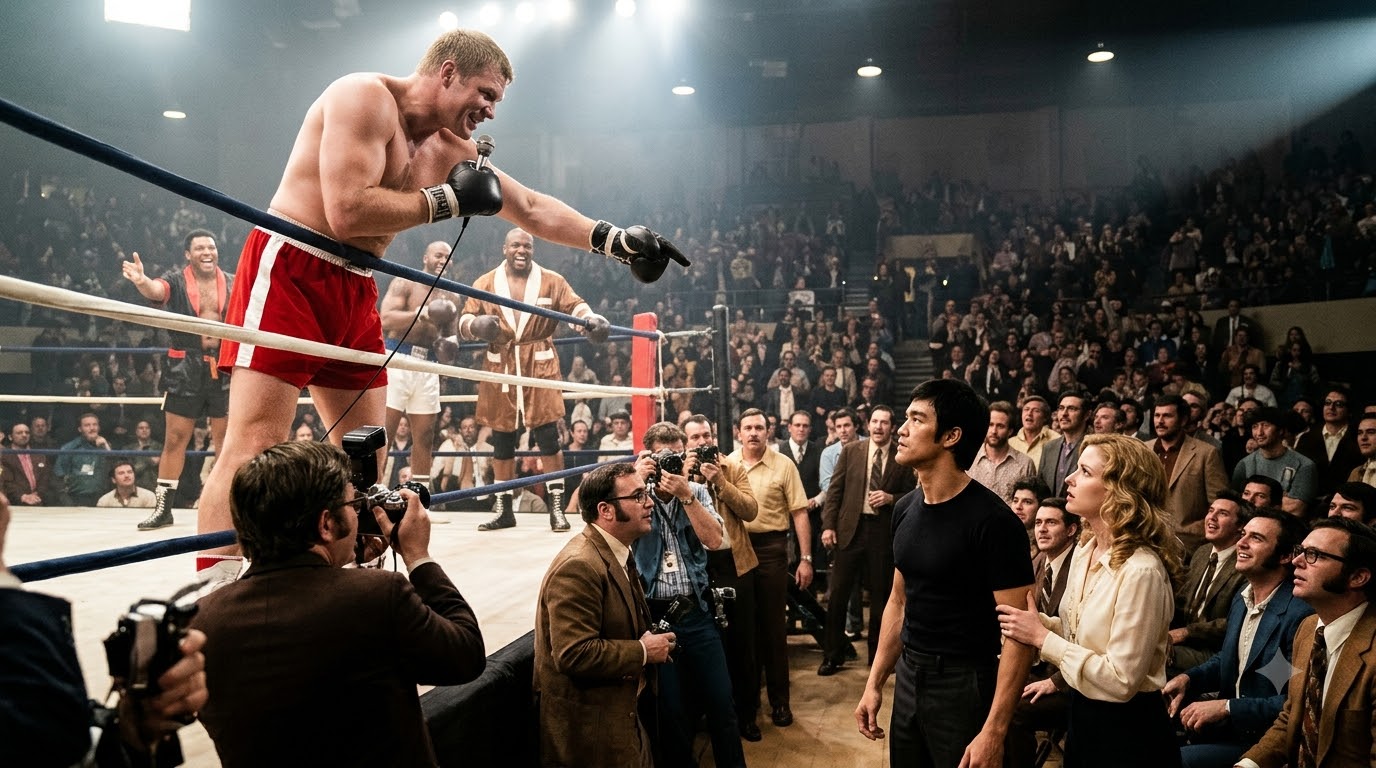
Their first major victory went to their heads. The organizers realized the crowd wanted a more brutal spectacle. That’s when the exhibition fights against local martial arts masters began. Men who’d spent years training in quiet gyms. Men who’d never stepped onto a big stage.
The first to get hurt was an unassuming karate instructor. One reckless punch broke his collarbone. No one apologized. No one helped. The crowd just laughed at his cry of pain.
Word spread through the martial arts community. Some tried to protest, sending complaints to the organizers. Those complaints disappeared into a maze of paperwork. The money these fights brought in was all that mattered. With every city, the trio grew more brazen.
Each new arena drew a bigger crowd than the last. They traveled from place to place, leaving shattered lives behind. Bruce’s friend became one of their victims. He stepped into the ring on principle, not for money, but for honor. He wanted to show that Eastern martial arts deserved respect.
What happened was far more brutal than he’d expected. Bruce found out the next morning. A phone call woke him before dawn. The voice on the other end was trembling. From that moment on, time stood still for him.
Everything else faded into the background. Only one clear, cold purpose remained. White hospital walls, a silence so deep it hurts, the beeping of monitors, steady, monotonous, unsettling. The smell of medication hangs in the air. A man lies in a narrow bed, a young martial arts master, a childhood friend.
His face is covered in dark bruises, bruises beneath his eyes, broken ribs beneath a tight bandage. His bandaged hands lie motionless. Every word takes effort. He hadn’t simply lost to them. They weren’t just winning sparring matches.
They kept beating men who were already down. They crushed their dignity along with their bodies. They laughed at Eastern martial arts, called them children’s ballet. His voice breaks on that word. Bruce sits beside him, listening in silence.
There’s no rage on his face, only an icy focus. His gaze turns inward. He takes his friend’s hand. “Your fight isn’t over,” he says quietly. “I’m just taking it from here,” he adds, his voice steady.
His friend looks at him for a long moment. There’s hope in that look, mixed with a pain that runs deep. Bruce stands and heads for the door. Behind him, the hospital room falls silent. His mind is made up.
That same day, Bruce finds the address, the address of that very instructor, a small house on the edge of town. A man on crutches opens the door. His arm is still in a cast. His eyes are wary, accustomed to disappointment. “Who are you?” he asks suspiciously.
Bruce introduces himself without wasting words. He explains why he’s there. He just came to see how the man is holding up. The instructor listens in silence, his expression slowly changing. Distrust gives way to something like surprise.
“No one’s ever come by just to ask,” he says quietly. “The organizers didn’t even answer my letters,” he adds bitterly. Bruce nods. He knows that pain firsthand. “They shouldn’t get away with this,” he says firmly.
The instructor studies him. “You sound like a man with a plan,” he remarks. Bruce gives him a brief smile, neither confirming nor denying it. “I’m doing this for more than just you,” he replies. “It’s for everyone they forced into silence.
For the first time, the instructor allows himself a smile, faint but sincere, real. Bruce shakes his good hand and leaves with the same quiet, determined stride. The instructor watches him go from the doorway. For the first time in a month, something inside him comes back to life. Silence greets Bruce at home.










