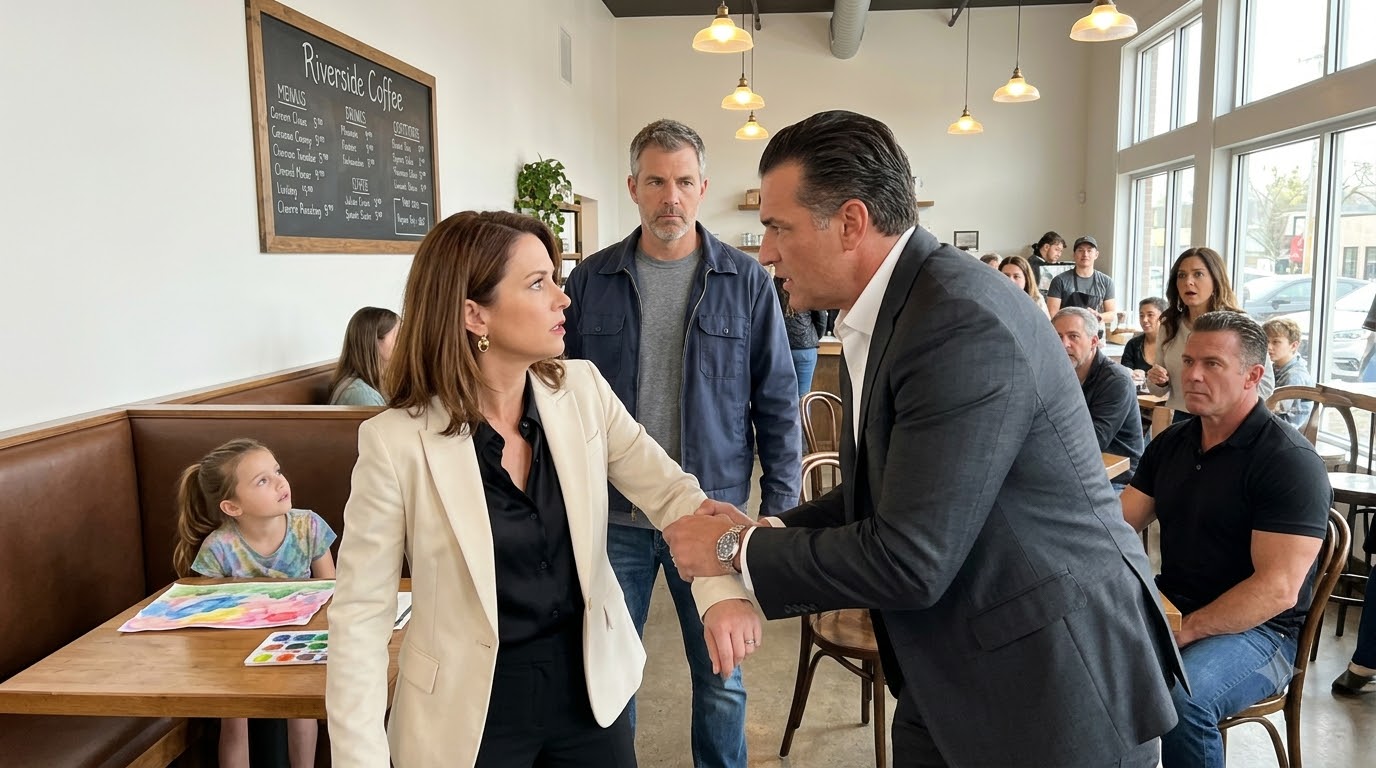
The coffee shop was nearly empty on that Tuesday morning when Garrett Cole walked in with the kind of confidence that money and achievement had purchased over decades. He was 47 years old, owned three martial arts studios across the state, held a black belt in Taekwondo, and had built a reputation as someone who didn’t back down from anyone. His bronze trophy sat on his office desk, proof that he’d competed in tournaments, won more than he’d lost, and believed himself to be superior to ordinary people who’d never tested their discipline in combat. What Garrett didn’t understand was this. The man sitting quietly in the corner booth, nursing black coffee while his 8-year-old daughter colored in a sketchbook beside him, had spent 17 years as a Navy SEAL.
This man had seen combat in three different countries, had trained soldiers in the art of survival, and had learned long ago that real strength had nothing to do with trophies or the size of your ego. Christine Mercer, the woman who would enter this coffee shop moments later, struggling against three men who believed their power made them untouchable, was about to have her life transformed by two people who seemed ordinary. What happened next would shake all of them to their foundation, but it wouldn’t happen because of a fight. It would happen because of something far more powerful than violence. Garrett Cole had not always been confident.
Growing up small and overlooked in his working-class neighborhood, he’d made a silent promise while watching his parents work impossible hours. Respect could be earned. Achievement could be accumulated. Power could be built. When he was 12, his father enrolled him in a martial arts program at a community center.
Garrett was terrible at first, slow, clumsy, and terrified of contact. But he had something stronger than natural talent, hunger. He trained 6 days a week, studied forms until his muscles memorized every movement, and competed in local tournaments where he discovered something intoxicating, the feeling of winning, the respect that followed victory, the way other people’s eyes changed when they looked at him after he defeated them. By the time he was 30, Garrett had won state championships and owned his first martial arts studio. By 35, he had expanded to two additional facilities.
By 43, he commanded 14 instructors and had coached over 200 students, many of whom had gone on to compete at regional levels. He lived in a modern home with floor-to-ceiling windows, drove a luxury sedan, and wore expensive watches that he made sure were visible during conversations. Yet something had begun to change around his 45th birthday. A subtle shift that he hadn’t fully acknowledged, a restlessness, almost a dread. The empire felt increasingly hollow.
He had won nearly everything the martial arts world had to offer. Yet he woke up some mornings feeling like that small, overlooked child trying to prove something to people who would never be satisfied. His solution had been predictable, work harder, train longer, push his students further and farther toward achievement. If he couldn’t find contentment inside, perhaps he could manufacture it by dominating the people around him. That’s who Garrett Cole was on the morning he walked into Riverside Coffee, a man at the peak of his professional success in the depths of his spiritual poverty, though he lacked the self-awareness to recognize the difference.
The coffee shop was a quiet place, the kind where regulars sat in the same booths and nobody bothered anybody else. Classical music played softly from overhead speakers. A barista knew most customers by name. It was not the type of establishment where conflict typically erupted, which was exactly why what happened that morning was so jarring. Across the room, a little girl, maybe 8 years old, had created a watercolor painting of a sunset over mountains.
The canvas still glistened with moisture, blues bleeding into purples. She was absorbed in the work, her tongue slightly protruding in concentration, adding details to a small cabin nestled in a valley. The man across from her was reading a newspaper, occasionally glancing up to see her progress. When she accidentally knocked her water cup sideways, spilling across the table and threatening the painting, he pulled several napkins and moved the artwork to safety. He handed his daughter a fresh cup of water and a clean section of the table, then returned to his newspaper as if nothing significant had happened.
Sophie smiled at him, and he smiled back, not a forced smile, but something genuine that transformed his entire face. It was that moment Garrett felt something sharp and unwelcome move through his chest. Recognition. That simple expression was love. Real, uncomplicated, unconditional love, the kind that didn’t require achievements or trophies or the admiration of people who mattered.
Just a father present with his daughter, protecting something beautiful she had created. He turned away and told himself it was sentimental, weak, exactly the kind of domestic complacency that separated champions from ordinary people. But he couldn’t stop thinking about it. 3 days later, Garrett returned to Riverside Coffee at the same time, as if something was drawing him back. Perhaps he wanted to see the man and child again. Perhaps he wanted to remind himself why he’d chosen the path he had chosen.










