“Scared, buddy?”
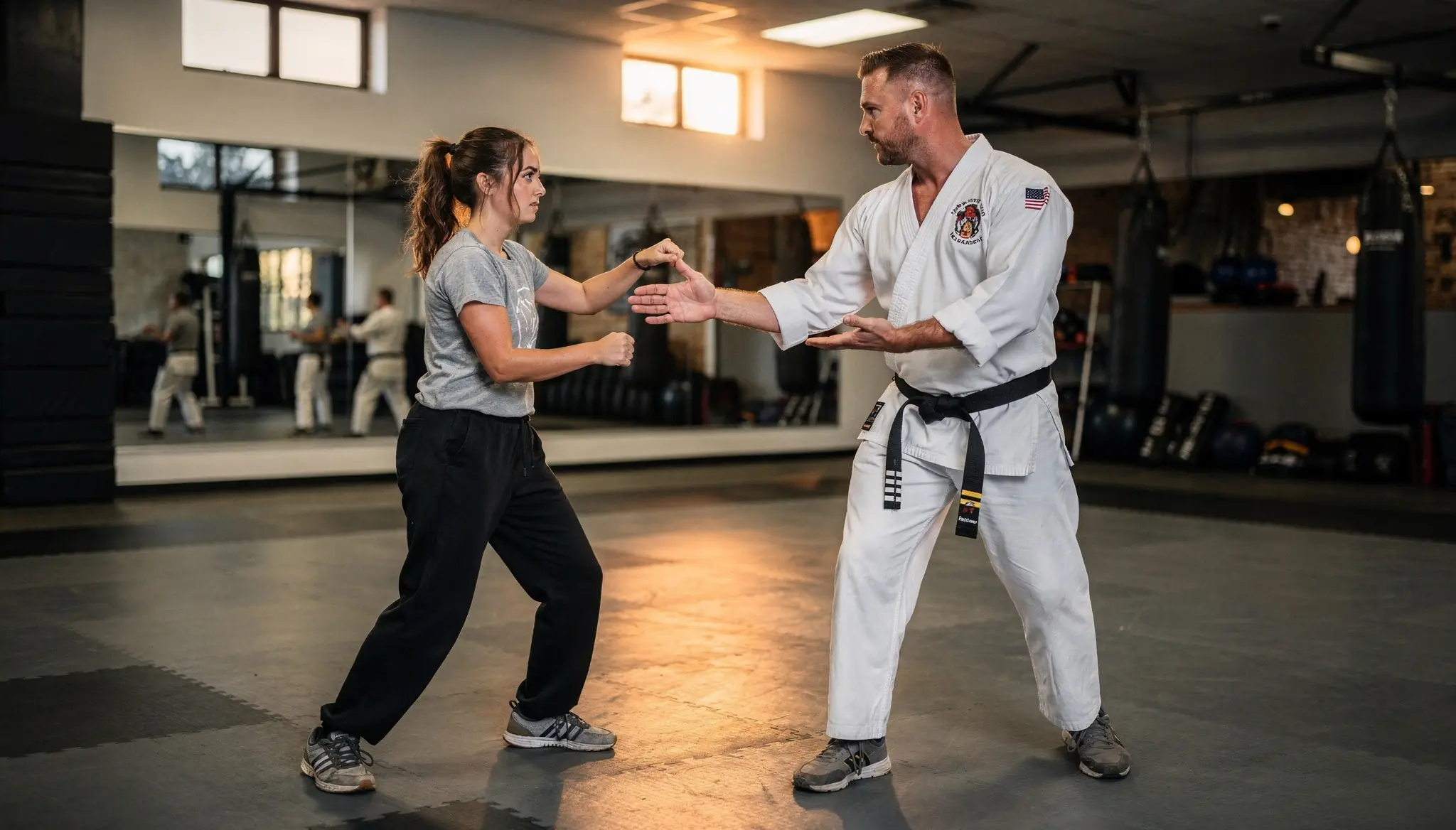
The whole gym went quiet. A hundred people watched a black belt point across the room at a waitress in sweatpants—a woman he’d spent two weeks calling slow, clumsy, a joke.
She’d been banned from that building. She wasn’t supposed to be there at all, and she’d already picked her coin up off his floor once without a word after he tossed it in the trash and called it a pawn shop trinket.
She stood up anyway.
“I’m not scared of you, Tanner. I never was. I think that’s what this has really been about.”
He lunged. Two seconds later, he was face down on his own mat, arm locked, unable to move, and a voice from the back of the room said the words that stopped that town cold:
“Josephine Merrick.
On behalf of a grateful Navy…”
Nobody in Mill Haven knew who she really was. They were about to find out.
Let me tell you about a woman named Jo Merrick.
You wouldn’t look twice at her if you passed her on the street. 32 years old, tired eyes, a ponytail that never quite stayed in place by the end of a shift. She wore the same brown apron five nights a week at a diner called the Wagon Wheel, out on Route 9 in a small Ohio town called Mill Haven.
Nobody in that town knew who she really was. Not the cook who worked beside her. Not the regulars who tipped her a few extra dollars because she always remembered their coffee order. Not even the man who was about to humiliate her in front of a room full of strangers.
This is a story about patience, about the kind of strength that doesn’t shout, and about what happens when a loud man picks a fight with a quiet woman without knowing a single thing about who she used to be. Sometimes the strongest thing a person can do is nothing at all—right up until the moment doing nothing stops being an option.
Mill Haven wasn’t much to look at: one main street, a hardware store that had been there since before most folks could remember, a church on nearly every other corner, it seemed like, and the Wagon Wheel sitting at the edge of town. Its neon sign was missing the letter G, so it just read “The W on Wheel” after dark—a running joke among the regulars nobody had ever bothered to fix.
Jo worked the night shift: 10:00 at night until 6:00 in the morning. It wasn’t glamorous work: truckers passing through on their way to somewhere bigger, late-shift nurses grabbing pie before heading home to sleep through the daylight, the occasional young couple who’d wandered in after a movie, still laughing about something that had nothing to do with the diner at all.
She was good at it, though. She moved fast. She never forgot an order. And she had a way of talking to people that made them feel like they mattered, even at 3:00 in the morning when most folks are their worst selves.
Her shift ended at 6:00. She’d drive home, catch a few hours of sleep, then spend the rest of her day being a mother: packing lunches,
sitting at the kitchen table, helping with homework, falling asleep some evenings in the middle of a cartoon, only to wake up and start the whole cycle over again a few hours later.
It was a hard way to live. She never complained about it—not once, not even to herself on the nights it felt heaviest. She’d made a decision a long time ago that some things you simply carry, and you carry them without making a show of it.
That decision, more than anything else, was about to be tested.
Under her uniform, on a thin silver chain, Jo wore something most people never saw: a coin. Not a lucky penny or some cheap trinket picked up at a gift shop, but a challenge coin—the kind sailors carry,
heavy in the hand, stamped with an anchor and a set of numbers that meant something only to the people who’d served alongside her.
She never talked about where it came from. Not to her coworkers, not to her landlord, not to the man at the bank who processed her car loan and asked out of politeness more than curiosity whether she’d ever served.
“A long time ago,” she’d say, and then she’d change the subject.
That was Jo’s way. She didn’t hide her past because she was ashamed of it; she hid it because some things hurt too much to hand over to people who’d only ask questions out of curiosity, not care.
There’s a story people in Mill Haven tell about Jo, one that has nothing at all to do with Tanner Priestley or the trouble that was coming,
and it says more about her than anything that happened later.
One night that winter, a young trucker named Denny Holoran came into the diner near midnight, hollow-eyed, counting change out of a coffee can he kept on his passenger seat. He was $3 short for the meatloaf special and too proud to ask for anything cheaper.
Jo rang him up for a cup of coffee and a slice of pie instead, told him the diner ran a promotion that night, then quietly covered the difference out of her own tip jar before her manager ever saw the ticket.
There was no promotion. There never had been.
She didn’t tell Denny that. She just refilled his coffee twice, asked him about his route, and let him sit in that booth a little longer than the diner’s usual turnover allowed. Denny told that story to anyone who’d listen for months afterward. Jo never mentioned it to a soul.
That was the kind of person she was: quiet generosity offered without an audience, because she believed that the whole point of doing something decent was that nobody needed to know you’d done it.
There was one man at the diner who noticed more than most. His name was Walt Higgins, 71 years old. He came in every morning around 5:30, right before Jo’s shift ended, and ordered the same thing every single day: two eggs over easy, wheat toast, black coffee, no sugar.
Walt had led the local Veterans of Foreign Wars chapter for almost 15 years. He’d served his country back when he was young enough to think it would never change him. It changed him plenty, but he never talked about the details, and Jo never asked, because she understood something about him that most people didn’t: some folks carry things quietly. Walt was one of them. And in a strange way, without either of them ever saying it out loud, Jo was one, too.
“You look tired, kid,” Walt told her one morning in early spring, watching her pour his coffee with a hand that trembled just slightly from exhaustion.
“Long night,” she said.
“They’re always long when you’re doing it for someone else,” Walt replied.
He meant her son—a quiet boy at home, watched most nights by a neighbor while Jo worked. Walt never asked much about him either; he simply understood that a woman working a graveyard shift alone was carrying more weight than her small frame let on. Walt liked Jo. Just something in how she carried herself: steady, careful with her words, someone who watched a room before she ever spoke in it. He had no idea yet how right his instincts were.
There was another regular who sat at the counter most mornings: an old-timer named Earl Bannister, 83 years old, who’d farmed corn outside of town for 50-some years before his knees finally gave out on him. Earl liked to talk, mostly about the weather or the price of feed or how the town had changed since he was a young man. But every so often, Earl looked at Jo a certain way and said something that seemed to come from somewhere deeper than small talk.
“You remind me of my sister,” he told her once out of nowhere while she refilled his coffee. “She served as a nurse overseas a long time back. Came home different. Quieter. Stronger, too, in a way most folks never noticed unless they knew to look for it.”
Jo just smiled and told him his coffee was on the house that morning. She didn’t say much else; she rarely did. But she thought about that comment for the rest of her shift, turning it over the same way she turned the coin over under her collar, wondering how much of a person’s history stays written on them, even when they never say a single word about it.
It started, as these things often do, with something small.
Late one night in March, a woman named Carol Weiss, who worked the closing shift at the pharmacy two blocks from the diner, was walking to her car when a man grabbed her purse. He shoved her to the ground; she hit her head on the curb. She was fine, thank goodness, just shaken up with a nasty bruise on her hip.
But the story spread through Mill Haven the way a grass fire spreads through dry summer fields. Suddenly, everyone was talking about it at church, at the barbershop, in line at the grocery store.
“It’s not safe for a woman to walk to her car alone anymore,” people said. “Something needs to be done.”
Carol herself recovered well enough within a week or two, at least physically. But something about the sense of safety in Mill Haven had cracked. For a while, folks started walking each other to their cars after dark; husbands waited in parking lots for wives finishing late shifts.
A man named Gary Priestley heard every word of it. And he heard it the way a certain kind of man always hears fear: not as a problem to solve, but as an opportunity waiting to be claimed.
Gary owned Ironclad Self-Defense Academy, the only martial arts gym in town, sitting inside a converted warehouse just off Main Street. He also held a seat on the town council, up for reelection that fall.
At the next council meeting, Gary stood up in his pressed blazer and made an announcement: “In light of recent events, Ironclad Academy will be offering a free two-week self-defense course open to anyone in town—especially our night shift workers, our nurses, our waitresses, the people who walk to their cars alone in the dark.”
The room applauded. Someone from the local paper snapped his photograph; it ran on the front page the next morning under the headline, Local Business Steps Up for Community Safety.
What the article didn’t mention was that the town council would be voting in the weeks ahead on a grant to expand Ironclad’s building—a grant Gary badly wanted, and one that would look a whole lot easier to justify if the whole town had just watched him play the hero.
Gary didn’t teach the classes himself, though. He handed that job to his son.
Tanner Priestley was 36 years old, built like a man who spent four hours a day in front of a gym mirror—because he did. He wore a black belt with three gold stripes stitched into it, and he made sure everyone who walked through the door of Ironclad noticed it within the first 30 seconds.
Tanner had a story he told often about how he’d almost joined the military once, how he’d been this close to signing up before deciding the discipline of martial arts was a purer path. It was a good story: confident, a little sad around the edges in a way that made people feel for him.
It also wasn’t quite true.
Tanner had tried to enlist at 22; he’d failed the psychological evaluation twice. Nobody in Mill Haven knew that except his father, and Gary Priestley had buried that piece of history so deep he’d almost convinced himself it never happened at all. But something in Tanner never let it go—a quiet, gnawing shame that lived underneath all that muscle and all that swagger. And like a lot of men who carry shame they refuse to examine, Tanner had found a way to turn it into something else entirely: anger aimed, more often than not, at anyone who reminded him of the life he never got to have.
He didn’t know it yet, but Jo Merrick was about to remind him of exactly that.
The free class started on a Tuesday evening in early April.
Twelve people showed up, mostly women: a retired schoolteacher, a young pharmacy clerk, a nurse working the same graveyard hours Jo did, and Jo herself, standing near the back of the room in sweatpants and an old T-shirt, arms crossed, watching everything before she said a word.
Watch first, speak later, if at all.
Tanner stood at the front of the room in a crisp white gi, addressing the group like a man giving a speech to a stadium. “Statistics don’t lie, folks,” he said, pacing slowly. “Most attacks happen in under ten seconds. Ten seconds to decide whether you’re a victim or a survivor. Tonight, we start building the instincts that separate the two.”
He walked the group through basic stances: how to plant your feet, how to keep your hands up without looking like you expected trouble. Simple stuff, honestly. But he delivered every instruction like it was sacred knowledge only he possessed.
Jo followed along deliberately a beat slower than everyone else. She let her stance wobble slightly. She let her block land a half-second late when Tanner demonstrated a grab and asked for volunteers. She wasn’t trying to hide, exactly; she was trying to disappear into the wallpaper. She’d learned a long time ago that some rooms go easier on you if nobody notices you’re in them.
Around her stood a handful of people she’d come to know a little better over the following weeks: Dana Fitch, the night-shift nurse, stretching out a shoulder aching from years of lifting patients; Margaret Wren, upright and attentive the way old teachers tend to stay for the rest of their lives; Shelby Combs, the pharmacy clerk, quiet and still a little rattled from what had happened to her coworker Carol.
They were an unlikely group: a waitress, a nurse, a teacher, a clerk. None of them had asked to be there for any grand reason; they just wanted to feel a little safer walking to their cars at night.
The second class fell on a Wednesday, and the third followed close behind on Thursday of that same first week. Tanner used both sessions to build momentum the way a showman builds momentum, layering small jokes on top of small jokes until the room got comfortable laughing along with him.
He picked at little things: the way Jo held her hands too low, the way she stepped, according to him, like she was still deciding whether to commit to the fight or not.
Margaret Wren found herself growing uncomfortable with it, though she didn’t say anything either. Margaret had spent 34 years in a classroom, and she knew a bully when she saw one, even a grown man wearing a black belt and calling himself an instructor. And she watched with quiet admiration how Jo simply refused to shrink: no matter how many jokes landed at her expense, Jo never argued, never rolled her eyes, never sighed. She just did the drills a beat slower than she was capable of, and waited.
By Thursday, Tanner had grown frustrated that his jokes weren’t landing the way he wanted. A joke needs a reaction to work; Jo wasn’t giving him one, and a man used to being the loudest, most impressive person in any room did not know how to handle silence that refused to bend to him.
That frustration was still sitting in him when he called Jo up for a demonstration on the fourth night.
“Now,” Tanner said, addressing the room while holding her arm, “watch what happens when someone’s instincts just aren’t there.”
He twisted—not hard enough to actually hurt her, but hard enough to make his point. Jo fumbled the escape on purpose, stumbling half a step. The class laughed again, louder this time.
Tanner grinned. “See that hesitation? That’s what gets people hurt out there.”
He let go of her wrist, and as he did, his hand brushed against the thin silver chain around her neck. He caught it with two fingers before she could stop him, pulling the coin out from under her collar.
“What’s this?” he said, holding it up to the light, turning it over. “Some kind of medal?”
“Please give that back,” Jo said quietly.
Something in her voice landed differently than anything her classmates had heard from her before: steady, not scared, not embarrassed, just firm—the way a mother speaks to a stranger reaching for her child.
Tanner didn’t notice the difference; he was too busy performing for the room. “Navy, huh?” he said, squinting at the anchor stamped into the metal. “You serve?”
“A long time ago,” Jo said—the same words she gave everyone, the same door she quietly closed.
Tanner smirked, something ugly slipping into his voice. “Sure you did.” He tossed the coin almost lazily toward the trash can by the front desk; it missed the rim and clattered onto the floor beside it. “Where’d you get it? Some pawn shop? Etsy? Come on, look at you. You can’t even land a basic wrist escape.”
Jo didn’t move for the coin, not yet. She stood there, hands loose at her sides, looking at him the way you’d look at a dog barking behind a fence: unafraid, but not about to provoke it either.
Tanner leaned in slightly, lowering his voice just enough that it felt personal, even though the whole room could still hear him.
“Scared, buddy?” he said, grinning.
Jo looked at him for a long moment. “No,” she said. “Just disappointed.”
She walked past him, bent down, picked the coin up off the floor without any drama, and slipped it back beneath her collar. Then she returned to her spot at the back of the room, arms crossed, and waited for class to continue.
Tanner blinked, caught off guard by how little reaction he’d gotten. He recovered quickly, laughing it off and moving on to the next drill, but a few people in that room noticed: the nurse standing beside her, the retired schoolteacher near the door. They noticed that Jo Merrick hadn’t flinched.
Class ended at 8:30. Jo walked home that night instead of taking the bus, keeping her hand on the coin under her shirt, rubbing her thumb over the raised edge of the anchor.
She wasn’t angry; that surprised her a little. Instead, she just felt tired in a way that had nothing to do with the hour.
She thought about her husband. He’d given her that coin the week they got married, told her half-joking that as long as she carried it, some piece of him would always be looking out for her. She hadn’t taken that coin off her neck once in the four years since he died. Tanner didn’t know any of that; to him, it was just a piece of scrap metal some sad woman wore to feel important.
Dana Fitch had been standing right beside Jo during that wrist grab demonstration, close enough to see something the rest of the class missed: a fraction of a second where Jo’s whole body shifted—weight dropping into her back foot, free hand rising just slightly, like it already knew exactly where it needed to go—before Jo reeled it back in and stumbled on purpose.
Dana mentioned it to Walt Higgins two days later at the Wagon Wheel.
“There’s something about the way she moves,” Dana said. “It’s like she already knows the moves before he teaches them, but she keeps holding back.”
Walt set his spoon down slowly. He thought about the coin Jo wore beneath her collar. He thought about how many years he’d spent at VFW meetings listening to people describe the strange, quiet weight of coming home from service. He didn’t say any of that to Dana, but for the first time, Walt found himself looking at Jo Merrick a little differently.
The second week of class started worse than the first ended. Tanner had noticed the whispers, and he decided the fastest way to shut them down was to make sure everyone saw publicly that Jo Merrick was completely unremarkable.
On Thursday night, he called for a live sparring demonstration: light contact to simulate a real mugging. He picked his partner without hesitation.
“Jo, come on up.”
She hesitated, just a beat too long for Tanner’s taste.
“What, scared, buddy?” he said again.
Jo stepped forward. Tanner explained the drill to the room: he would grab her from behind, and her job was to break free.
“Ready?” he asked.
“Ready,” she said.
He grabbed her from behind, one arm looping around her shoulders with far more force than the drill called for.
For a half-second, Jo’s body reacted before her mind caught up to it: weight dropped, her elbow snapped back—stopping less than an inch from Tanner’s ribs, controlled with extreme precision—and her free hand found the pressure point on his forearm that would have made him let go instantly.
And then, just as fast, she stopped herself. She pulled the strike, let her hand rest against his side instead of driving into it, and stepped back out of his grip in a motion that looked like a slightly clumsy version of the technique.
Dana was paying close attention; so was Margaret Wren. Tanner rubbed his forearm, more startled than hurt, covering it quickly with a laugh. “Not bad. Little rough on the follow-through, but not bad.”
For a moment, something flickered across Tanner’s face that looked almost like recognition, but he buried that feeling fast.
Afterward, in the parking lot, Dana caught up with Margaret. “You saw that, too, right? That wasn’t beginner’s luck.”
“I’ve watched children learn things for 34 years,” Margaret said. “I know the difference between someone learning a skill and someone remembering one.”
Two days later, on a Saturday afternoon, Jo stopped by the town police station to file a complaint. It wasn’t about the coin or the drills; it was about what happened after Thursday’s class. Tanner had followed her out to the parking lot and made a low comment about how women like her needed to be reminded who was actually in charge in that gym. It lived in that gray space designed to never quite cross the legal line, but it sat wrong with her.
The officer at the front desk was Cole Priestley, Tanner’s first cousin.
As soon as Jo mentioned Tanner’s name, Cole’s posture changed. “Look, I know Tanner can come across a certain way, but he’s not the type to actually hurt anybody.”
“I’m not saying he hurt me,” Jo said. “I’m saying he made me uncomfortable, and I want it documented.”
“Sure, sure,” Cole said, his tone shifting into going through the motions. “I’ll note it down. But between us, if this turns into a he-said-she-said thing, it’s not going to go anywhere. No witnesses, no contact—just words.”
Jo studied him, thanked him for his time, and left.
She didn’t know that Cole texted Tanner the second she walked out the door: Heads up. The waitress from your class came in complaining. Nothing’s going to come of it. Just be smart for a while.
Tanner read the message with a smirk: She’s not going to be a problem.
There was one more person who noticed something during those first two weeks: Frank Doyle, 78 years old, the retired martial arts instructor who had trained Tanner for nearly a decade before health problems forced him to sell his dojo to Gary Priestley.
Frank had noticed the sparring demonstration, but he’d noticed something else, too: Tanner’s belt. Frank knew what a real three-stripe black belt looked like on a man who had earned it through sanctioned testing. Tanner’s form carried gaps that never should have existed at that rank.
One evening, flipping through the gym’s testing binder, Frank found Tanner’s third-stripe record: dated a Sunday in November, four years earlier. Frank remembered that Sunday clearly, because he had spent that entire weekend in a hospital waiting room three counties away beside his wife during a heart scare. He hadn’t been anywhere near the gym; he certainly hadn’t administered any testing board.
Frank made a phone call that night to an old training partner, Samuel Devo, who sat on regional testing boards.
“No record of him anywhere in my files, Frank,” Samuel reported back. “And if he’s claiming a third stripe from that period, there’s only three boards in this whole region that would have been sanctioned to award it. I sat on two of them myself, and I know the man who ran the third.”
Frank hung up the phone and sat in his quiet living room, thinking about Jo Merrick’s coin lying on that gym floor, and about how much easier it was to mock someone else’s earned history when you’d never bothered earning your own.
The following Monday, Gary Priestley called an assembly of all the free class participants, town council members, and a reporter from the Mill Haven Gazette.
“In light of the incredible response,” Gary announced, “Ironclad Academy will be hosting a public community showcase in 12 days, on a Saturday evening. Each student will get a chance to show what they’ve learned.”
The mayor was invited; the council members set to vote on Ironclad’s expansion grant two days later were invited as well.
Council member Ruth Polowski asked a pointed question: “And the grant vote falls just two days after this showcase? That timing seems convenient, Gary.”
“Coincidence, Ruth,” Gary said smoothly.
As the meeting dispersed, Tanner caught Jo’s eye across the room. “See you at the showcase. Try not to embarrass yourself in front of the whole town.”
“I wouldn’t worry about me,” Jo said quietly.
That night, after her son was asleep, Jo’s phone buzzed: an unfamiliar number.
“Is this Josephine Merrick?” a man’s voice asked, formal and careful. “My name is Robert Kessler. I served with your husband. There’s some paperwork from his file that never got closed out properly. I think it’s something you’re going to want to see.”
Robert Kessler arrived in Mill Haven on a Tuesday morning, six days before the showcase, driving a gray sedan with government plates. Jo met him during her break at the diner.
Robert slid a folder across the table. “This is a nomination form for a commendation. It was filed 11 days after the incident, then disappeared into a backlog during a command transition.”
“A commendation for who?” Jo asked.
“For you,” Robert said. “You pulled four people out of that compartment before it fully collapsed. You went back in twice after you’d already gotten clear yourself, sustaining second-degree burns on your left arm. Your husband was the fifth person in there… too far gone. There wasn’t anything more you could have done. The nomination was for the Navy and Marine Corps Medal, for lifesaving heroism.”
He slid a second page across. “The award has been approved. What’s left now is the presentation itself.”
“I don’t want a ceremony,” Jo said.
“Think it over,” Robert replied gently. “Sometimes a ceremony reminds a community what quiet sacrifice actually looks like.”
Walt Higgins had noticed the gray sedan and the government plates. At the monthly VFW meeting that Thursday, Walt spoke to the room: “There’s someone in this town who might need us soon. When the time comes, I want this chapter ready to show up. Not with speeches—just with presence.”
Meanwhile, Tanner decided that the fastest way to secure his reputation before the showcase was to remove Jo entirely.
On Thursday evening, three days before the showcase, Tanner quietly instructed Curtis, an eager younger student: “Go a little harder than usual on this one. Push through the block instead of stopping at contact.”
When the drill began, Curtis grabbed Jo’s arm with excessive, painful force. Jo’s reflexes took over: she pivoted, broke the grip cleanly, and her elbow clipped Curtis’s jaw, dropping him to one knee with a split lip.
“I’m sorry,” Jo said immediately, kneeling beside him. “Are you all right?”
“I think I grabbed you too hard,” Curtis admitted quietly.
“Whoa, whoa!” Tanner cut in loudly. “That was way more than the drill called for! Is anyone getting this on video?”
A student had recorded the final second on a phone: Jo’s elbow connecting, Curtis dropping. It showed none of the excessive grip, none of Tanner’s private instructions.
By Friday morning, Gary Priestley suspended Jo from the class, citing liability, and gave a statement to the Gazette that painted her as an unstable aggressor. Gary also called the owner of the Wagon Wheel, applying quiet pressure until Jo’s manager asked her to take a few days off. On Saturday morning, Jo received a formal letter barring her from Ironclad’s premises entirely.
Saturday afternoon, Dana Fitch and Margaret Wren arrived at Jo’s door.
“We know it’s not true,” Dana said. “We saw how hard Curtis grabbed you.”
“I already gave a statement to Tanner’s cousin at the police station,” Margaret added firmly. “You don’t strike me as someone who loses control over nothing.”
On Sunday afternoon, Earl Bannister brought a sack of homegrown tomatoes to her porch. “Heard folks talking ugly about you in town. Didn’t sound like the woman who’s been pouring my coffee. Figured you could use some tomatoes and someone telling you that.”
Sunday evening, Walt Higgins and two VFW members knocked on her door. “Whatever happens tomorrow,” Walt told her, “you’re not walking into that building alone.”
By 5:30 on Saturday evening, Ironclad Academy was packed. Mayor Diane Coulson and the town council members were seated near the front; reporters and families filled the rows.
Jo arrived quietly, sitting in the very back row in plain clothes. Walt Higgins, Otis Redmond, and several VFW members sat two rows ahead of her; Dana and Margaret sat in the middle.
At 6:00, Gary Priestley opened the event with smooth political remarks, alluding vaguely to “a participant who was unfortunately asked to step back in the interest of safety.”
He then introduced his son: “Ironclad’s head instructor, Tanner Priestley!”
Tanner took the microphone, soaking in the applause. “Tonight, you’re going to watch real self-defense in action from someone who’s earned the right to teach it.”
That was the exact moment Frank Doyle stood up.
“I’d like to say something, if I might,” Frank said, walking toward the mat with a manila folder. “A black belt with three stripes isn’t something a man just decides to wear one day. It’s earned through sanctioned testing.”
Frank opened the folder. “This official testing record for Tanner’s third stripe is dated a Sunday in November four years ago. I have here a signed statement from Samuel Devo, a certified regional board examiner, confirming no such testing ever took place under his authority. And I was in a hospital waiting room three counties away that entire weekend. I couldn’t have administered it either.”
A stunned silence fell over the room. Gary’s face drained of color; council member Ruth Polowski began writing furiously in her notebook.
Desperate to regain control, Tanner’s eyes swept the room and locked onto Jo sitting in the back row.
“Maybe we should ask our former student what she thinks about real skill,” Tanner announced, stepping off the mat and pointing straight at her, “since she’s clearly decided the rules don’t apply to her either. You’re not even supposed to be here. But come on up. Show everybody what you showed poor Curtis. Unless… you’re scared, buddy?”
The room went completely still.
Jo rose slowly from her chair and walked toward the mat.
“I’m not scared of you, Tanner,” she said, her voice carrying through the quiet. “I never was. I think you’ve known that for a while now, actually. I think that’s what this has really been about.”
Tanner lunged at her.
It happened faster than the room could process. Jo stepped off the line of his attack, redirected his momentum with a small, precise turn of her hip and shoulder, and locked his arm. A half-second later, Tanner was face down on his own mat, completely immobilized.
“Stay down,” Jo said quietly. “I’m not going to hurt you, but I’m also not going to let you get back up until you understand that this is over.”
From the back of the room, a clear, commanding voice cut through the silence:
“Josephine Merrick.”
Every head turned. Standing near the entrance in full dress uniform was Commander Robert Kessler, flanked by a female naval officer with silver eagles on her shoulders, and behind them, filling the doorway, stood nearly every member of the Mill Haven VFW chapter.
Jo released Tanner, who scrambled backward into the crowd, entirely forgotten.
“Commander Kessler,” Jo said, straightening. “What is this?”
“I told you I’d follow up,” Robert said, walking toward the front as the crowd parted. He turned to address the entire assembly:
“Four years ago, a fire broke out aboard a vessel during deployment overseas. Nine sailors were trapped in a compartment that was rapidly becoming unsurvivable. One of those sailors, working almost entirely alone, pulled four of her fellow crew members to safety before the compartment fully collapsed, sustaining second-degree burns. She went back in twice.
That sailor’s nomination for the Navy and Marine Corps Medal was misplaced during a records transition and recovered last spring. Josephine Merrick, on behalf of a grateful Navy, and on behalf of four families who still have their sailors home today because of what you did that night, it is my honor to finally deliver this to you.”
The senior officer stepped forward. “In over 20 years of service, I’ve seen very few nomination packets that made the decision as easy as this one did.”
Nobody in the gym moved. Gary Priestley stood frozen as his credibility vanished in front of the council members. Dana Fitch was crying openly; Margaret Wren held her hands to her mouth.
Walt Higgins stepped forward, reaching into his pocket. Resting in his palm was a brand-new challenge coin, an exact match to the one Jo carried.
“Figured a woman like you should never have to wonder if a coin like this could be replaced by anyone who doesn’t understand what it means,” Walt said. “This one’s just in case life ever hands you another hard week.”
Jo took the coin, holding both the old and the new in her trembling hand. “Thank you,” she said, her voice breaking for the first time in four years.
The entire room erupted into a roar of applause.
The aftermath moved swiftly.
Ruth Polowski approached Gary before he could leave: “Monday’s funding vote is going to look very different than you were expecting.”
The council voted unanimously against the expansion grant. Within a month, Ironclad Academy was sold to new management, and both Priestleys were removed. Gary chose not to seek reelection that fall.
Tanner’s black belt certification was formally revoked by the regional testing board following Frank Doyle’s documentation; he left town shortly after.
Cole Priestley faced an internal review, cooperated fully, and submitted an amended report that included Curtis’s admission about Tanner’s drill instructions. He kept his badge, but lost his cousin’s friendship—a trade he decided was well worth making.
Curtis came by the Wagon Wheel that Tuesday, turning his cap in his hands, to apologize for not speaking up sooner.
“You didn’t do that to me; Tanner did,” Jo told him gently, refilling his coffee. “You told the truth eventually. That counts for something.”
The diner’s owner called Jo, profusely apologizing and offering her job back along with an extra week of paid leave.
The following weekend, the local VFW organized an informal gathering in the town square with coffee and a banner that read: Thank You, Josephine. Neighbors came by to shake her hand; Earl brought more tomatoes; Frank and Loretta Doyle stopped by, the old man standing tall with a long-carried weight finally lifted from his shoulders.
Robert Kessler spoke to Jo privately before leaving town. “Your husband would be proud of you,” he said.
“It’s worth quite a lot, actually,” Jo replied.
That evening, Jo sat on her back porch, watching the sunset. She held both coins in her palm—one worn smooth, one sharp and new. She thought of her husband, of her son sleeping safely inside, of Dana, Margaret, Earl, Frank, and Walt—ordinary people who had chosen to stand up for a quiet woman’s dignity.
She walked inside, placed both coins into the wooden keepsake box on her closet shelf beside the photograph of her and her husband in uniform, and closed the lid gently.
“We did all right,” she whispered.
Then she turned off the light and slept soundly through the night.










