The year was 1887, and the silence of the high plains was a living thing. For 14-year-old Arthur McBride, it was the only constant companion he had left. It had settled into the log cabin the day his father’s coughing had finally stopped, and it had deepened into something permanent, when his mother followed a winter later, claimed by a grief that had hollowed her out from the inside. Now the silence was his inheritance, as tangible as the deed to the 160 acres of unforgiving land that surrounded him on all sides. His life had shrunk to the size of his chores, splitting wood, checking his snares, tending the meager garden, and staring out at a horizon that promised nothing but more of itself.
Arthur was small for his age, wiry and tough, in the way of things that have learned to bend rather than break. His face was a perpetual study in solemnity, his blue eyes holding a watchfulness that belonged to a much older man. He rarely spoke, having no one to speak to, and the sound of his own voice often startled him when he muttered to the stubborn mule or cursed a rusted hinge. The world had taught him that survival was a quiet, solitary business. Emotions were a luxury, a weight you could not afford to carry when your every ounce of strength was needed just to see the next sunrise.
His grief for his parents was a stone he carried in his gut, cold and heavy, a thing he never acknowledged, but was never without. He lived in a state of managed desperation. His routines a bulwark against the vast, crushing loneliness of his existence. He cooked his meager meals, patched his worn clothes, and read the same three books his mother had cherished, a Bible, a collection of poems, and a worn primer until the words were more familiar than his own reflection. The homestead was an island in a sea of grass, the nearest town, Harmony Creek, a two-day ride away, and he had no reason to go there.
The town’s folk knew his story. They saw him as an unfortunate footnote, the orphan boy clinging to a lost cause. Their pity felt sharper than their scorn, so he stayed away, embracing the isolation that had been thrust upon him. He was a ghost haunting the edges of his own life, a boy frozen in the amber of his loss. One evening, as the sky was bruising into the deep purples and oranges of twilight, a storm rolled in from the west.
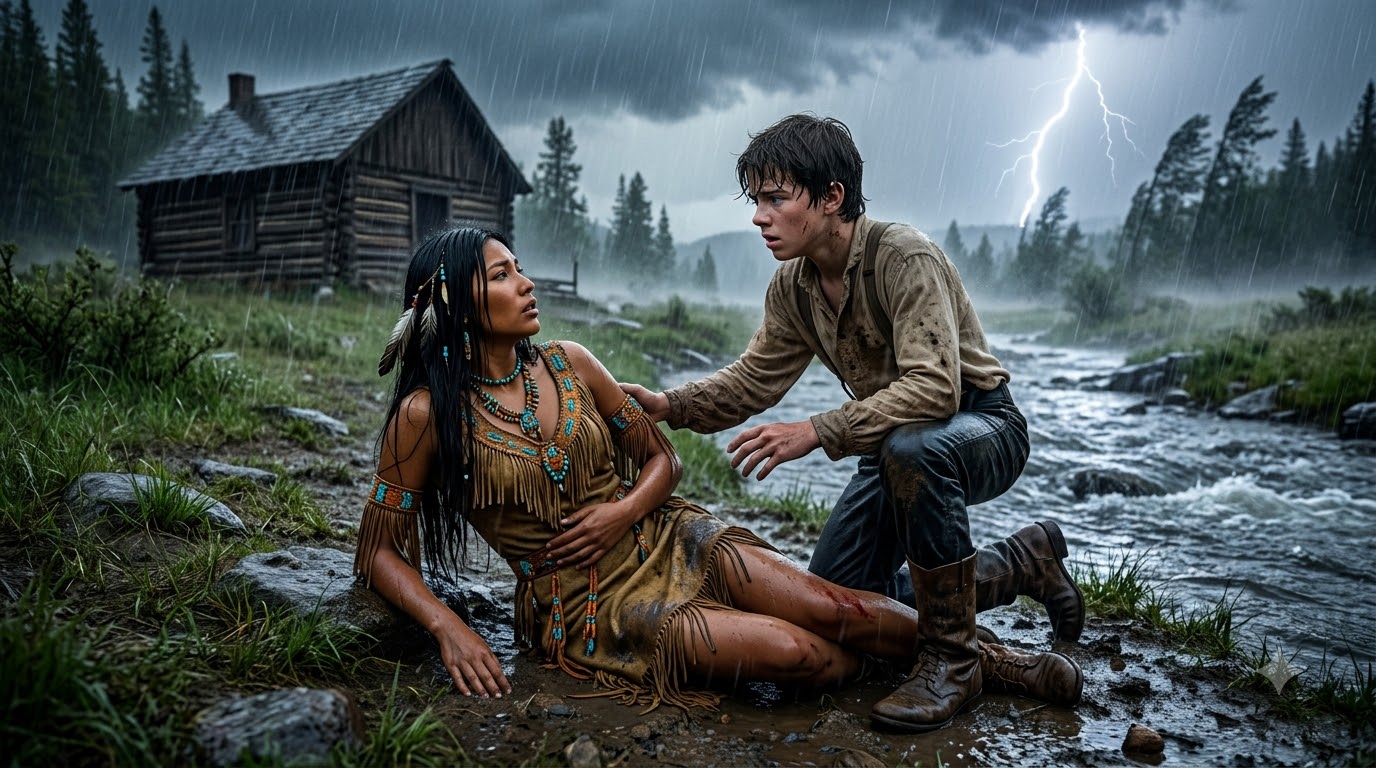
It came without warning. a dark wall of cloud that swallowed the mountains and galloped across the plains. The wind rose to a howl, a roar and mournful sound that seemed to tear at the very foundations of the cabin. Arthur had just finished securing the mule in its lean-to and was battling his way back to the door when he saw eater shape crumpled near the creek bed, almost lost in the whipping grass and gathering gloom. Caution was an instinct drilled into him by his father. Out here, the unexpected was rarely a friend.
It could be a predator, or worse, a man with bad intentions. He flattened himself behind a rocky outcrop, his heart a frantic drum against his ribs, and squinted through the rain-lashed air. It was not an animal. It was a person, small and still. He watched for a long moment, the rain plastering his hair to his scalp, his mind racing through a dozen grim possibilities.
Then a flash of lightning illuminated the scene, and he saw the dark braids, the buckskin dress, the unmistakable profile. It was a native woman. Every fearful story he had ever heard in Harmony Creek came rushing backtales of raids, of bitter land disputes, of a people who had every reason to despise settlers like him. His father had been different. He had spoken of the Cheyenne with respect, trading with them fairly and counseling a peace that few others seemed to want.
But his father was gone. To help her was to invite a world of trouble he was not equipped to handle. to leave her was to let the storm and whatever had brought her down finish the job. He saw her stir, a faint, weak movement, a hand clutching at her side. He could see the dark stain spreading on her dress even from this distance. The stone of grief in his gut seemed to shift.
He thought of his mother, her body growing colder in her bed while he had watched, helpless. He had been a boy then, powerless. He was still a boy now, but this was different. This was a choice. The wind howled like a thing grieving, and in its cry, Arthur made his decision.










