The cold of November 1867 was merciless. It cut through leather, wool, and bone as Caleb Morrison rode alone through the frozen mountains, carrying a sealed letter that had already cost three men their lives. The horse beneath him stumbled where ice had swallowed the trail. Caleb leaned forward and whispered to the animal as if a gentle word might be worth more than another mile of strength. His name had once meant something in the mining towns south of the divide.
Now there was a reward for his capture, a fresh grave behind him, and a promise he had no right to believe he could keep.
The pine needles glittered with frost. Beyond the trees, something moved. Caleb slid one gloved hand toward the revolver at his hip, then stopped when he saw the face between the branches: an older Native man with long dark hair and a fur collar, watching with the terrible stillness of someone who had waited a long time for this meeting. Neither spoke. The horse breathed white clouds into the silence.
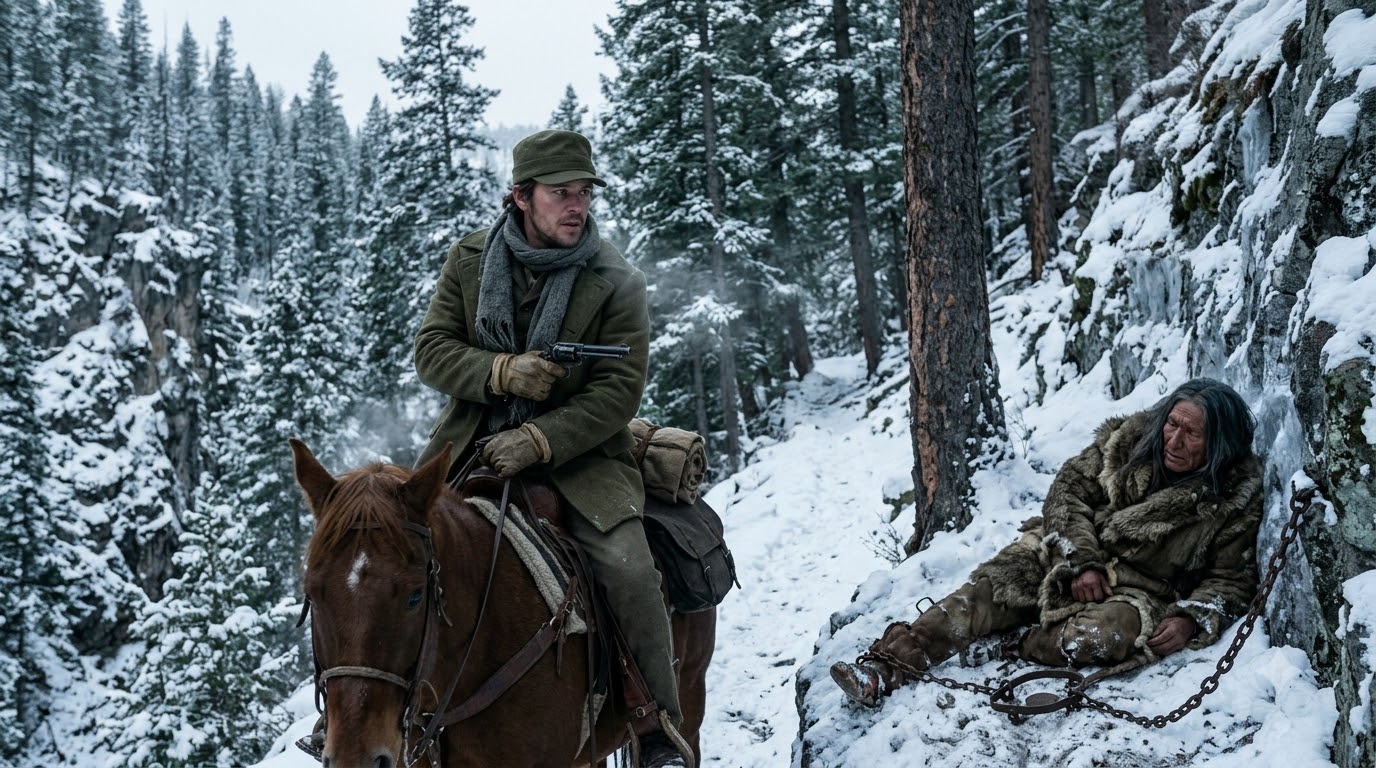
At last the stranger said, “If you have come to finish what they began, you are too late.”
Caleb had imagined enemies in every shadow since leaving Fort Mercy, but he had not imagined a man who knew what he carried. “I didn’t come to finish anything,” he answered. “I came to put something right.” The stranger looked at the revolver, then at Caleb’s face. “Those are different things,” he said. “And the mountains will make you prove which one you mean.”
At a hidden camp among black spruce, the next part of the journey began with a silence that felt heavier than any argument.
The letter bore the names of families driven from their winter valley. Caleb had learned to distrust simple explanations. In the territory, a story could be made respectable merely by repeating it in an office with clean windows, and a lie could travel farther than a horse because it never had to stop for water. The wind found the gaps in the walls and stirred the lamp flame. Nobody reached for an easy answer.
They had all seen what happened to people who mistook certainty for safety.
The first witnesses spoke in low voices, as though the men who had displaced them might still be listening outside. Caleb learned to wait through their silences. He had arrived wanting to deliver a document; he now understood that he was being entrusted with histories that could not be folded into an envelope. At a smoke-darkened shelter beside a frozen stream, the danger acquired a clearer shape. Eliza had been a teacher at the mission and had copied the original orders.
She recognized the broken red seal on Caleb’s envelope.
At a narrow gorge under a leaning wall of ice, the danger acquired a clearer shape. Three hired trackers followed the prints of Caleb’s horse. Caleb chose to lead them away from the camp rather than shoot from cover.
The first witnesses spoke in low voices, as though the men who had displaced them might still be listening outside. Caleb learned to wait through their silences. He had arrived wanting to deliver a document; he now understood that he was being entrusted with histories that could not be folded into an envelope. In a memory of a crowded courthouse in summer, the danger acquired a clearer shape.
Thomas had confessed that a survey map was forged to steal a silver-rich valley. He had begged Caleb to deliver the proof instead of taking revenge. Every conversation returned to the same terrible question: who had profited while families were forced away? The answer was scattered across maps, signatures, ledgers, and memories that powerful men had expected to disappear. Caleb listened carefully, because a careless promise could endanger someone else.
At a cedar grove where the wind could not reach, the danger acquired a clearer shape. Nakoa offered a guide only if Caleb surrendered his revolver. Caleb placed the weapon on a stump and stepped back.
The first witnesses spoke in low voices, as though the men who had displaced them might still be listening outside. Caleb learned to wait through their silences. He had arrived wanting to deliver a document; he now understood that he was being entrusted with histories that could not be folded into an envelope. At an isolated cabin roofed in snow, the danger acquired a clearer shape.
Martha Bell kept a ledger of food shipments diverted from the displaced families. She had hidden two children when soldiers searched the valley. The journey demanded patience that Caleb did not always possess. His brother’s death remained close enough to make every delay feel like betrayal, yet the people traveling with him had already lost too much to another reckless decision. He forced himself to think beyond the next mile.










