The year was 1884, and for Esther Hail, time had clotted like old blood. Two winters had passed since the fever had stolen her husband, Henry, and then their daughter, little Clara, leaving Esther in a silence so profound it had its own weight. She lived on a small homestead at the frayed edge of Redemption Creek, a town whose name was a cruel joke. There was no redemption here, only judgment, hard as the packed earth of its single street. The land itself was a study in severity, vast wind-scoured canvas of brown and gray that offered little comfort and demanded constant toil.
Esther’s life had shrunk to the size of her loss. Her days were a metronome of chores, a rhythm of survival that kept the deeper currents of grief from dragging her under. She woke before the sun, its first pale light, finding her already in the dirt of her garden, coaxing stubborn life from the unforgiving soil. She mended, she cleaned, she preserved. Each task was a bulwark against memory, a way to fill the hollow spaces Clara’s laughter and Henry’s quiet strength had once occupied.
The town’s folk saw her as a phantom, a woman wrapped in perpetual mourning, and they left her to it. Their pity was a blade she did not wish to feel, and their piety a suffocating blanket. So she kept to the margins a solitary figure moving through a life that felt like it belonged to someone else. Her isolation was a fortress she had built brick by silent brick. Inside its walls, she was safe from the whispers and the pitying glances, safe from the casual cruelty that Redemption Creek reserved for anyone who did not fit its rigid mold.
This cruelty was most often directed at the Cheyenne, whose ancestral lands the town had been carved out of. They were specters from a past the settlers wanted to forget. Their presence on the outskirts of town, a constant, unwelcome reminder. They were called savages, thieves, heathen swords, spat like tobacco juice, staining the air with contempt. Esther heard the talk on her rare trips into town for salt and flour, and she simply lowered her head, making herself smaller, wanting only to finish her business and retreat back to the quiet ache of her solitude.
Her grief was a world unto itself, leaving no room for the injustices of the one outside. It was a trip for kerosene and thread that shattered the fragile piece of her existence. The sun was high and merciless, beating down on the dusty street. A commotion had gathered outside the mercantile, a tight knot of self-righteous anger. At its center stood Arthur Vance, the town’s blacksmith and self-appointed arbiter of justice, his face flushed with power.
Before him, held firm by two grim-faced men, was a girl. She couldn’t have been more than 15, a slip of a thing with wide, terrified eyes, and the proud, sharp features of the Cheyenne. “Stole a whole sack of flour,” a woman shrieked, her voice thin and sharp. “Right from my wagon.” The girl, whose name Esther would later learn was Mesa, said nothing.
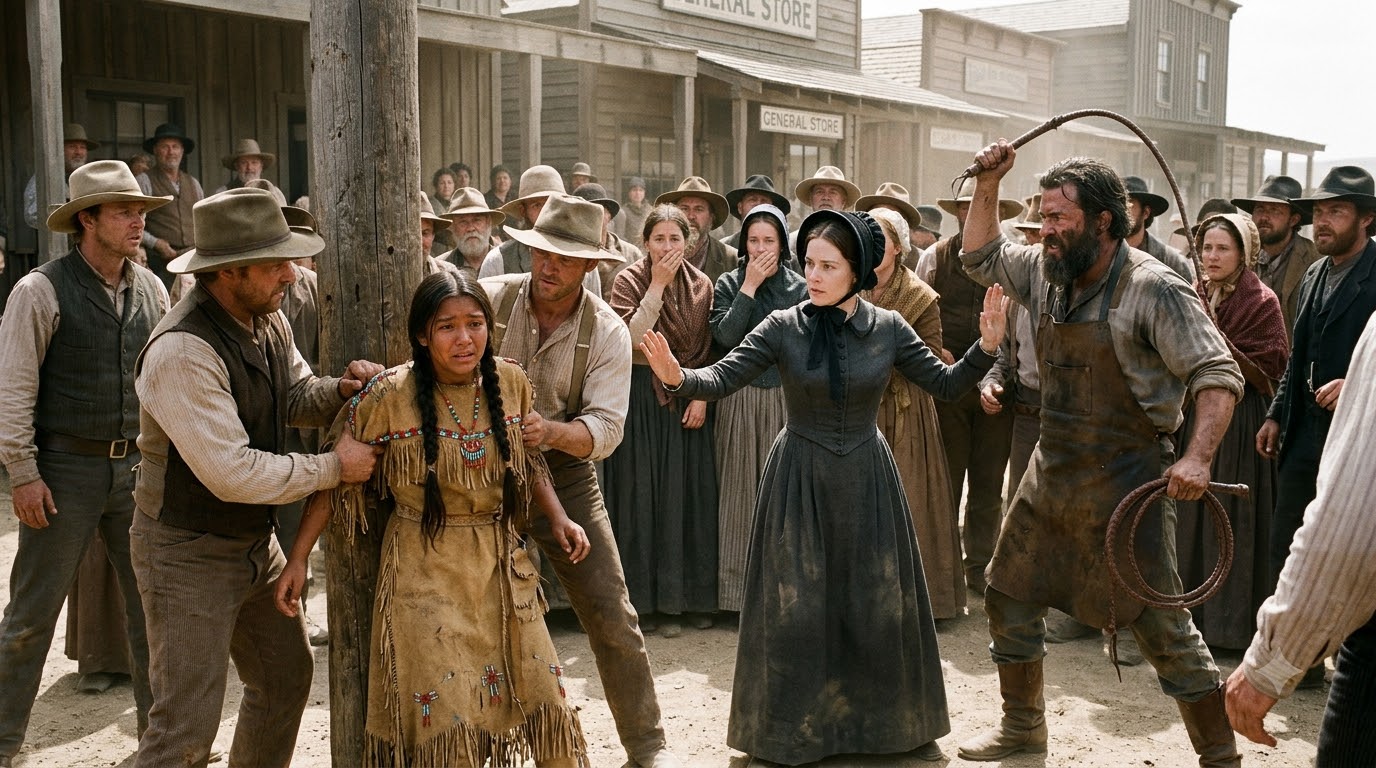
Her silence was not an admission of guilt, but a wall of dignity against their hate. She stared straight ahead, her small frame trembling almost imperceptibly. We have laws against thievery in this town. Vance boomed, his voice carrying over the murmuring crowd. He enjoyed these moments, the rapt attention of his neighbors, the fear in the eyes of his victim.
And we make examples of thieves, 10 lashes, let it be a lesson to her kind. A collective gasp, part horror, part grim satisfaction, rippled through the crowd. 10 lashes could break a grown man. For a child this slight, it was an act of unspeakable brutality. Esther felt a cold sickness wash over her.
She saw the raw terror that finally broke through the girl’s composure, her eyes darting around, searching for a friendly face and finding none. In that terrified gaze, Esther saw a spectre of her own Clara, lost and alone. Something inside her, a cord of maternal instinct, she thought long dead, pulled taut. The numbness that had been her shield for two years cracked, and a hot, fierce rage poured into the fissures. Before she understood what she was doing, her feet were moving, carrying her through the parting crowd until she stood before Arthur Vance.
The town went silent, mouths a gape at the sight of the reclusive widow stepping into the center of their drama. “Mr. Vance,” she said, her voice rusty from disuse, but surprisingly steady. He turned, his eyes narrowing. “Mistress Hail, this is no concern of yours.”
“The girl,” Esther said, her gaze fixed on him, ignoring the burning stares of the town’s people. “She is just a child. Whatever she did, this is not justice. It is cruelty.” Vance let out a short, humorless laugh.










