Get this dirty black kid away from my table before he steals something or gives us all some disease. Gregory Hamilton said it loud. 8:30 p.m. on a Friday in October. 52°. The Sterling Oaks patio.
String lights glowing. Gas heaters fighting the chill. Hamilton in his $12,000 wheelchair. Seven dinner guests laughed nervously. Champagne glasses raised.
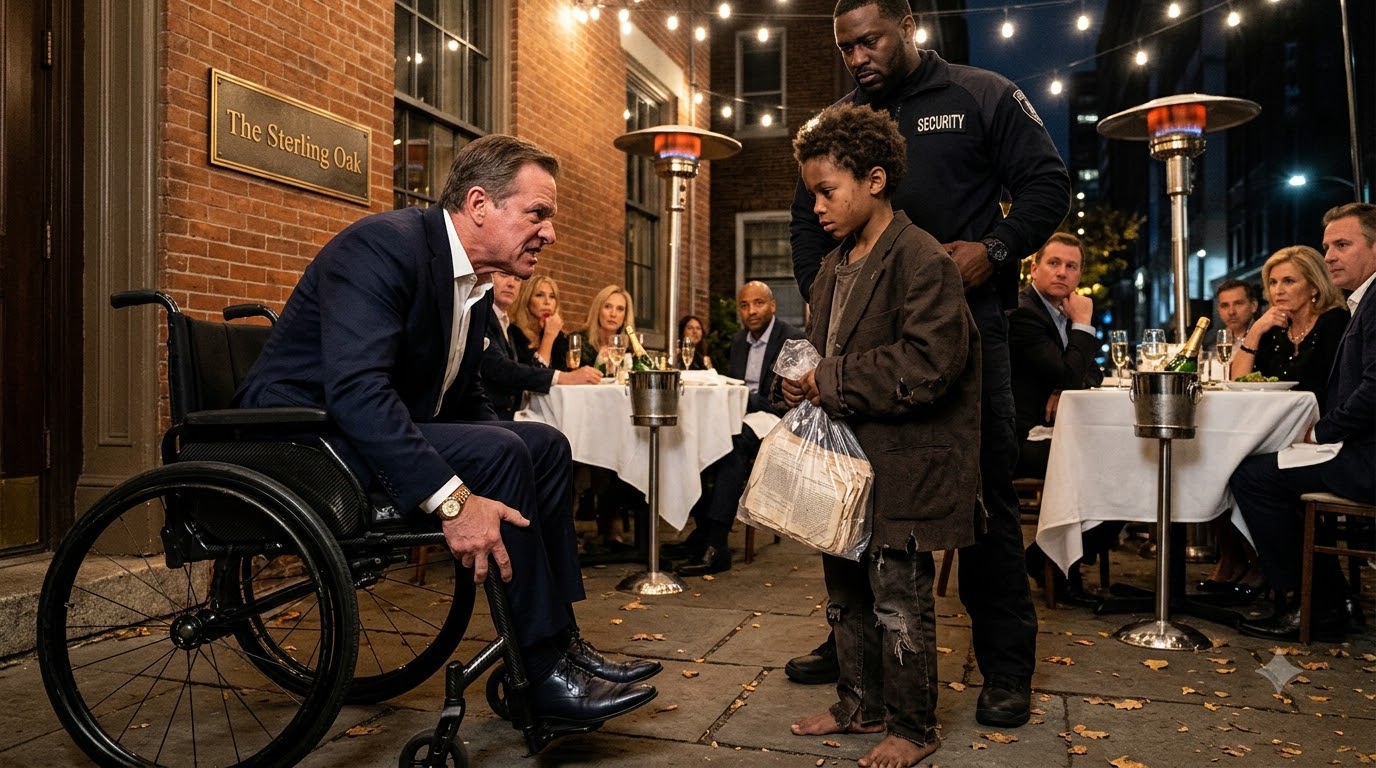
Miles Underwood stood 3 ft away. 9 years old, homeless, barefoot, jacket torn from digging through their dumpster. Black in a sea of white faces. Sir, please. I can help your leg.
You Hamilton laughed. How long would this miracle take, boy? Miles’s voice shook. Seconds. The journal said seconds.
Laughter exploded across the patio. Hamilton pulled out his checkbook, laughing so hard tears streamed down his face. Perfect. Heal me for $1 million in your magical seconds, street rat. When you fail, police take you.
Miles whispered, “Okay.” 30 minutes earlier. 30 minutes. 8:00 p.m. Miles had followed the smell six blocks from mile 34 overpass. Garlic butter, grilled ribeye, food from a different universe.
October air bit at his bare feet, but 52° wasn’t cold enough to kill. Not yet. November would be different. the Sterling Oak sat like a mansion. Brick and ivy.
Warm light spilling from every window. people who’d never been cold, never been hungry, never been invisible. Miles found the service entrance, the dumpster, and beside it, the recycling bin where someone had tossed reading material. Three torn copies of the Journal of Emergency Medicine, July 2024 issue, coffee stained, water damaged, someone’s discarded subscription. To Miles, they were gold.
He smoothed the pages on the ground beside decorative shrubs that separated the dumpster area from the outdoor patio. 5 ft away, through gaps in foliage, he could see everything. 12 tables under string lights, gas heaters glowing orange, the kind that cost more than his mother’s monthly salary when she’d had one, when she’d been alive. Miles found bread crust in the dumpster’s top layer. Ate it while reading by borrowed patio light.
Article title: Acute sciatic nerve entrapment from gluteal spasm emergency release protocol. His eyes moved across the page once. That’s all he needed. Photographic memory. Tested at age six.
Extraordinary. The school counselor had said. That was before extraordinary stopped mattering before his mother died. And extraordinary became just another word for different. The text imprinted on his brain like a photograph.
Perfect, permanent, complete. Acute piriformis or gluteal spasm causing sciatic compression presents as sudden onset lower extremity paralysis. Emergency release protocol. Identify trigger point 2 in inferior to greater trochanter. Lateral approach 45° angle.
Sustained pressure 8 to 12 lb. Duration 15 to 30 seconds. Muscle relaxation and nerve release is instantaneous. Miles whispered the protocol to himself, adding it to his internal library. 50 pages before this, 51 now.
His entire medical education stored in a Ziploc bag and his unbreakable memory. On the patio, celebration exploded. The center table, eight people, champagne bottles in silver ice buckets. Cristal, $1,200 per bottle. He’d found a wine menu last week.
A man sat at the head in a wheelchair, custom carbon fiber, maybe mid-50s. tailored suit, expensive watch. He raised his glass to $200 million and the biggest land deal Philadelphia has seen in a decade. Crystal clinked. Laughter rolled like thunder.
But Miles wasn’t watching the celebration. He was watching the man. The way he shifted his weight every few minutes, always left side, grimacing when he thought no one looked, reaching down to adjust his left leg like furniture that wouldn’t stay in position. A younger man leaned in. Mr. Mr. Hamilton, you sure you’re okay?
I’m fine, Brandon. Keep the champagne flowing. But he wasn’t fine. Miles could see it in the micro movements. Hamilton’s left foot at an unnatural angle.
The way he shifted position like clockwork. 3 minutes, 4 minutes. Pressure building with nowhere to release. Miles looked at the journal page at the anatomical diagram showing gluteal muscle wrapped around sciatic nerve. At the trigger point marked with an X, at the words instantaneous release, he looked back at Hamilton, struggling through celebration.
Miles’s fingers found the hospital wristband in his pocket. His mother’s Temple University Hospital. Patient ID. Tu284091. Rebecca Underwood, age 31, dead 8 months, 2 weeks, 4 days because nobody had listened when she’d said something’s really wrong.
He looked at Hamilton in pain, and Miles knew with the certainty of 51 memorized pages and 8 months watching medicine through hospital windows that something was about to go very wrong. He didn’t know yet he’d be the one to fix it. Miles pulled the hospital wristband completely out of his pocket. Yellow plastic, scratched from being carried everywhere for 8 months, 2 weeks, and 4 days. The text was fading, but he could still read every character.
He’d memorized it anyway. Rebecca Underwood, DOB: March 15th, 1994. Admitted August 13th, 2025. Allergic to penicillin. His mother had been 31 years old when she died.
31. Young enough that she should have had decades left. Young enough that when she’d first said, “I think something’s really wrong in that emergency room,” they should have taken her seriously instead of telling her to wait. instead of processing people with insurance cards first, instead of making her sit in that plastic chair for 6 hours while the infection in her body multiplied and spread. Someone please listen, she’d said over and over, getting weaker each time.










