Sir, please let me work to pay off the debt. Richard Whitmore III looked up from his poker cards and laughed. ” Work to pay it off? A Black cleaning woman paying back fifteen thousand dollars?” He shook his head. ”
People like you can’t even count to ten.” He towered over Denise in her stained work uniform. ” You’ve been cleaning my floors for twelve years. Twelve years of hanging around here as if you belong, when you don’t. You smell like bleach and poverty.
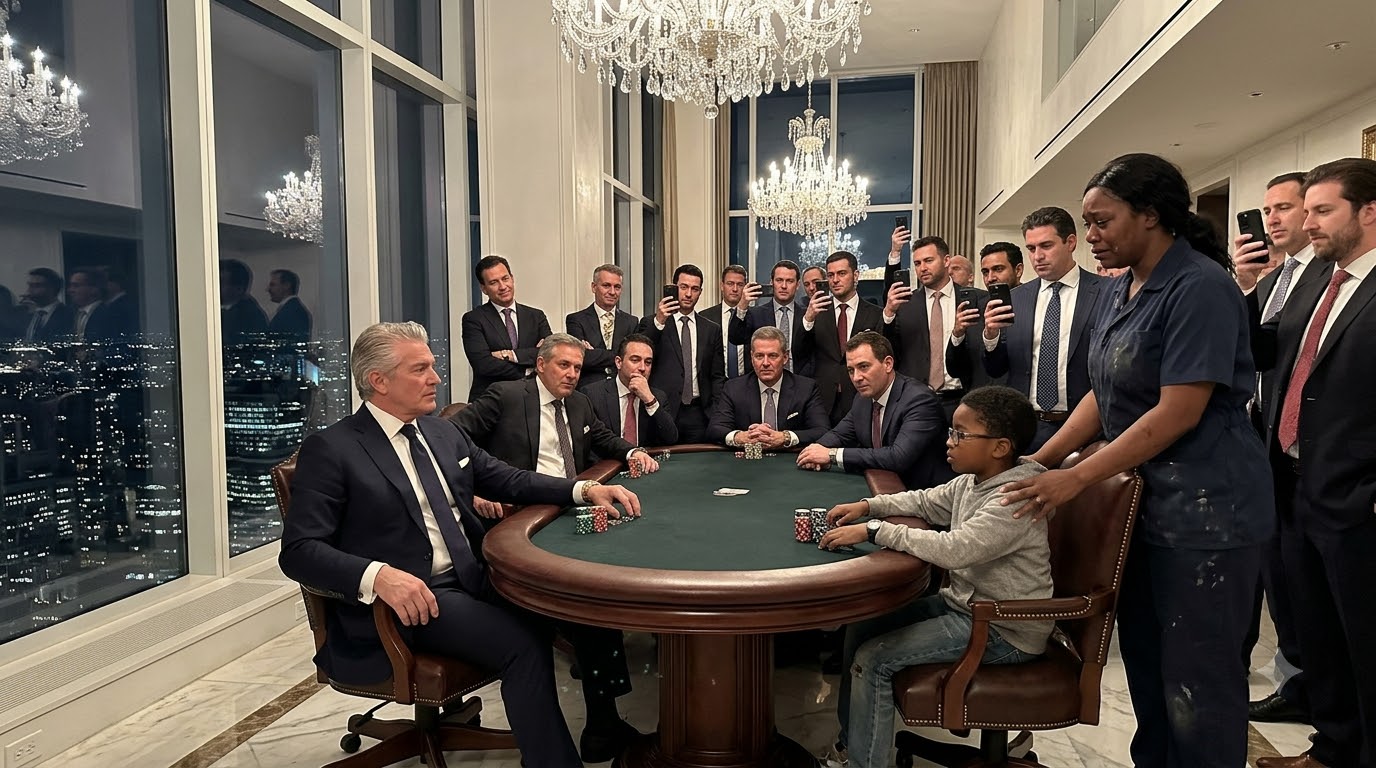
And that little boy of yours in the ragged hoodie will end up just like you, serving people like me forever.” The executives laughed. Someone pulled out a phone and began livestreaming. Security guards watched with folded arms, and no one moved. A ten-year-old Black boy stood frozen as he witnessed his mother’s humiliation.
But none of them knew what was coming. The child they dismissed as a slum kid was about to sit at the poker table and take everything from the richest man in the room in a single hand. To understand that night, you must understand two different worlds. The first was sixty-three floors above Manhattan: the Whitmore Capital penthouse, a palace of leather chairs, crystal decanters, and hand-rolled Cuban cigars. Its private poker room featured a custom mahogany table covered in green felt imported from Monaco.
Photographs on the walls showed Richard Whitmore III shaking hands with senators, celebrities, and Fortune 500 CEOs. In a glass display case near the bar, three amateur poker championship trophies glittered in the soft light. Those trophies were Richard’s pride and joy. He spent more than fifty thousand dollars a year on private coaches, flew to Las Vegas six times annually, and never missed a World Series of Poker broadcast. He was not merely wealthy; his family had been rich for three generations.
His grandfather had built the fortune, and his father had doubled it. Richard himself had never earned a dollar in his life. But he had mastered something else: making other people feel small. That, rather than cards or business, was his real talent—cruelty. The second world was five miles north, in a fifth-floor Harlem walk-up.
Cracked windows let the winter wind in, and the clanking, groaning heater worked only half the time. Library books covered the kitchen table, and tape held together the seat of a folding chair. The walls were bare except for one framed photograph: a man in military uniform holding a deck of cards. This was Preston Foster’s world. Preston was ten, small for his age and therefore an easy target in the eyes of bullies.
He was so quiet that teachers sometimes forgot he was in the classroom. His glasses were repaired with tape, and his clothes came from Goodwill. They were always clean and carefully pressed because his mother insisted on dignity even when money was scarce. His dark, sharp eyes were just like his grandfather’s; they missed nothing. His mother, Denise Foster, was forty-two and had cleaned Whitmore Capital for twelve years.
She worked nights, weekends, and holidays. For twelve years she scrubbed toilets for men who earned more in a minute than she made in a month. Her hands were rough and her back always hurt, but she never complained. Every dollar she could save went toward Preston’s future. She dreamed of college, a scholarship, and a way out for her son.
She did not know that Preston had already discovered a different route. Three years earlier, his grandfather William had taught him to play cards—not children’s games, but real Texas Hold’em poker. He taught the mathematics of probability, the psychology of reading people, and the discipline of controlling emotion when everything was at stake. William Foster was a Black Korean War veteran from Alabama. He had learned poker in the barracks, where white soldiers refused to let him join their table until they needed a fourth player and could find no one else.
Nineteen-year-old William won six months of their pay in a single session. They beat him, called him a cheat, broke two ribs, and split his lip. But they could not take back what he had learned. After the war, William played in underground games in Chicago. Hidden rooms and basement clubs were some of the only places a Black man could play for serious money in 1950s America.
He won enough to buy a house, then lost everything to a swindler who rigged a game against him. ” The game itself is honest,” he always told Preston. ” It’s the world that cheats us.” Cancer took William when Preston was seven. During his last three years, he poured everything he knew into his grandson: every trick, every tell, every formula for calculating odds in real time.
Preston proved even more gifted than William. At ten he computed probabilities faster than most adults could add single digits. He spotted a lie in a tightened eyebrow, a shift in breathing, or the movement of fingers toward poker chips. Gamblers called this a natural gift: an almost uncanny ability to understand people. For two years, Preston had played online under the name Ghost 12.










