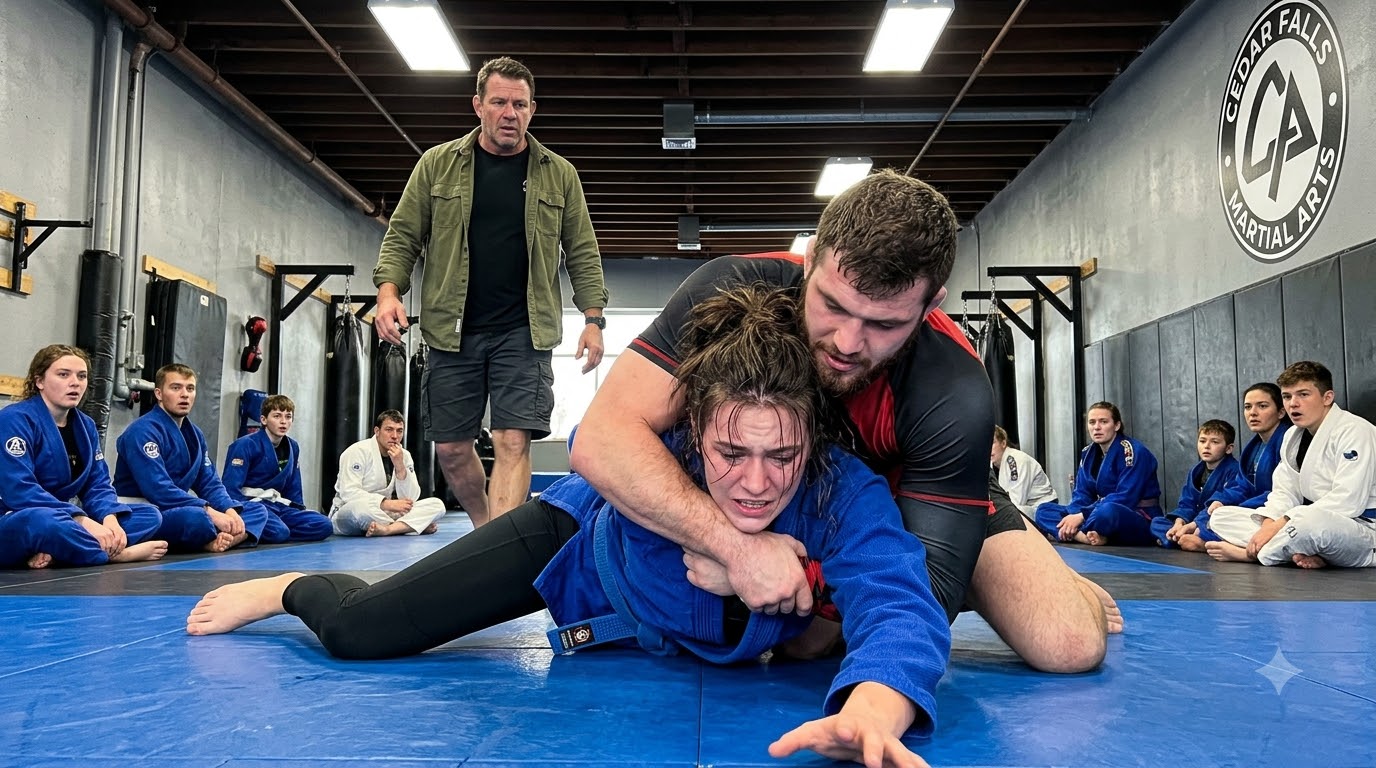
She tapped his arm twice, clear and deliberate, the signal every fighter knew. He did not let go. “Come on,” Tyler whispered against her ear. “Don’t quit on me. Three more seconds.”
Three seconds meant nothing on most days, but that day they seemed to last forever. The room fell silent, no one moving or saying a word. The instructor stepped out of his office, saw the young woman on one knee struggling for breath, and said only, “Everybody take a water break.” She did not scream or fight back. She picked up her bag and walked out.
Everybody in that town thought she was merely a gentle waitress. Nobody thought to ask who her father was. Six weeks later, in a hall crowded with townspeople, a tall stranger in a dark jacket stood in the back row. “My name is Daniel Whitfield,” he said. “I’m Casey’s father.”
And Cedar Falls seemed to stop breathing. Every small town has a story it likes to tell about itself. Cedar Falls told a pleasant one: friendly people, clean streets, and a diner where the staff knew your order before you sat down. But every town also has a story it would rather not tell. This was that second story, beginning with a young woman whom nobody noticed and ending with a lesson the town would never forget.
Her name was Casey Whitfield, and she was twenty-one. She entered rooms quietly, not timidly but carefully, like someone who had learned to think before speaking. Casey arrived in Cedar Falls on a Tuesday in early September with a suitcase, a duffel bag, and an old Honda showing 140,000 miles. Nobody waited for her, and there was no welcome party, only a rented room over a hardware store and a job interview scheduled for the following morning. Anyone passing her during that first week would probably not have looked twice.
That was precisely how she wanted it. She had grown up moving from place to place. Her mother died when she was sixteen, and her father’s career in the Navy kept him away for long stretches. Casey learned early to look after herself, pack in ten minutes, and avoid getting too attached to places she might soon have to leave. She chose Cedar Falls almost at random on a map, far from her former addresses and everything associated with them.
She wanted a fresh start and, more than anything, a little peace. Doris Bennett ran the diner on Main Street. She was sixty-eight, with silver hair tied into a bun at five every morning and hands that had flipped more pancakes than anyone could count. She had buried her husband and raised two children in the apartment above the diner. Doris did not hire casually, but something about Casey’s application caught her eye: neat handwriting, not a wasted word, and reliability listed as a skill rather than simply a personality trait.
“Ever waited tables?” she asked across the counter on a slow Wednesday morning. “Yes, ma’am. Two years back home.” “Where’s home?” Casey paused for half a second.
“Lots of places. Military family.” Doris nodded; her own father had served. “You start Monday, six sharp. Don’t be late, and don’t call me ma’am.
Makes me feel older than I am.” Casey almost smiled. “Yes, Doris.” It was the beginning of the only real friendship she would have in Cedar Falls for some time. That friendship started with black coffee and burned toast, and eventually meant far more than either expected.
The diner suited Casey: work kept her hands busy and her mind quiet. Old men came for eggs and conversation every morning; truck drivers stopped for the coffee Doris deliberately brewed too strong. Nobody asked too many questions, and that suited her. Yet the room over the hardware store became very quiet at night. There she maintained a ritual from years of moving between apartments and towns.
Before bed, she took a small leather case from the bottom of her duffel bag and placed it on the windowsill where the streetlight caught it at an angle. Inside was a single metal object, her father’s Navy SEAL Trident insignia. He had given it to her five years before, after her mother’s funeral, during a moment neither of them ever discussed again. He had said little: “Your mother always said you were the strongest person in this family. I think she was right.”
Casey had never worn the insignia or shown it to anyone. Some late nights she looked at it, then put it away again, hidden and safe, not ready to be seen. Perhaps she did not want people to see her differently, or perhaps she was not prepared to carry everything the emblem represented. She might not have been able to explain it herself. For now, leaving it in the bag was enough.










