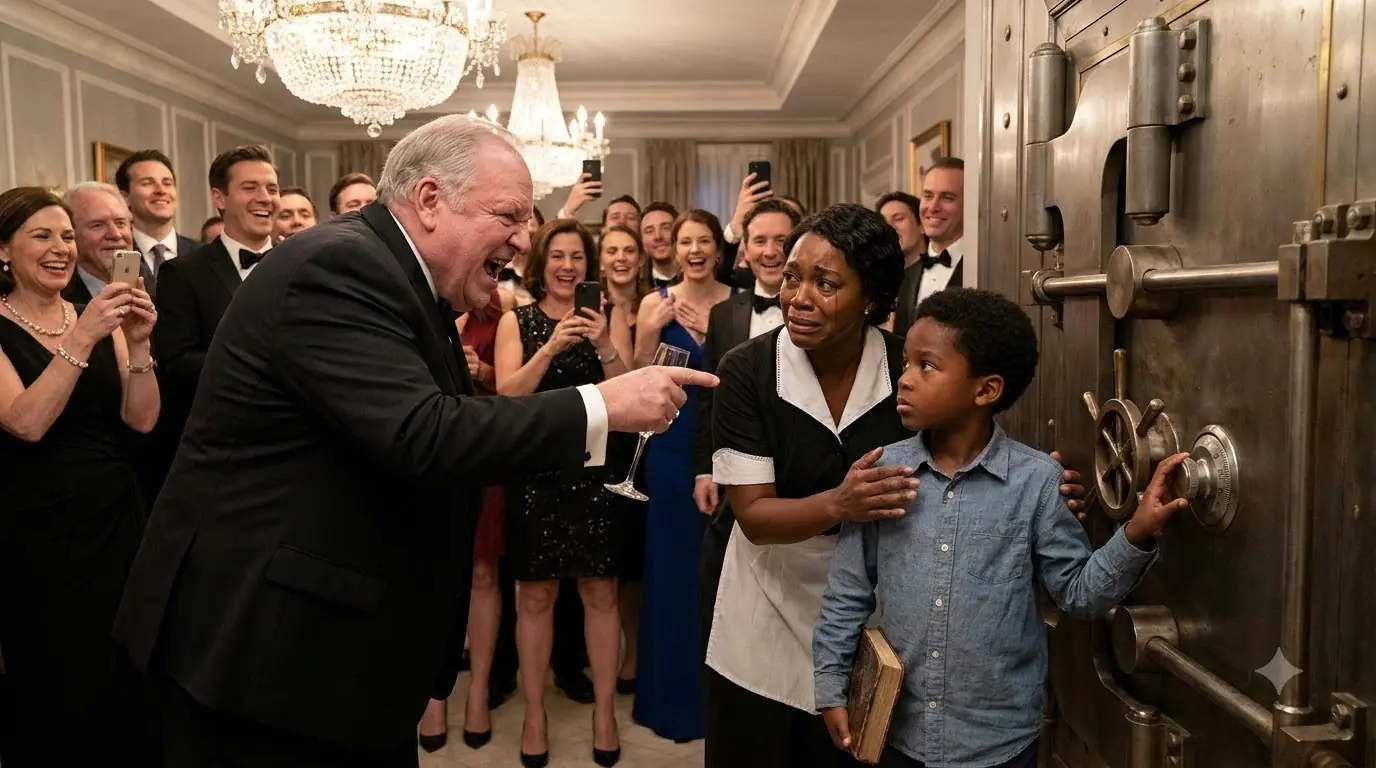
The first thing Caleb Morgan noticed was that the billionaire had moved his mother’s name from the guest list to the wager.
“Five minutes,” Gideon Rook said, lifting a jeweled watch so everyone in the ballroom could see it. “Open that safe in five minutes, and I’ll write your mother a check big enough to buy her freedom. Fail, and she leaves my employment tonight. No severance. No recommendation. Nothing.”
Caleb was ten years old. He had a library card in his back pocket, a borrowed dress shirt with one button missing, and an unfinished science worksheet folded inside his sock because he had been afraid of losing it. His mother, Tessa Morgan, stood beside a tray of untouched champagne glasses with the expression of a woman trying to keep an entire building from falling by holding up one corner.
“Mr. Rook,” she said, “my son didn’t come here to entertain your guests. His babysitter canceled. I explained that to Mrs. Feld. He was supposed to sit in the service office. Please let me take him home.”
“You brought a child into a private reception.” Rook sounded almost bored. “Then you let him tell people he could do what paid experts couldn’t. I’m giving him a chance to prove it.”
“I never said I could open it,” Caleb said.
Rook looked down at him. He was tall, silver-haired, and dressed in a dark suit whose cloth seemed too smooth to belong in the same world as Caleb’s mother’s uniform. Behind him stood a steel cabinet taller than the child, with an antique brass emblem above its double doors. A velvet rope surrounded it. A small museum-style placard announced that the contents were valued at two hundred million dollars.
“What was that?”
“I said it looks like a Hollis document vault,” Caleb answered. “And I asked why the side of the door isn’t even.”
Someone laughed. Another person lifted a phone. A dozen more followed. Guests had been taking photographs all evening, but now their lenses were pointed at a boy who had never agreed to be photographed. Caleb’s mother moved in front of him, and Rook smiled as if he had been handed the last piece of entertainment he needed.
“A mechanical genius,” he announced to the room. “Wonderful. We have found one in the service corridor.”
Caleb looked at his mother’s hands. They were raw across the knuckles where cleaning products had dried the skin. The long sleeve of her uniform hid most of the old burn she had gotten pulling a hot tray out of an oven that wasn’t part of her job. She had worked for Rook House Hospitality for fifteen years. She called the regular guests by their titles and could recite their dietary restrictions, their children’s birthdays, and the names of dogs she had never been permitted to pet. Most of those guests did not know hers.
“The job is hers whether I touch it or not,” Caleb said quietly. “You can fire her either way.”
Rook’s smile narrowed. For the first time, he seemed to hear a statement he hadn’t rehearsed a reply to.
“Clever boy. You’re sure you want to talk to me like that?”
Caleb wasn’t sure. His knees had started trembling. He thought about the envelope marked RENT that his mother kept beneath the sugar jar, and the red notice from their landlord that had arrived on Tuesday. He thought about his sister Josie at their grandmother’s apartment, asleep with a stuffed rabbit under her arm. He thought about his father telling him that courage was not the absence of fear but the decision to be careful while frightened. His father had said many things before he died. Caleb remembered this one because he had never expected to need it in a ballroom.
“Please don’t make him,” Tessa said.
“Oh, we’re well past that.” Rook snapped his fingers at the event coordinator. “Start the clock.”
A young woman at a podium raised a tablet. A red digital timer appeared on the screen over the fireplace. Five minutes. The room seemed suddenly larger, with people arranged in silent rings beyond Caleb’s reach. At the edge stood a woman with a gray braid and a plain navy jacket, different from the glittering guests. She was watching Rook, not the safe.
Caleb turned toward his mother. Her eyes were wet, but she shook her head just once. It was not a command. It was fear asking him not to carry what belonged to adults.
Then Rook said, too loudly, “He can count to five, can’t he?”
Caleb stepped beneath the velvet rope.
He did not know that by midnight a paper hidden behind those doors would make a woman in the room drop her champagne glass. He did not know that the paper would lead to a building on his own street, a trust established before he was born, and a decision his mother had been forced to live with for thirteen years. He knew only that the brass emblem was crooked by an amount small enough that everyone else had missed it. And he knew that someone had made this safe to protect things, not to humiliate children.










