“It’s just metal, Ohio,” he said. He threw her father’s dog tags onto the ground and stepped on them. Forty football players watched, along with thirty cheerleaders. Nobody said a word. The freshman girl did not scream or cry.
She knelt on the grass, picked up the chain, and brushed the dirt off the metal as though she were cleaning something sacred. Then she looked him straight in the eyes. “You still have a chance to back off,” she said. He laughed at her, and so did his friends. For six weeks, they had laughed, spread lies about her late father, planted evidence in her bag, and left bruises on her best friend’s arms.
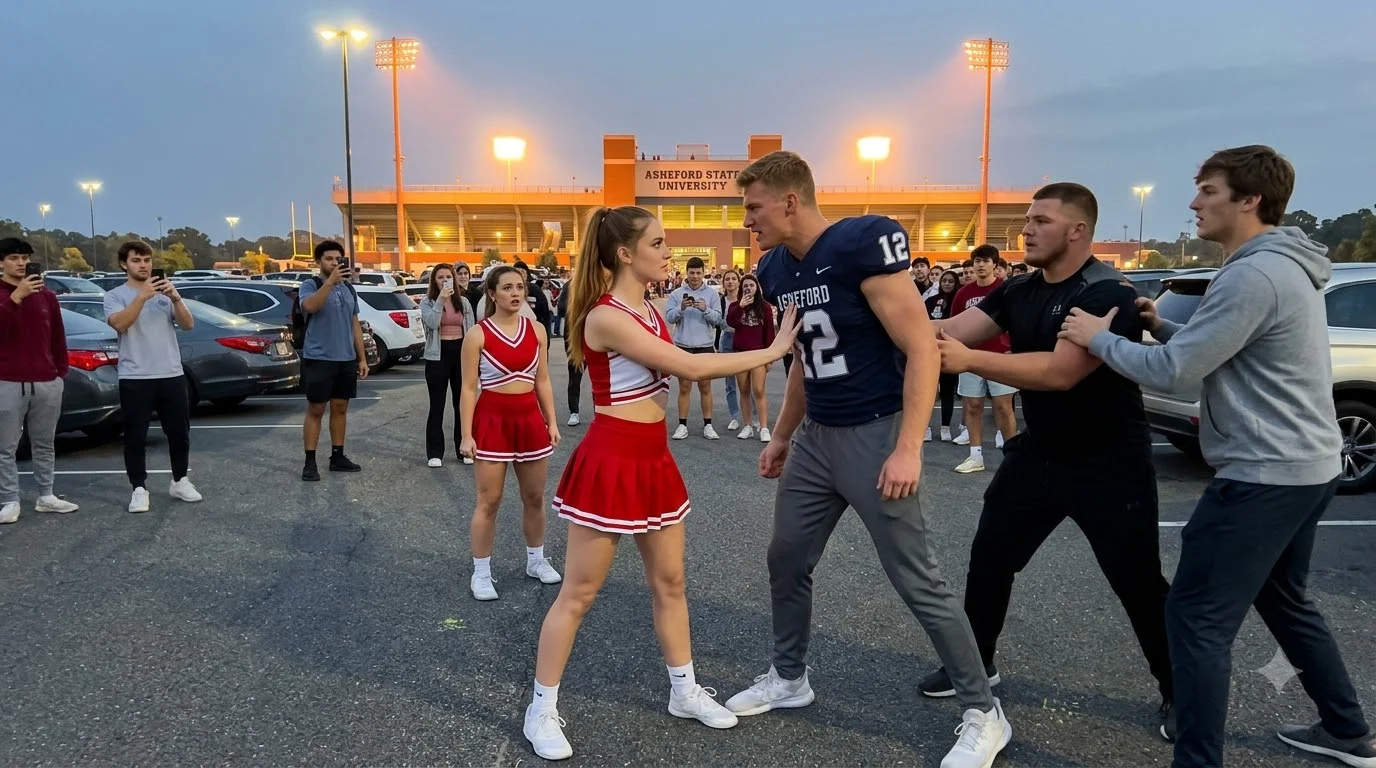
They thought she was weak because she was quiet. They did not know that her father had spent twenty years teaching soldiers how to fight without weapons, or that he had taught his daughter everything he knew. In a dark parking lot, all three of them would discover the truth. The town of Asheford stood where the cornfields ended and the university began. It was not a large place; everyone knew someone, and that someone knew everyone else.
On a Tuesday morning in late August, a moving truck stopped outside a small brick dormitory on the edge of campus. A young woman stepped out of the passenger seat. Her name was Josephine Callaway, although most people called her Joe. She was eighteen, with pale skin, light brown hair tied in a simple ponytail, and eyes that observed far more than she spoke. She carried two duffel bags, one in each hand, and needed no help.
She had learned to manage on her own a long time ago. Inside one of the bags, wrapped in an old T-shirt, was a small wooden box containing a set of dog tags. They had belonged to her father, Daniel Callaway, a former sergeant major in the United States Army. He had spent years teaching young soldiers hand-to-hand combat and how to remain calm when everything around them descended into chaos. Three years earlier, he had been killed while serving overseas.
Joe did not talk much about his death. She did not need to; it lived inside her, quiet and steady as the beat of her heart. She entered the dormitory, where a woman at the front desk checked her name against a list and handed her a key. Room 214 was on the third floor, and there was no elevator. When Joe reached it, she was breathing a little harder, but her expression revealed nothing.
She set down her bags. Another girl was already there, sitting cross-legged on one of the two beds and sorting a box of photographs. “You must be Joe,” the girl said. “I’m Nora. Nora Bennett.”
Norah had dark curly hair and a bright smile. She was majoring in journalism and, although she had arrived only two days earlier, had already befriended nearly half the building. “Nice to meet you,” Joe said. That was all. Norah waited for more, but nothing came.
In the weeks ahead, she would discover that Joe Callaway did not speak merely to fill the silence; when she said something, she meant it. Still, Norah tried again, because that was her nature. “Where are you from?” she asked. “A small town in Ohio,” Joe answered. “You’ve probably never heard of it.”
“Try me,” Norah said. As expected, Norah had never heard of the place, and she admitted it with a laugh that put Joe more at ease than she had anticipated. They spent the next half hour unpacking and deciding who would take which side of the room. It was the ordinary, small negotiation of two strangers learning to share a space. Norah talked enough for both of them, filling the room with pleasant chatter about her hometown, her older brother, and the newspaper her mother insisted on reading from beginning to end each morning before anyone else was allowed near the coffee pot.
Joe listened more than she talked, as usual, though something about Norah’s easy warmth made listening feel less like keeping her distance and more like relaxing. Asheford State University was not a famous school. Its football program made no national headlines. But in a small town like Asheford, the football team was practically royalty, and every royal court had its entourage. At the center of that circle was a young man named Grant Sterling.
Grant was the starting quarterback and had held that position since his sophomore year. He was tall and broad-shouldered, with an easy charm that made teachers forgive him and parents trust him without asking why. His father, Preston Sterling, owned three automobile dealerships across the county and sat on the university’s board of trustees. When people in Asheford spoke the Sterling name, they did so with the automatic respect they might give to a bank. Grant had two friends who followed him almost everywhere, like shadows in the late-afternoon sun.










