“Excuse me, sir. I’d like to check my account balance,” said a Black boy standing at the counter in worn-out shoes. He was ten years old, with cracked soles, frayed shoelaces, and a secondhand jacket hanging loosely on his small frame. The bank manager stopped, slowly looked him up and down, and burst into laughter. “Check your account? This is First National Heritage Bank, not a welfare office for street children.” Bradley Whitmore approached, the smell of his expensive cologne contrasting with the ugliness of his sneer. “Look at those shoes. Look at that skin. Another Black kid begging for money. You’re all the same, so get out before I call security. We serve real customers here.” The security guard moved closer with a hand resting on his baton.
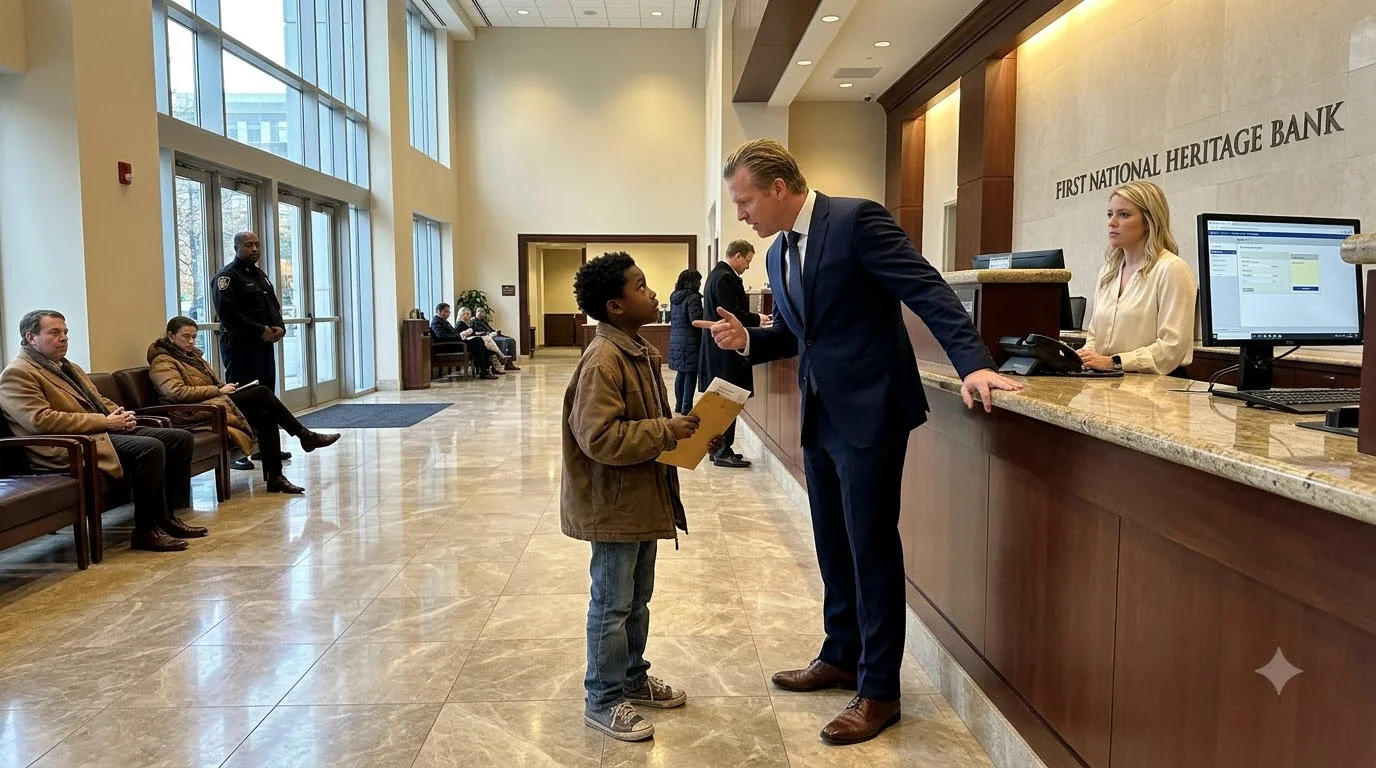
A wealthy customer shouted from behind them, “Throw him out already. He’s making the whole place stink.” Cruel laughter echoed through the marble lobby, loud and unified against one small child. Nobody defended him, not a single person. But none of them could imagine what would happen next. Within an hour, Bradley Whitmore himself would be begging, not for money, but for forgiveness. Wesley Brooks did not argue or shout.
He held his ground as Grandma Eleanor had taught him. “Sir, I have an account here,” he said, his voice trembling but not breaking. “My grandmother opened it for me. She passed away two months ago, and she left me this.” He held up a brown envelope containing documents, a bank card, and the letter his grandmother had written before she died. Bradley rolled his eyes theatrically. “Your grandmother? Let me guess, she also left you a mansion in the Hamptons and a private jet.” Another round of laughter followed, and the wealthy customers seemed to enjoy the performance.
Chelsea Morrison, the senior teller, leaned over the counter with contempt on her face. “Sir, should I call the police? This child is obviously running some kind of scam.” Bradley waved her off. “Not yet. Let’s see what kind of scam he’s trying to pull.” He snatched the envelope from Wesley’s hands and roughly pulled out the papers. Bradley glanced over the documents with bored contempt until he noticed the black bank card. It was a premium Platinum Reserve card, the sort issued only to high-net-worth clients.
For a second, confusion and perhaps doubt flashed across his face. But prejudice was powerful enough to blind him to what was right in front of him. He pushed the doubt away and demanded, “Where did you steal this?” He held up the card for everyone to see, as if presenting evidence at a trial. “A Black kid from the slums with a Platinum Reserve card. Do you really expect me to believe that?” Wesley’s hands shook as he protested that he had stolen nothing and that the card belonged to him. Bradley cut off his mention of his grandmother, tossed the card onto the counter, and watched it slide across the marble.
“I’ve worked in banking for fifteen years, kid. I know a fraud when I see one.” Bradley pointed toward the farthest corner of the lobby, beside the janitor’s closet and the restrooms, where the worst seats in the building stood. “Sit there. Don’t move or talk to anyone. I’ll call headquarters to verify this supposed account.” Wesley walked to the corner, each step heavier than the last, and sank onto a cold metal chair. Alone among marble, brass, and wealth that seemed to mock his battered shoes, Wesley took out Grandma Eleanor’s letter. Her handwriting had been shaky but full of love. “My brave Wesley, never let anyone make you feel small. You are worth more than they could ever know.” He read the words three times, trying to believe them.
His phone vibrated with a message from Uncle Lawrence. “Stuck in a meeting. I’ll be there in twenty minutes. You’re doing great, champ!” Wesley almost smiled. He had no idea how much those twenty minutes would change. The first stage was waiting. Fifteen minutes passed, then twenty, then twenty-five, while Wesley remained in the corner, invisible and forgotten.
The bank continued its business around him. Customers came and went, tellers smiled, and transactions were completed as usual. Bradley helped a white man in a golf polo open an account even though the man had arrived fifteen minutes after Wesley. That customer was welcomed immediately, without suspicion, extra identification demands, or a humiliating interrogation. Wesley watched Chelsea bring Bradley coffee from the break room.
They laughed together beside the water cooler, repeatedly glancing at his corner. He could not hear what they were saying, but he did not need to. A wealthy woman in a designer dress deposited a check for thousands of dollars and departed within three minutes, never glancing at the child sitting alone near the janitor’s closet. An older woman named Diane Campbell finished her transaction at the main counter. She was different from the others, at least for a moment.










