Before the first armored truck even turned onto Meridian Street, Officer Dale Pruitt—no, wait. Let’s back up, because what happened to Elijah Fontaine on that sun-baked stretch of county road outside Caldwell, Georgia on a Tuesday afternoon didn’t start when the convoy arrived. It started the moment officer Shane Decker decided that a black man in a silver Lexus driving the speed limit was automatically doing something wrong. And here’s what Decker didn’t know, what he couldn’t have known because he never bothered to look, was that the quiet, gray-templed man he’d just yanked out of that car and thrown face-first onto the asphalt was the sitting director of the National Counterterrorism Center, that the phone currently buzzing in Elijah Fontaine’s breast pocket was a classified line from Langley, and that a federal GPS embedded in his government-issued credentials had already pinged three separate agencies the moment his vehicle stopped moving an unscheduled location for more than 4 minutes. Decker had just grabbed a live wire with both hands.
He just didn’t feel the current yet. Elijah Monroe Fontaine was 54 years old and he had the kind of stillness about him that people sometimes mistook for passivity. Colleagues at the agency called it the freeze, that particular, practiced quiet he carried into rooms where the stakes were impossibly high. The stillness of a man who had spent 30 years in the intelligence community and understood, bone-deep, that the most dangerous person in any room is the one who never raises their voice. He was driving home from Atlanta, where he’d spent the morning at a closed-door congressional briefing.
The briefing had run 2 hours long. His driver had the day off for a family medical situation. Elijah had insisted on it, so he’d taken his personal vehicle, the silver LS 500 his daughter Priya had helped him pick out the previous Christmas. The drive from Atlanta to his house in the rolling hills outside Caldwell was a route he knew by memory. He preferred it to the interstate.
Quieter, he could think. He was thinking when the lights came on behind him. He checked the speedometer, 51 mph in a 55 zone. He checked the rearview, one patrol car, Caldwell County Sheriff’s markings. He checked his mirrors, signaled with plenty of lead time, and eased the Lexus onto the gravel shoulder with the practiced calm of a man who had navigated considerably more dangerous situations than a traffic stop.
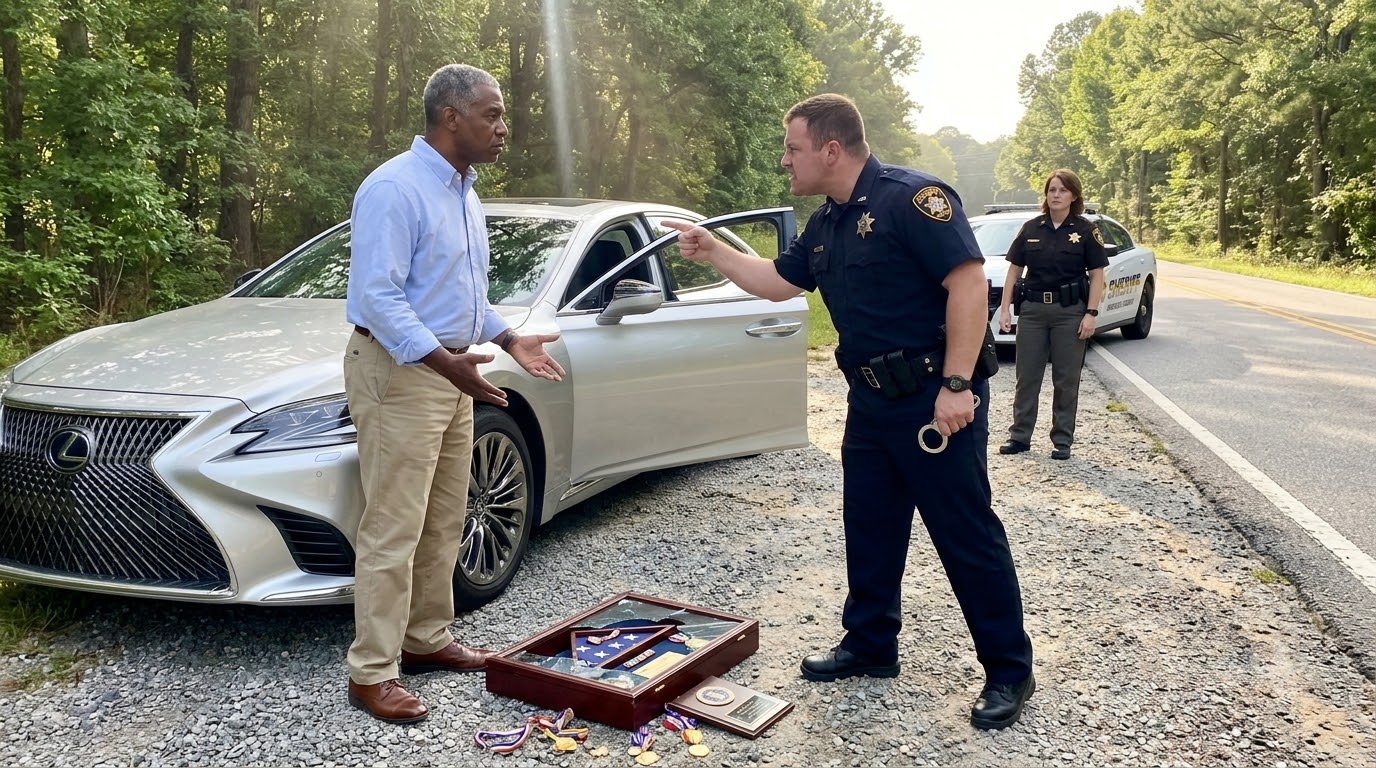
He put the car in park. He lowered both front windows. He placed his hands on the steering wheel at 10:00 and 2:00. He waited. Officer Shane Decker was 31 years old and had been with the Caldwell County Sheriff’s Department for 6 years.
He had the build of a former high school linebacker gone soft at the middle and the walk of a man who’d never been told no by anyone who mattered. His partner, Deputy First Class Angela Trout, was a decade his senior and considerably wiser. She climbed out of the passenger side of the cruiser and hung back at the rear quarter panel, one hand resting loosely on her radio, her eyes careful. Decker came up to the driver’s side window like he owned the road and everything on it. “License and registration,” he said, with no greeting or explanation.
“Good afternoon, officer,” Elijah said. His voice was even unhurried. May I ask the reason for the stop? Decker’s jaw tightened. I ask the questions, license and registration, sir.
The “sir” landed like an insult, Elijah noticed. He noticed everything. Slowly telegraphing every movement with deliberate visibility, he reached into his breast pocket and produced two cards, his Georgia driver’s license, current, and a secondary identification that bore a federal seal, a photograph, and the words Director, National Counterterrorism Center embossed in black ink beneath a security classification stripe. Decker took both cards and spent approximately 1 and 1/2 seconds looking at the federal ID before flipping it face down against the driver’s license like it was a nuisance, like it was a loyalty card for a sandwich shop. Where are you headed?
“Home. My residence is approximately 12 miles north on Caldwell Ridge Road.” “You live up there?” Decker’s tone carried a distinct flavor of disbelief, the kind that had nothing to do with geography. “I do,” Elijah replied pleasantly. Decker leaned in slightly, shining his flashlight across the interior of the Lexus, even though it was 2:30 in the afternoon and there was no conceivable need for artificial light. His eyes snagged on the rear seat, where a polished mahogany display case sat upright against the leather.
The case was approximately 18 inches wide, sealed with a brass latch, and bore a small engraved plate on the front. “What’s in the box?” Decker demanded. A personal display case. “Open it.” Elijah turned his head slowly to look at Decker. Officer, you have not articulated a reason for this stop.










