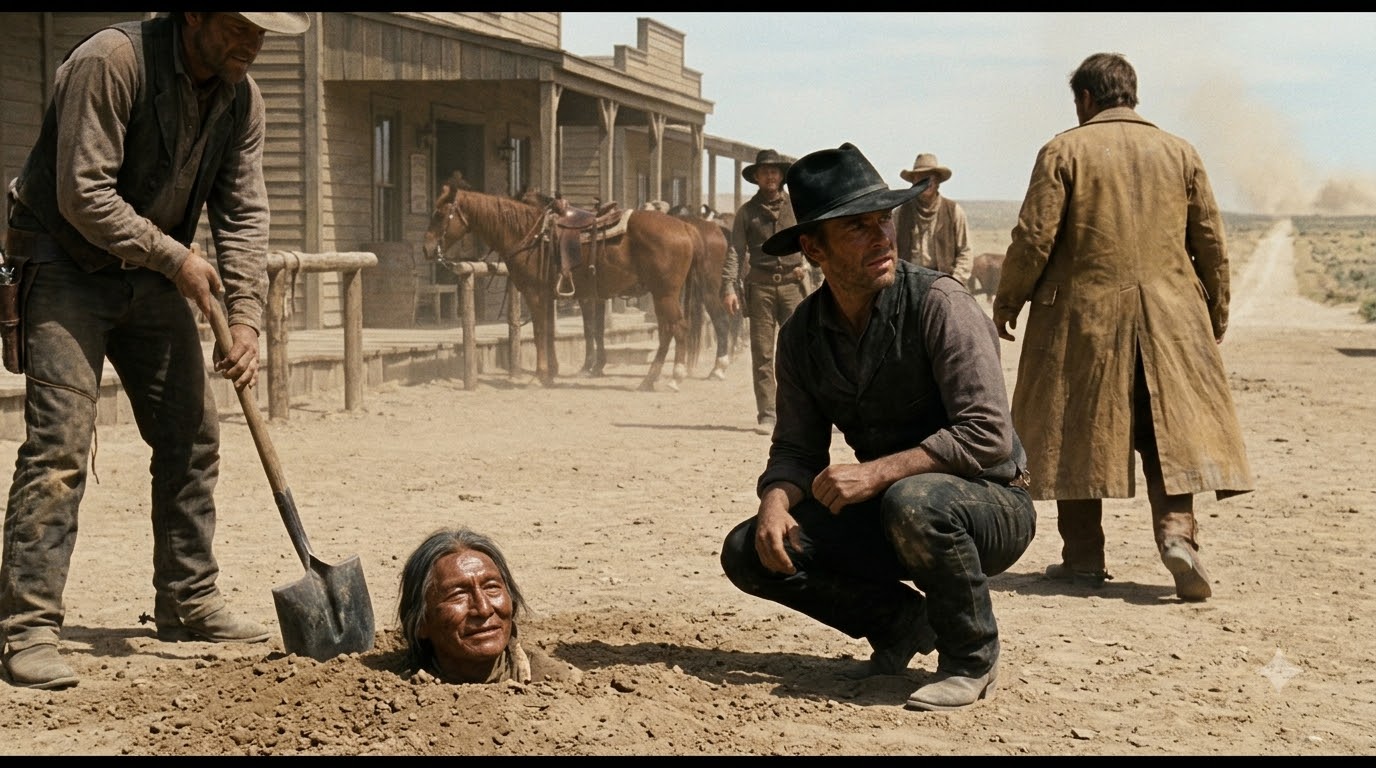
Hear that? That’s the law in Harrow Creek now. The town square was empty except for a fresh mound of dirt and three men with shovels who hadn’t finished laughing yet. “Hear that?” Delam said, pressing his boot down on the earth.
Something shifted beneath it. Something that was still breathing. “That’s the sound of the law in Harrow Creek.” He looked at his men and grinned the way a man grins when he owns everything in sight. “Bury him another foot.
I want him to think about it a while.” A rider at the edge of the square had watched the whole thing without moving. “That’s enough.” the stranger said. Nobody had heard him ride in. Nobody knew where he had come from.
And in the 30 seconds that followed those two words, the town of Harrow Creek would discover that the man who had just spoken them was not making a request. What happened next would be carved into the memory of every witness who survived it. But to understand it, you have to understand what Delam had done to Harrow Creek. And you have to understand why a quiet man on a tired horse had ridden into a town he had no business being in and spoken two words that changed everything. To understand Harrow Creek, you have to understand what it looked like before Delam arrived.
In the spring of 1882, it had been a decent town. Not prosperous, not growing fast, but decent in the way that frontier towns occasionally managed to be decent. A functioning marshal’s office, a schoolhouse with actual children in it, a weekly church service that most of the population attended, and a water rights agreement that kept the small ranchers and the homesteaders from killing each other over the Redstone Creek tributaries that fed the valley. The town had a marshal named Eugene Pratt who had held the badge for 11 years without disgracing it. A compact, quietly stubborn man of 54 with a gray beard and bad eyesight, and the specific durable courage of someone who has never once considered that the job might not be worth doing.










