Five men surrounded a little girl while a crowd of people turned away. The eight-year-old stood alone on a garden path, screaming for her mother, but not one adult in the park stepped forward. People watched, filmed, and whispered to one another about getting involved, about the risks, and about how someone else would surely handle it. One man finally did something. He was not a hero looking for trouble; he was simply an exhausted mechanic who had packed his daughter’s lunch that morning and driven to the park because the weather had finally cleared.
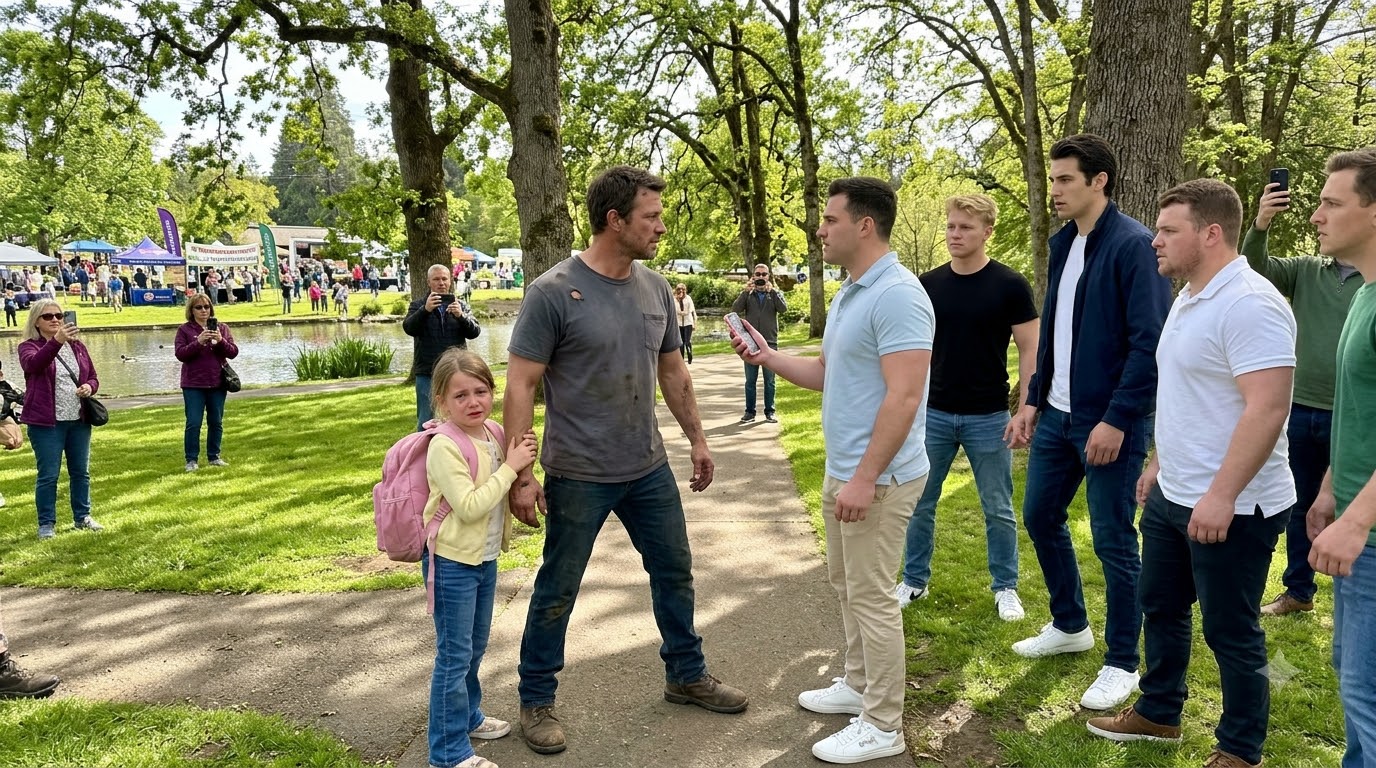
There was still grease beneath his fingernails. He had not slept well in three nights. When he saw the little girl surrounded by five grown men, he handed his daughter the truck keys and told her to stay near the park attendant by the fountain. Then he walked straight toward the trouble unfolding on the garden path in Bellhaven, Oregon. None of the five men knew what he had once done for a living, but they were about to find out.
Let us go back to the beginning of that Saturday. Grant Callaway’s morning had started the way most of his Saturdays did: with too little sleep and his nine-year-old daughter, Piper, having an opinion about everything. She wanted pancakes, then changed her mind, then wanted pancakes after all, but with blueberries on the side instead of mixed into the batter. Last week, some of the berries had burst while cooking, and she disliked the sensation on her tongue. Grant stood at the stove in an undershirt, spatula in hand, and nodded as if her request were perfectly reasonable.
“You’re the only person I know who has a problem with blueberries doing what blueberries do,” he said. “They shouldn’t explode,” Piper replied with complete seriousness, already sketching something in the notebook she carried everywhere. Grant put a small bowl of uncooked blueberries beside her plate, and she looked satisfied. He had finished his coffee at the counter because he still had not replaced the coffee maker after the old one broke in February. It was April by then, which probably said something about the pace of his life.
He was thirty-seven years old. He owned a truck that needed a new alternator and rented a two-bedroom house on Clover Street with a backyard that was mostly weeds and one stubborn rosebush he had not planted and could not identify. From Tuesday through Saturday, he worked at Mercer’s Auto, changing oil, repairing transmissions, and occasionally diagnosing noises customers insisted their cars were making. Most of the time, the noise turned out to be a loose cup holder. By every ordinary measure, Grant was an unremarkable man, and that was exactly what he had worked hard to become.
Before Piper, before Bellhaven, before Mercer’s Auto and the rosebush and the broken coffee maker, Grant Callaway had spent nine years doing work that never made the newspapers and never put his name in press briefings. He had been a Navy SEAL, not the kind celebrated in movies, but the quiet, careful kind who finished difficult jobs in the dark and moved on without credit. He had been very good at it. He had also watched it take things from him that could never be returned. The first months of his daughter’s life had been spent on the other side of the world.
His marriage had survived deployments, distance, and fear until it quietly collapsed under the weight of his return home, in ways neither he nor his wife could fully explain. She died two years after their divorce in a car accident on Highway 7 one Tuesday morning. It was the kind of accident that had nothing to do with danger, which somehow made it worse. Piper had been five years old. Grant left the Navy and moved to Bellhaven with custody of Piper.
He knew almost no one there, so he built a small, controlled life in which most days were enough. He did not talk about his military service. The one person who knew was his neighbor, Dale Fitch, a sixty-two-year-old retired high school football coach. Dale had guessed rather than been told, and he was wise enough never to mention it in public. That was the extent of Grant’s social circle, broadly speaking.
He showed up at Piper’s school events. He remembered her teachers’ names. He made blueberry pancakes with the berries on the side because she did not like surprises in her food. Most of the time, he thought this was a perfectly adequate version of a life. The park had been Piper’s idea.
Hawthorne Lake Park sat on the eastern edge of Bellhaven, a wide stretch of gentle lawns, paved paths, and oak trees old enough to have been there when the town was still deciding what it wanted to become. There was a duck pond on the south side. Piper liked it because she claimed the ducks had individual personalities, a position Grant did not argue with because debating a nine-year-old about duck personalities was a battle with no clear victory condition. It was a warm Saturday in April, the kind of Oregon day that felt like a gift. The park was crowded, with families spreading blankets on the grass, children playing on the equipment, joggers following the loop path, and a charity event taking place near the main pavilion.










