They Mocked a 74-Year-Old Shaolin Master — Until Four Men Came to His Door
The boys on Thirty-Eighth Street called him the dancing old man. Every morning, before the city had fully awakened, seventy-four-year-old Wen Goulang stepped into the narrow backyard of his granddaughter’s rented house and practiced the movements he had spent sixty years perfecting. His hands moved slowly through the cool air, his feet shifted across the cracked concrete, and his breathing remained steady despite the pain in his left knee. To the teenagers watching from the neighboring apartment building, it looked ridiculous.
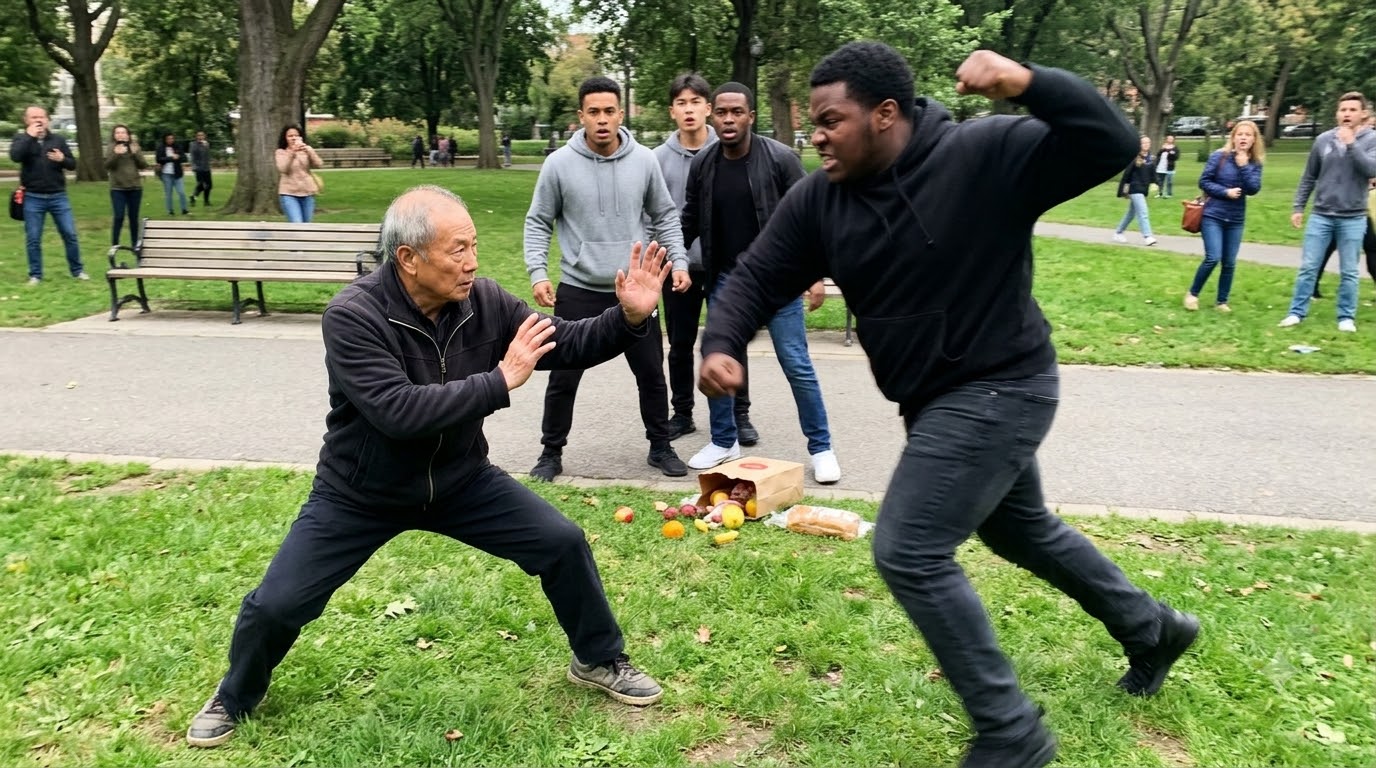
“Yo, Shaolin! Do the thing again!” Taye shouted from the balcony, raising his phone. His friends copied Wen’s movements and laughed until they nearly fell against the railing. Wen kept practicing, neither hurried nor offended. The camera followed him anyway, because a quiet old man was easier entertainment than anything the boys could find on television.
Wen had arrived from China eleven days earlier with one suitcase, a wooden walking stick, and an envelope of photographs. His granddaughter, Maywin, had collected him at the airport after finishing a twenty-four-hour shift as a firefighter. She was twenty-eight, exhausted, and delighted to see him. She had insisted he move into her spare room after a fall had left him with a damaged knee and a doctor had recommended that he stop living alone.
“You don’t have to practice out here,” Maywin said one morning, watching the phones appear over the fence. “Do it inside. Anywhere they can’t film you.” Wen glanced at the small backyard and smiled. “Then they would film the backyard,” he answered. She wanted to argue, but she knew he was right: the problem wasn’t where he practiced. The problem was that the boys had decided kindness meant weakness.
Maywin returned home that afternoon with smoke in her hair and exhaustion around her eyes. “Long night?” Wen asked, setting tea beside her. “Two structure fires and a cat,” she replied. “Did the cat make it?” “Cat’s fine. The building wasn’t.” She rubbed her forehead and asked about his knee, which he always described as seventy-four years old and therefore entitled to complain.
She noticed a letter from his former martial arts school beneath the teapot. It confirmed the sale of the building where he had taught for decades. “You didn’t have to sell the school,” she said. Wen looked toward the window. “The school had thirty students. You have one grandfather.” She told him her father thought they were both crazy. “Your father thinks we are both crazy,” Wen said, and she laughed for the first time that day.
Maywin had been scheduled for two days off, but a staffing shortage changed everything. Her captain called and asked her to return for another twenty-four-hour shift. Before leaving, she stood in the doorway with her boots in one hand. “Please stay in the house. Taye is nineteen, and those boys are looking for trouble.” Wen folded the newspaper. “Then he is a tall child.” “Grandpa.” “I will go for a walk.” She closed her eyes, knowing she had lost the argument.
The neighborhood was changing, though not in the way people described on the news. Old stores were closing, rents were rising, and families who had known each other for generations now passed strangers on familiar sidewalks. The corner convenience store, run by a middle-aged man named Luis Ortega, was one of the few places where everyone still spoke to everyone. Luis had watched Maywin grow up. He greeted Wen in slow, careful English, offering directions even after Wen had memorized the six blocks between the house and the store.
That afternoon, Wen stopped outside the shop to study a newspaper rack. A woman sweeping her steps across the street asked whether the boys were bothering him. “They are bored,” he replied. “Bored is how it starts,” she warned. Wen thanked her and entered the store for a bottle of water. He noticed two young men by the refrigerator, both wearing dark hooded sweatshirts despite the warmth. One kept looking toward the front window; the other kept adjusting his right shoe.
Luis was counting change when the first man pulled a pistol. “Register. Open it now!” he yelled. The second robber jumped over a display of snacks and grabbed Luis by the collar. A customer screamed and dropped behind a shelf. Wen stood beside the drinks cooler, his water bottle still in his hand. The gunman pointed the weapon at Luis’s face and demanded the safe code.
“Please,” Luis said. “The register is open. Take the money.” The gunman struck the counter with the pistol and turned toward Wen. “Old man, on the ground!” Wen lowered his eyes, noting the shaking hand, the unlocked elbow, and the way the robber’s feet were too close together. “I said on the ground!” the young man repeated. His companion yelled that they should forget the old man and take the money.










