“YOU HAVE BEEN FILMING ME IN MY BATHROOM!”
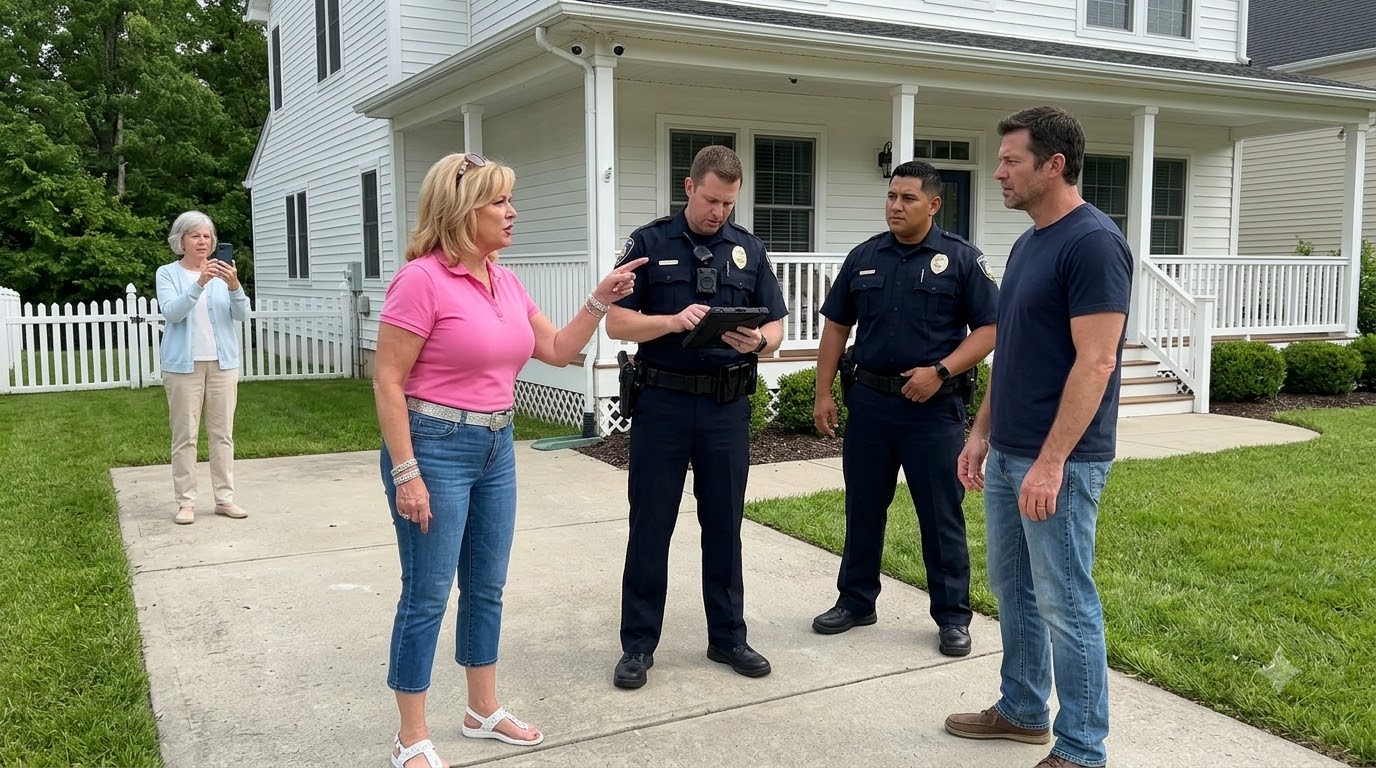
The accusation exploded across the front porch before Officer Daniel Mercer had finished reading the first page on his tablet. Across the white picket fence, the late-morning sunlight washed the houses of Ashford Creek in warm gold. Birds called from the maple trees, and a lawn sprinkler clicked steadily in the yard next door. It should have been an ordinary Saturday in a neighborhood where people spent more money on flower beds than they did on vacations. Instead, Vanessa Whitmore stood at the foot of my porch in a bright pink polo shirt, cropped blue jeans, glittering bracelets, and white sandals, demanding that the police arrest me.
She was sixty-one, blond, and accustomed to getting her way. Her sunglasses rested on top of her carefully styled hair, and the expensive silver belt around her waist flashed whenever she moved. Officer Mercer held a tablet in one hand, while his partner, Officer Luis Ortega, watched Vanessa with the patience of a man who had heard too many neighborhood disputes to believe the loudest person automatically told the truth. Vanessa stabbed a finger toward the two small security cameras beneath my porch roof.
“Those cameras are aimed straight at my bathroom,” she insisted. “He watches me undress. He records me in the bathtub. I want every camera destroyed before I leave this property.”
My name is Ethan Brooks. I was forty-three, a widower, and the owner of the house where Vanessa was making her accusation. I had installed the cameras after somebody repeatedly entered my yard, tampered with my mailbox, and left threatening notes on my door. The cameras faced my own driveway and front walkway. Neither could see through Vanessa’s bathroom window, which was on the opposite side of her house, behind a solid fence and two walls.
“I can show you the footage and the camera angles,” I told the officers.
Vanessa laughed. “Of course he can. He’ll show you the edited version.”
Mercer enlarged a document on his tablet. He had been checking the complaint number when his expression changed. He scrolled upward, frowned, and looked from the screen to Vanessa. For the first time that morning, she stopped talking.
“Mrs. Whitmore,” he said, “why does this complaint reference an account belonging to Ashford Creek Community Services?”
Vanessa’s smile disappeared. “That has nothing to do with my bathroom.”
“Perhaps not,” Mercer replied. “But the same account appears in another report we’re investigating.”
I remember the sudden silence more clearly than her shouting. The sprinkler kept clicking. A delivery truck rolled past. Vanessa’s bracelets rattled as she folded her arms, but she no longer pointed at the cameras. In that moment I realized the argument she had brought to my porch was only the visible edge of something much larger.
To understand why a woman would invent a humiliating accusation against her neighbor, you have to understand what had happened in Ashford Creek during the previous eighteen months. And to understand that, you have to know why I installed the cameras in the first place.
The morning air smelled of freshly cut grass, and the neat houses looked as if they had never contained an argument.
Ethan and his late wife Rachel purchased their home; their teenage daughter Sophie still grieves; Ethan values privacy and ordinary family routines. Vanessa introduces herself as HOA president, charming in public and controlling in private. She demands extra landscaping fees without citing rules.
Ethan kept returning to one troubling detail: ethan and his late wife Rachel purchased their home; their teenage daughter Sophie still grieves; Ethan values privacy and ordinary family routines. He had spent years making decisions by comparing what people said with what the documents actually showed. Rachel used to tease him for keeping receipts for everything, but now that habit felt less like fussiness and more like protection. He opened the folder on his desk, wrote the date across a fresh page, and made himself describe only what he knew. Anger could wait; the facts needed to survive.
For Sophie, the problem had a different shape. Vanessa introduces herself as HOA president, charming in public and controlling in private. She had already learned that adults sometimes hid their fear behind certainty, and she could hear the strain beneath her father’s calm voice. At dinner she asked whether the neighborhood would ever feel normal again. Ethan wanted to promise that it would, but he refused to offer certainty he did not possess. Instead, he promised that they would keep talking and that he would never ask her to carry the problem alone.
Vanessa interpreted the same situation as a test of authority. She demands extra landscaping fees without citing rules. She had grown accustomed to people backing away when she mentioned attorneys, property values, or the association’s supposed powers. Every unanswered question from Ethan felt to her like a public insult. She rehearsed explanations in her car before meetings and grew more furious whenever somebody asked for a written record. What she called maintaining standards increasingly meant making sure nobody could challenge her decisions.










