Your daughter doesn’t belong here, and I will enforce that. That was the last thing Marla Kendricks, president of our HOA board, said before she fired a warning shot above my 13-year-old daughter’s head. One second, Neve was sitting quietly on the pool lounger, sketchpad balanced on her knees. The next, a crack split the air, and she froze, eyes wide. Every ounce of recovery shattered in a heartbeat.
I said move, or I’ll make sure you never come back here again. Marla’s voice was sharp, breathless, like she’d already decided this was justified. Her hand trembled slightly on the pistol lifted skyward, but her gaze was fixed on my daughter. I stepped between them so fast I barely registered the scrape of the concrete under my boots. That’s my kid you’re threatening, and that shot just violated three separate state statutes.
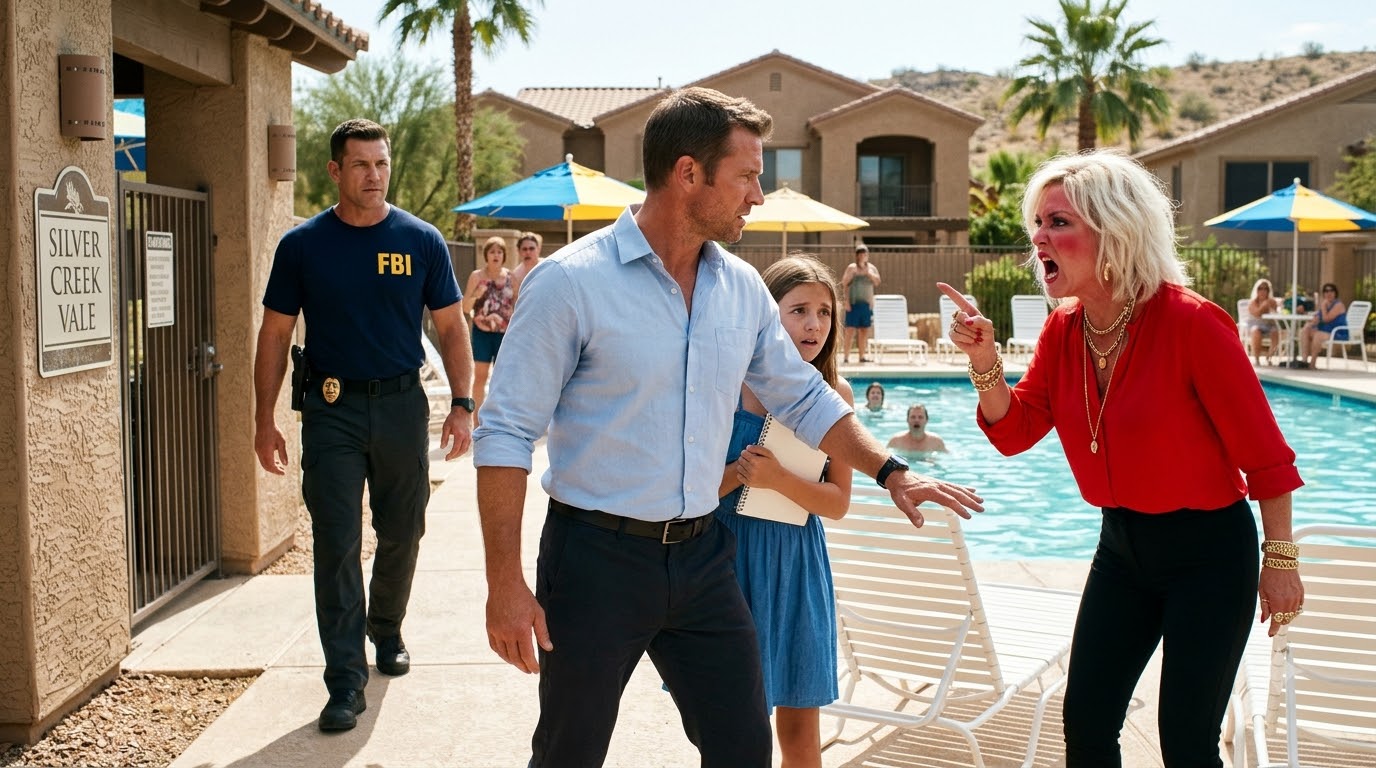
Her face twitched just for a moment. Then she squared her shoulders, trying to recover whatever authority she thought the gun gave her. The entire pool had gone silent. Only the chlorine filter hummed behind us. Someone gasped.
Another person muttered, did she just? My name’s Thayne Merrow. I’m a federal trauma psychologist. I work with witnesses who’ve lived through violence, and I don’t just recognize PTSD. I treat it.
My daughter was sketching poolside because her therapist and I agreed it was a necessary step. One of the final ones. That lounger she’d claimed at the Cormier? It’s where Neve first smiled again after her school shooting last year. It’s where she stopped needing me to sit 3 ft away.
It’s where she started reclaiming the right to exist without fear. And Marla just pulled a gun on her. The HOA bylaws don’t say a word about age-restricted pool access during daylight hours, but that never stopped Marla Kendricks. She doesn’t enforce policy, she enforces preference. She’d sent three warnings in the past month, one accusing Neve of loitering, one claiming she wasn’t visibly wearing a wristband.
She was. And another that suggested psychologically unstable minors should require additional adult supervision. That last one wasn’t even veiled, and it came with a fine. My husband Ronan had warned me. She’s escalating, he’d said, watching our feed from the trail cam we’d set across the cul-de-sac.
She doesn’t care about bylaws. She cares about control. Ronan knows escalation. He’s a special agent in the FBI’s Critical Response Group. He doesn’t flinch easily, but when I called him seconds after the shot, my voice cracked.
He was at the community gate in under two minutes. Marla hadn’t holstered the pistol. She was still posturing by the pool ladder when Ronan arrived, badge clipped and camera already rolling. I’d advise you to place the weapon on the ground, he said evenly. You just fired a shot within 30 ft of a child.
That’s a class six felony in this state under ARS 13-1209. You’re not law enforcement, you’re not licensed security, and you’re not exempt. Marla blinked at his badge, then at him. You don’t have authority here. This is private property.
Ronan stepped forward. You discharged a firearm near a minor with known trauma history. I have every jurisdiction I need. Behind us, Neve’s sketch pad had fallen into the pool. The water rippled across the graphite line she’d drawn of the same lounger, a peaceful scene, quiet, safe, the exact opposite of this moment.
I wanted to comfort her, but I couldn’t move. Not yet. I had to make sure Marla didn’t touch that gun again. I had to be the wall my daughter had lost once already. The neighbors were still frozen.
Phones had started recording. Victor Eames, HOA secretary, was halfway down the path, mouth parted like he wanted to speak but didn’t. Not yet. Marla finally lowered the pistol, slowly, but her jaw stayed tight. She shouldn’t have been here, she whispered.
She had every right, I said, and you just gave up yours. The cuffs clicked behind her wrists exactly 90 seconds later. Ronan didn’t need backup. The law was already on his side. But this wasn’t over.
Marla had buried more than just her temper in this neighborhood, and I was going to dig every inch of it up. The police cruiser rolled away with Marla in the backseat, her hands cuffed and her mouth still moving in silent outrage. But the silence she left behind was louder than anything she’d screamed at Neve. No one said a word. Not at first.
The pool deck was littered with half-empty water bottles, towels that no one dared pick up, and flip-flops abandoned like the people wearing them had evaporated. Most of the residents who’d seen it happen slipped away behind mirrored sunglasses and forced nods, pretending they hadn’t seen a woman fire a gun near a child, pretending it had nothing to do with them. But it had everything to do with them because Marla Kendricks didn’t snap out of nowhere. She built her control in layers starting with language, then leverage, then isolation. She didn’t just enforce HOA policies.










