“You picked the wrong place to play the hero, boy.” The motorcycle gang leader shoved Marcus hard against the wall and knocked the donation jar to the floor. Coins scattered across the wooden boards of the Riverdale Community Center, sounding like the collapse of everything the children had worked to build. Marcus did not flinch, even as five large members of the Sovereign Riders surrounded him in creaking leather vests. At sixteen years old and six feet one inch tall, he studied every exit while their leader stepped closer, cigarette smoke heavy on his breath.
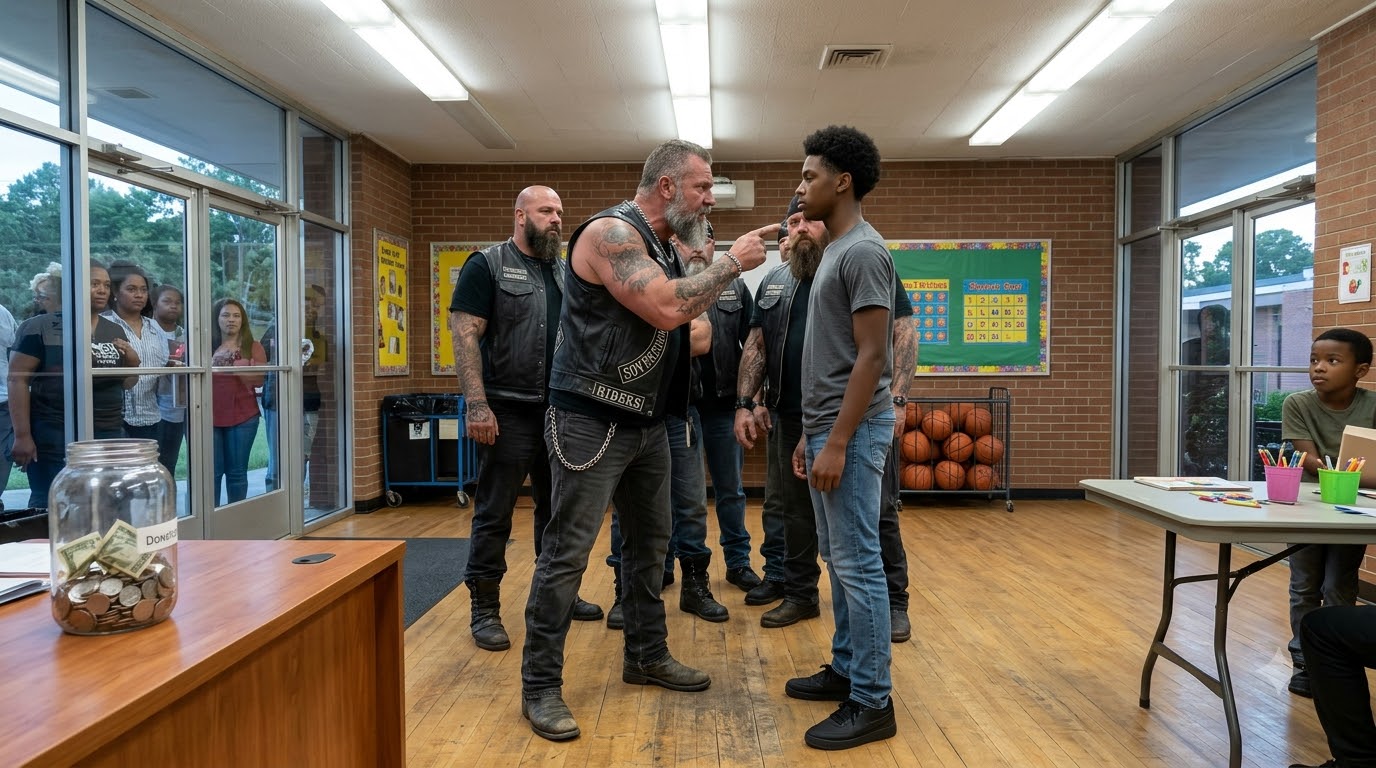
“This center isn’t for people like you,” the man said. “Know your place.” Marcus drew a measured breath, held it for four counts, and slowly released it, following the breathing discipline his father had taught him. The biker mistook his silence for fear and laughed before shoving him again. “What is a kid like you going to do about it?” he mocked, grinding his boot into the scattered coins.
The leader had no idea how far the consequences of that moment would reach through the small town of Riverdale. The community center had once been a neglected public building with peeling paint and cracked windows, but it had become a refuge for children who had nowhere else to go. Every weekday afternoon, its rooms filled with laughter, the scratching of pencils, and the determination of students who needed a little help. Marcus Jackson had played an important role in that transformation without ever asking anyone to praise him for it. For the past year, he had volunteered twenty hours each week, organizing tutoring sessions, coaching basketball, and helping vulnerable children feel valued.
“You’re doing great, Deshawn,” Marcus told a ten-year-old boy, pointing toward the next fraction problem on his worksheet. The child beamed with pride, a welcome change for someone whose family circumstances gave him so few reasons to smile. Marcus glanced at the clock and saw that it was five in the afternoon, time to begin closing the center. Most of the children had already been collected by parents or older siblings, leaving Deshawn and two others in the main room. “Is Ms. Garcia running late again?” Marcus asked, though he already knew that Deshawn’s mother worked consecutive shifts at the hospital.
“She said she’d be here by five-thirty,” Deshawn answered, carefully organizing his papers as Marcus had taught him. He asked whether they could shoot a few baskets while they waited, and Marcus promised to lock the front doors first. Before he could finish speaking, the entrance flew open and five men walked in, their heavy boots striking the floor. They were the Sovereign Riders, a motorcycle gang whose influence extended far beyond its membership. At their head stood Ray Mercer, a man who regarded the modest furniture and children’s books with unmistakable contempt.
Marcus placed himself between the bikers and the children. “We’re about to close,” he said evenly. “Can I help you with something?” Ray ignored the question, wandered around the room, ran a finger along a tabletop, and dropped a children’s book on the floor. “So this is where the city council spends all its money,” he said. “Interesting priorities.”
“The center is funded mainly through private donations,” Marcus explained. “People who care about the future of this community.” Ray scoffed and complained that his taxes supported the center while the roads his business depended on remained in poor condition. Marcus felt a flash of anger when he saw the book on the floor, but remembered his father’s lesson never to let an opponent dictate his response. He suggested that Ray raise his budget concerns at the Tuesday evening council meetings. Ray moved directly into his path and demanded to know why a boy thought he could explain how things worked in a town where Ray had lived for thirty years.
A volunteer appeared at the entrance to announce that Ms. Washington had come to collect Tamika and Jerome. Without taking his eyes off Ray, Marcus asked that the children be guided out through the side door. Only Deshawn remained, crouching nervously behind a table. Marcus reminded Ray that everyone was welcome during opening hours but that the center was now closing. The other bikers moved into a loose semicircle as Ray asked where Marcus came from, making the hostility beneath the question unmistakable.
“I’ve lived in Riverdale for three years,” Marcus replied. “My father moved us here after he retired.” One of the bikers sneered and asked whether his father had worked in a welfare office. “The military,” Marcus answered. “Special operations.” A brief hesitation passed across Ray’s face, but he quickly hid it behind another insult about a military man’s son running the community center.
Deshawn protested that Marcus did not let the children run wild and instead taught them homework and respect. Ray snapped that nobody had asked the little boy for his opinion. Marcus gently instructed Deshawn to wait in the office for his mother, then turned back to the bikers. “Mr. Mercer, I understand that you have concerns, but this isn’t the way to address them,” he said. Ray accused him of being an outsider who was taking resources away from families who had lived in Riverdale for generations.










