He slapped her across the face in front of everyone at the police station. The sound cracked through the room like a gunshot. Nobody moved, and nobody breathed. The twenty-four-year-old rookie stood with her cheek burning red, but she neither cried out nor stumbled. She simply turned her head slowly and looked straight into her attacker’s eyes.
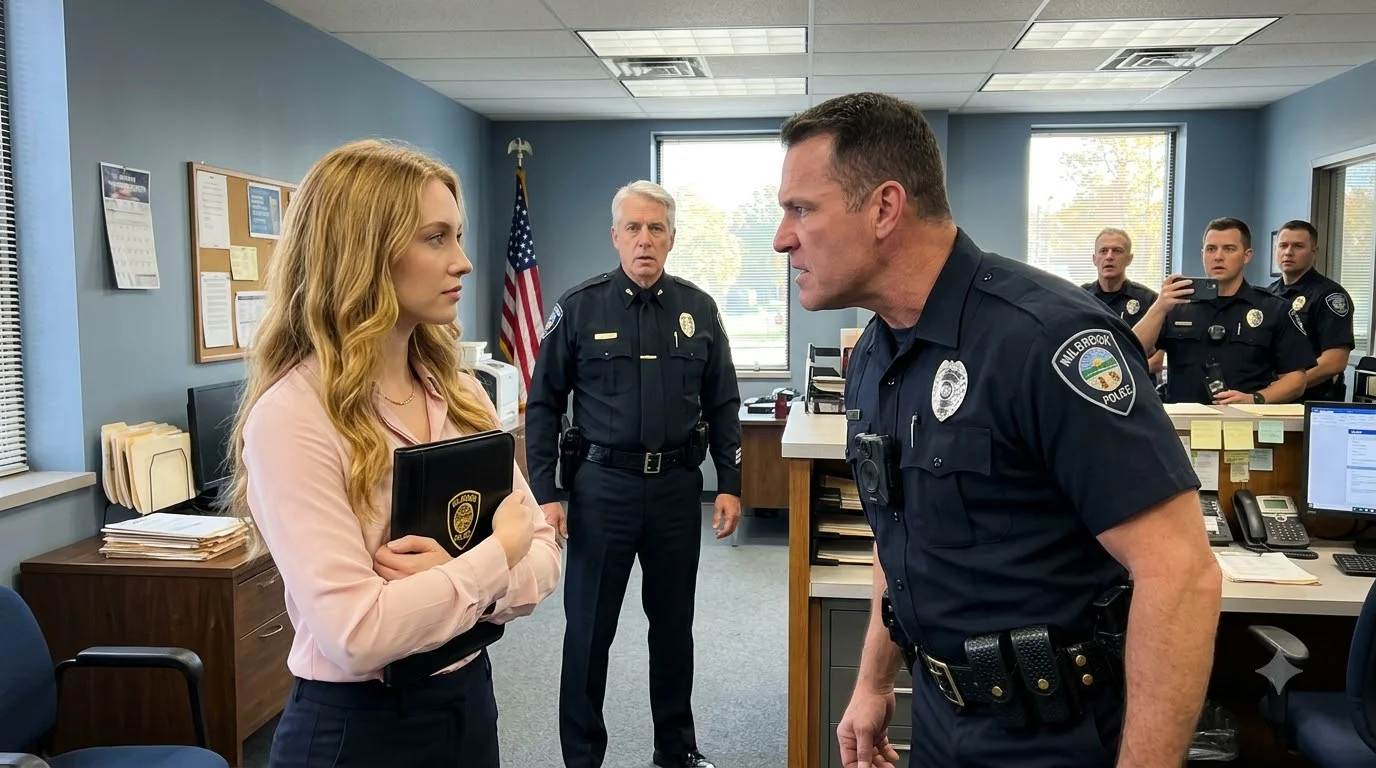
“Some men mistake silence for weakness,” she said softly. “That is often the last mistake they make.” What Sergeant Garrett Voss did not know that day was simple: the woman he had just slapped was no rookie at all. She was the daughter of the police chief he had helped bury twelve years earlier. And in just nine days, she would be sitting in his chair, holding evidence capable of turning the entire town upside down.
He had just made the worst mistake of his life. He simply did not know it yet. Every small town has a story it does not want to tell. Milbrook, Ohio, was one of those towns. On the surface, it looked perfect.
There was a church on Main Street and a diner that still sold coffee for a dollar. Old men occupied the same bench each morning just to watch the world pass by. Leaves were beginning to turn pale gold and rust beneath the faded autumn sky. Every Saturday, farmers drove their pickup trucks into town and sold pumpkins and apple cider from their tailgates. Children rode bicycles down streets where every neighbor still waved from the porch.
It was the kind of town people put on postcards. It was the kind of town people left and then spent years finding their way back to. Yet beneath that peaceful exterior, something had been rotting for twelve years. It would not come to light until a young woman walked through the front doors of the Milbrook Police Department on an ordinary Tuesday morning. Her name was Sloan Hart.
She was twenty-four, with blond hair tied neatly back and unreadable blue eyes. She did not look like someone about to change everything. She looked like someone others might easily overlook. That was exactly the plan. It was 7:45 a.m. when Sloan parked outside the station.
The building was old brick, constructed sometime in the 1950s. The American flag over the entrance had faded through years of sun and rain. Sloan sat in her car for a moment before getting out. In her hand was a small silver pocket watch that had belonged to her father. Its case had been polished smooth by years of handling.
Inside the cover, the words “Duty, Honor, Quiet Strength” were engraved. She traced each word with her thumb, as she always did before something difficult. Then she drew a breath, slipped the watch into her pocket, and stepped out of the car. She was not really a beginner that morning. But almost nobody inside the building knew that.
Nine days earlier, in a quiet office two hours away, Sloan had sat across from Mayor Grace Whitfield. The mayor was around sixty, with silver hair and perceptive eyes, a woman who had spent decades learning to read people. “You understand exactly what I’m asking you to do?” the mayor said. Sloan nodded.
“You want me to enter as a new officer, without rank or title, and simply observe.” “For nine days,” the mayor said, “before the state hearing. Soon afterward, your appointment will be decided.” Sloan looked down at her hands. “We’ve had complaints about that department for years,” the mayor continued, “about how its officers treat people.
I need someone who can see what happens firsthand, not merely read reports or files.” “And if I find something worse than bad attitudes?” Sloan asked quietly. The mayor’s expression hardened. “Then you’ll have nine days to prove it,” she said.
“Before the hearing decides whether that department should continue to exist.” The mayor leaned back and studied Sloan closely. “May I ask you something personal?” she said. “Of course,” Sloan answered.
“Why would someone your age want this particular job? You could have a desk in some quiet law firm or a comfortable office with your name on the door.” Sloan thought for a long time before answering. “Because comfortable offices don’t heal towns that are falling apart,” she said. “Someone has to be willing to walk into the mess.”
The mayor smiled faintly. “You remind me of someone,” she said. “I can’t quite remember who.” Sloan did not tell her the entire truth that day. She did not mention that her father had once worn that badge or that he had died in this town twelve years earlier in a car crash that had never made sense to her.
She did not say she had spent years studying law, procedures, and records so that she could one day return to Milbrook and ask questions nobody else dared ask. She kept those things private, believing some matters should remain concealed, like a watch in a coat pocket. Back at the station, Sloan stepped through the department’s front door for the first time. The lobby smelled of stale coffee and printer ink. Community notices covered a bulletin board, most faded and curling at the corners.










