“Stand up. Let me see your hands.” “ For what crime?” “ Talking back to a police officer.” There was no such charge, and there never had been one, not in Ohio or anywhere else in the country.
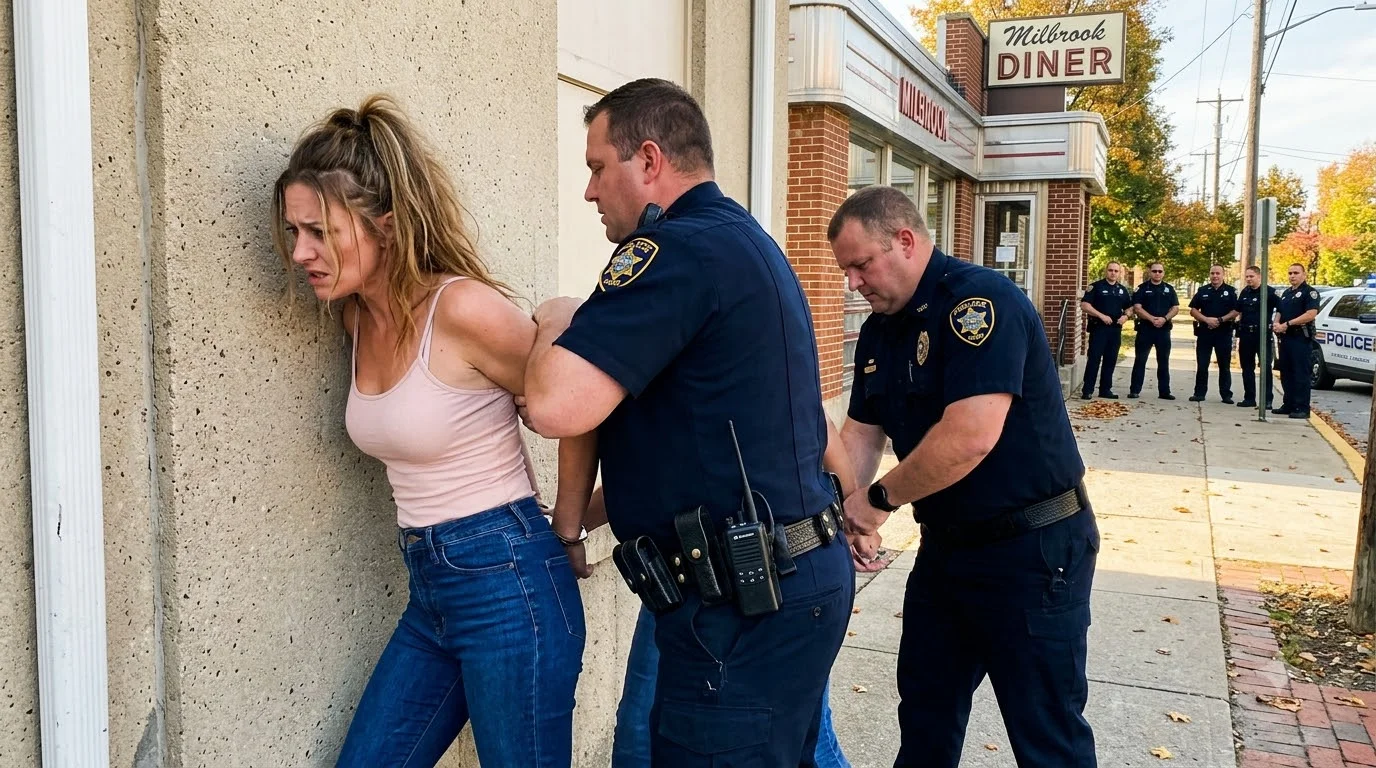
But Deputy Tucker Rner did not care. He turned the woman around, fastened handcuffs around her wrists, and dragged her out of a crowded diner while twenty people watched without saying a word. A silver coin slipped from around her neck and fell to the floor. “ Cheap junk,” he muttered, kicking it aside. He had absolutely no idea what he had just done or who the woman was.
Six days later, three black SUVs rolled into that little town before sunrise. A colonel from the Pentagon walked through the jail doors, and when they brought the quiet woman out of her cell, she wore a silver star on each shoulder. By noon, two careers were over. Milbrook, Ohio, stood where flat farmland finally gave way to the county’s first low hills. The town’s old high school mascot was still painted on the water tower, so faded it was nearly unrecognizable, but no one had bothered to repaint it.
No one had needed to. It was the kind of town where people waved to one another, where Sunday church still mattered to most families, and where a man’s word was supposed to carry weight. Usually, it did, until it didn’t. On a Tuesday morning in early October, fog still hung low over the fields when a woman walked into the Milbrook Diner and took a booth in the far corner. She wore a gray jacket, jeans, and boots that had seen a great many miles.
Nothing about her invited a second look, and that was precisely the point. Her name was Emory Whitfield, and she was thirty-four years old. Within three weeks, much of the country would know her name. But on that Tuesday, she was simply a new face in a small town, and small towns noticed new faces the way a still pond noticed a stone falling into it. Milbrook had fewer than four thousand residents, one traffic light, one diner, a hardware store, and a veterans’ clinic serving eleven counties across that part of the state.
Most people there had been born there, and so had their parents. Beyond the surrounding area, hardly anyone paid attention to Milbrook. That made it the kind of place where something could remain hidden for years without anyone in Washington thinking to look. Dana, the waitress, set a cup of black coffee in front of Emory without being asked. After four mornings, she already knew the routine.
“You’re becoming a regular,” Dana said. “ I like the coffee,” Emory replied, “and I like how quiet it is here before eight.” Both things were true. Neither was the whole story. Emory’s cover was uncomplicated, built to withstand ordinary curiosity rather than serious scrutiny.
When people asked, she said she was between jobs, taking time to figure out her next move, and staying with a distant relative of a friend while she sorted things out. Loretta Combmes had never actually met any friend of Emory’s, and a few persistent questions would have brought the story down. But nobody in Milbrook pressed. Small towns extended a certain courtesy to strangers who appeared harmless, and Emory had spent an entire career learning how to appear harmless. Inside her bag was a thick folder containing copies of medical records from the nearby clinic.
The dates did not match. Diagnostic codes had quietly been changed after the fact. Disability benefits had been diverted in small amounts into accounts bearing names nobody in the diner would recognize unless they knew exactly where to look. Emory knew exactly where to look. After all, that was her job.
No one drinking coffee at the counter that morning could have guessed any of this from her jacket or boots. She had eleven days left in Milbrook. After that, a hearing in Washington would determine whether three hundred veterans across four states finally received the benefits they deserved, or whether the people who had siphoned off that money for six years would get away with it. Eleven days. She had repeated the number to herself many times, unwilling to waste even one.
That was the morning the diner door opened and Deputy Tucker Rner entered as though the floor belonged to him. Tucker was twenty-seven. He had his father’s face and his father’s badge, and, as most people in Milbrook saw it, very little else that was truly his own. He nodded to a few regulars near the counter. Then his gaze swept the room like a man searching for something to correct when nothing around him was broken.
His eyes stopped on Emory. “ Haven’t seen you around here,” he said. It was not a question but a statement placed between them. “ Just visiting,” Emory replied evenly, without hurrying. “ Visiting who?”










