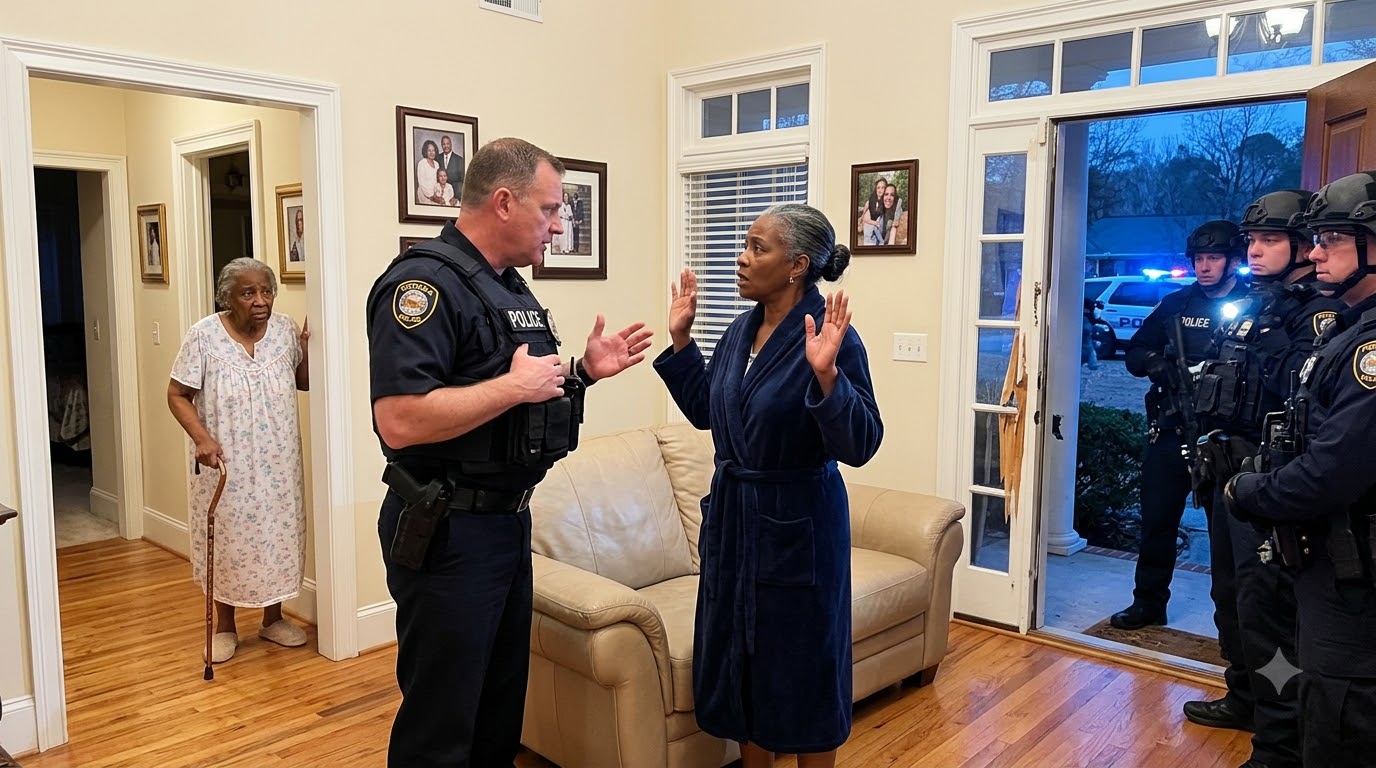
Police! On the ground. Nobody move. Officers kicked the door in. 30 rifles in every room.
Hazel Anderson raised both hands, fingers steady. Buckley walked in last. The hell? A black woman? He grabbed her arm, threw her off the couch.
We got a tip you broke into this house, you piece of trash. This is my home. Your home? Black people don’t live here. I live here.
I own it. You don’t own [ __ ]. Lying black trash. He shoved her face into the hardwood. Down the hall, Lorraine screamed.
That’s my mother. She’s 80 years old. That’s not my problem. Outside, neighbors gathered on porches, phones raised. 30 cops in that house, not one of them bothered to look at the frame on hallway wall.
That was the worst mistake every single badge in that room ever made. But before we get to that hallway, before Buckley’s gun hits the floor and his whole world collapses, you need to understand how this started. Because none of it began with a crime. It began with a moving truck. Three weeks before that raid, a moving truck pulled into Maplewood Estates, a gated community on the north side of Cartersville, Georgia.
Big lawns, brick colonials, three-car garages, every mailbox the same shade of white, every yard trimmed to HOA regulation height. For 25 years, not a single black family had owned a home there. Not one. Hazel Anderson changed that. She pulled up in a dark gray sedan on a Tuesday afternoon, stepped out in slacks and a pressed blouse, silver-streaked hair pinned low behind her neck.
She opened the trunk, grabbed a box labeled office, and walked up the driveway of 4412 Briarwood Lane like she’d been walking into a room she owned her whole life because she had. Her mother, Lorraine Anderson, 80 years old, came out behind her, slow, careful, one hand on her cane, the other gripping the car door. It took her a full minute to reach the front steps. Hazel waited at the top, arm out patient. They stepped inside together.
Across the fence, Vivian Cole watched from her kitchen window. She didn’t wave, didn’t walk over with a welcome basket. She stood behind the curtain with her phone in her hand and her jaw tight. Cole had tried to stop this. Weeks earlier, she’d rallied the homeowners association to reject Hazel’s purchase, argued the buyer wasn’t the right fit for the community.
She pushed hard, made calls, sent emails, but federal fair housing law doesn’t care about HOA opinions, and the sale went through. Cole lost, and she never forgave it. See, Cole wasn’t just any neighbor. Her husband sat on the Cartersville City Council, the same council that voted every year on whether to reappoint the police chief. That connection mattered.
It mattered more than anyone in that neighborhood understood, and it would matter most on the night Cole finally picked up her phone. For 3 days, Hazel moved boxes, books, lamps, kitchen supplies, a heavy oak desk she needed two movers to carry through the front door. In the hallway, she hung frames on the wall one by one, carefully leveling each with a small tool. From the street, you could see her shadow moving back and forth past the windows, unpacking a life. Cole watched every trip, every box, every car that came and went.
On the third evening, Cole called the Cartersville Police Department. She told the dispatcher, a black woman she didn’t recognize, had been entering and exiting the house at 4412 Briarwood Lane for several days. She said it looked like a burglary. Then she added four words that changed everything. I think she’s armed.
She wasn’t armed. There was no burglary. There was no crime of any kind. Just a woman unpacking her own house. But the word armed in that report changed the police response from a routine check to a high-threat tactical operation.
The call landed on Chief Garrett Buckley’s desk that same night. Buckley read the dispatch note. He knew exactly who had called, the wife of a city council member. The same council that controlled his job. He wasn’t going to send one patrol car and call it a night, not for her.
But it wasn’t just politics. Buckley had spent 20 years in Cartersville law enforcement. In those 20 years, he’d built a pattern when the department’s own data would later confirm of disproportionate force against black residents. He didn’t see it that way, of course. He never did.
He thought he treated everyone the same. So when he heard black woman and armed and Maplewood Estates, something clicked in his head. Not suspicion, certainty. He didn’t question the tip because it confirmed what he already believed a black woman in that neighborhood had to be a criminal. His Deputy Chief Wade Stanton pulled him aside, suggested sending a patrol car first, knocking on the door, verifying.










