The first thing Ava Sterling learned at Westbridge was that a gate could be open and still feel locked. The stone archway stood beneath a pale September sky, its carved letters promising discovery, courage, and service. Students crossed the courtyard with rolling suitcases, expensive headphones, and parents who carried flowers as if university admission were a coronation. Ava had one scuffed suitcase, a canvas bag full of carefully wrapped tools, and a pair of shoes she had polished the night before. She had chosen them because they were comfortable enough to walk across campus, not because anyone would admire them. She had barely stepped beneath the arch when a girl in a cream-colored jacket blocked her path. Two other students stopped beside the girl, watching with expressions that suggested the confrontation had been planned.
“This entrance isn’t for lost girls,” the girl announced. “You do not belong at Westbridge.” Ava looked past her at the registration desk. “I’m a student,” she replied. The girl laughed, and one of her companions lifted a phone. Ava could feel the heat gathering in her face. She had promised herself that arriving here would be a beginning, not another test of endurance. Yet the crowd was already slowing to watch. “You can humiliate me today,” Ava said, keeping her voice level, “but one day you’ll regret this.” The girl’s smile hardened. “One phone call and you’ll be kicked out of Westbridge.” Her friends laughed again. Ava walked around them before her shaking hands could betray her. A student in a faded green sweater caught up with her near the steps.
“Ignore them,” she said. “Welcome to Westbridge.” Her name was Maya Chen, and she offered to help carry the heavy bag. Ava declined the help but accepted the kindness. She had come to Westbridge to discover whether she could build a life without the protection of her father’s name. She had not expected to discover how quickly strangers could decide what she deserved.
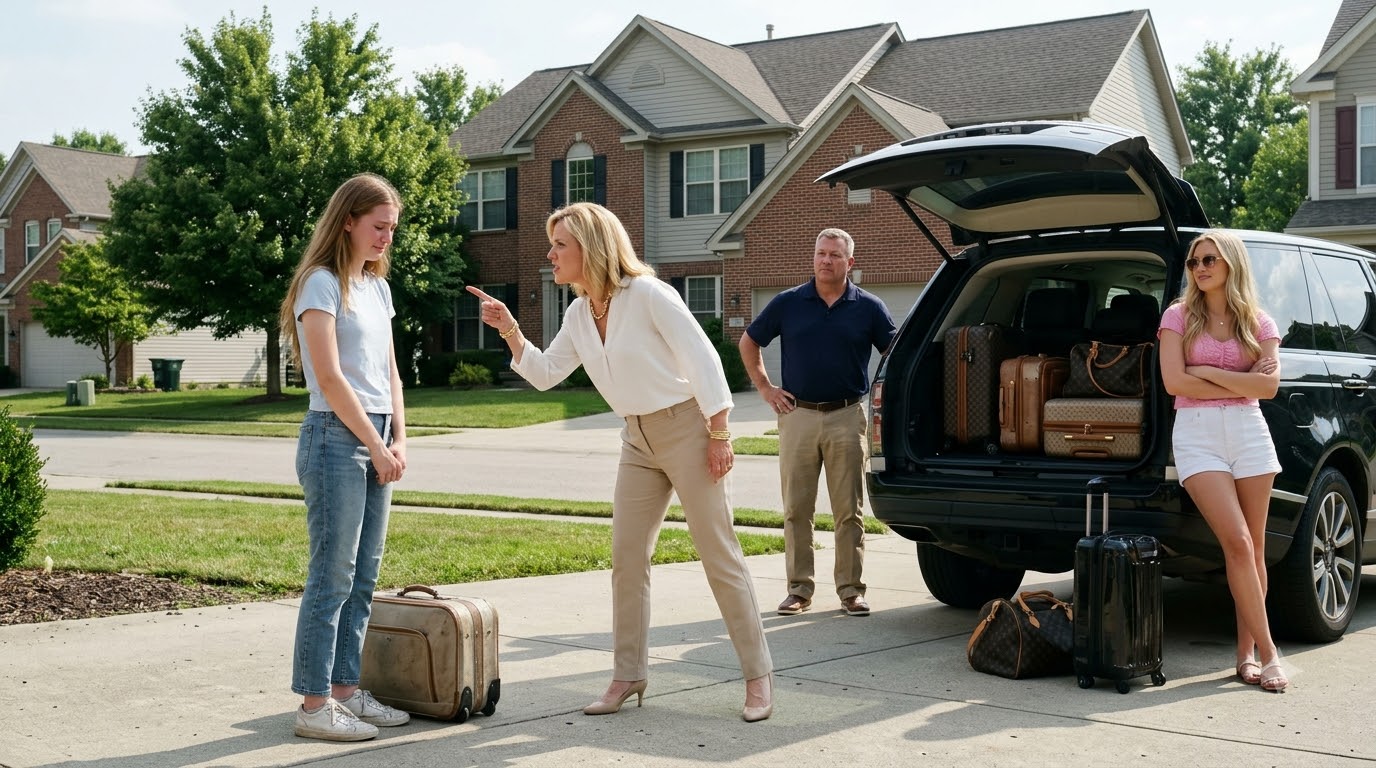
Ava’s dormitory room was on the fourth floor of an older residence hall where the elevator made a sound like a reluctant lawn mower. The room was small, with a narrow bed, a wooden desk, and a window overlooking a service alley. Maya lived across the hall and arrived carrying two mugs of tea before Ava had finished unpacking. “The girl at the gate is Victoria Vale,”
Maya explained. “Her family funds half the buildings they like to mention.” Ava folded a sweater and placed it in a drawer. “Does she always greet strangers that way?” “Only people she thinks can’t answer back.” Maya paused at the sight of the compact filtration unit Ava was removing from its protective case. Its transparent chambers, hand-cut supports, and coils of tubing looked less like a class project than a miniature municipal plant. “Did you make that?” Ava nodded. “It’s a prototype. It uses a gravity-fed prefilter and a replaceable membrane stage. The point is to make clean water affordable where electricity isn’t dependable.” Maya leaned closer without touching anything. “You designed this yourself?” “Most of it. I had help testing the materials.” Ava thought of her father’s workshop, the long evenings she had spent there,
and the careful decision to leave that part of her life out of her university application essays. Her surname was Sterling, but she had asked admissions not to publicize her family connections. The arrangement was imperfect. She could not erase where she came from, and she did not want to pretend that opportunities had never helped her. She simply wanted her work evaluated before people learned whose daughter she was. That evening, she called her father. He asked whether the room was comfortable and whether she had eaten. She answered both questions truthfully. When he asked whether people were treating her fairly, she watched two students laughing beneath her window and said, “I need to find out who I am without the name.” There was a silence on the line.
“Call me if you need anything,” he said. “I can handle this,” she told him. She hoped it was true.
The Sterling Innovation Fellowship was announced during the first week of classes. Posters appeared in the engineering building, the library, and the science atrium. The winner would receive a full research grant, access to the university fabrication center, and mentorship through a yearlong pilot program. The fellowship had been established by a foundation carrying Ava’s family name, but its judges were supposed to make their decisions independently. That distinction mattered to her more than anyone knew. At the information session, students crowded around a table of brochures. Victoria stood near the front in a white blazer, speaking loudly about her previous internships and the private laboratory her parents had arranged for her.
“That fellowship already has my name on it,” she said when she noticed Ava reading a brochure. “Stay out of my competition.” Ava looked up. “I earned my place here.” “Winning is in my blood,” Victoria replied. Maya, standing beside Ava, rolled her eyes so openly that Victoria’s friends noticed. A faculty coordinator described the judging criteria: practical need, originality, sound testing, and a credible plan for deployment. Ava listened carefully, taking notes on every requirement. Victoria interrupted twice to ask whether presentations could include professional promotional films. When the coordinator said that films were permitted but would not substitute for evidence, Victoria seemed personally offended. Afterward, Ava returned to her room and spread her drawings across the desk. Her design had already worked in small trials, but the fellowship would require a repeatable demonstration and an explanation of its maintenance costs. She would need weeks of careful measurements. She could imagine the moment when cloudy water entered one chamber and emerged clear from another, but she knew a compelling demonstration was not the same as a reliable technology. She wrote that distinction at the top of her notebook. Outside, the campus bells rang. She did not yet know how much of the semester would be spent defending the right to finish what she had begun.










